Know how your keywords landbefore the page goes live
Paste the copy, list the terms, and get the count and density of each one so you can fix stuffing or under-use in the next edit.
Separate keywords or phrases with commas.
Aim for roughly 1 to 2% on your primary keyword. Higher reads as stuffing.
What you get
A density check you can act on.
Most checkers give you a single number for a single word. This one takes the whole list and tells you which ones need work.
- 01
Multiple keywords
Check the primary term and every variation in one pass.
- 02
Whole-word matching
"Guide" does not count "guidelines". Numbers you can trust.
- 03
Count and density
See the raw count and the percentage of total words side by side.
- 04
Instant
Paste, click, read. No upload, no waiting.
- 05
Range hints
Results are colored so you can spot stuffing or under-use at a glance.
- 06
Private
Unpublished drafts stay in your browser. Nothing is sent anywhere.
How it works
Thirty seconds, start to finish.
Paste the text
The article, the landing page copy, the product description. Any length.
Add the keywords
Comma-separated. Include the phrase you are targeting and its close variants.
Read the density
Adjust the copy where a term is over- or under-used, then check again.
Why this one
Built into the editing loop, not bolted on after.
Numbers, then judgment
Density is a signal, not a rule. The point of checking is to notice the paragraph that leans on one term and the section that forgot the topic entirely. Fix those and the copy reads better for people, which is what ranking follows.
Before you publish
Catch the paragraph where the keyword appears four times before an editor or a search engine does.
While you edit
Rewrite, re-check, repeat. The loop takes seconds, so you actually do it.
Writing help docs?
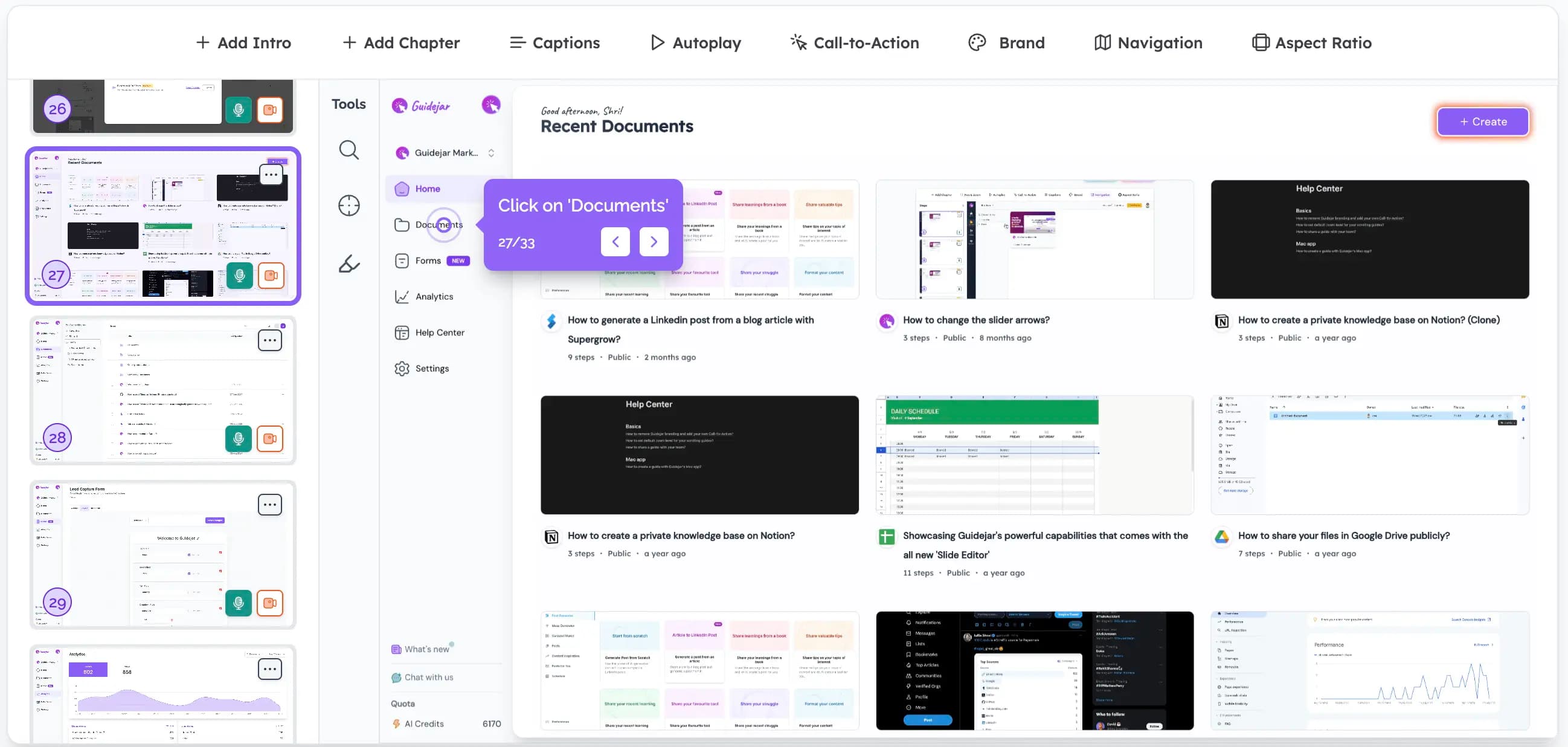
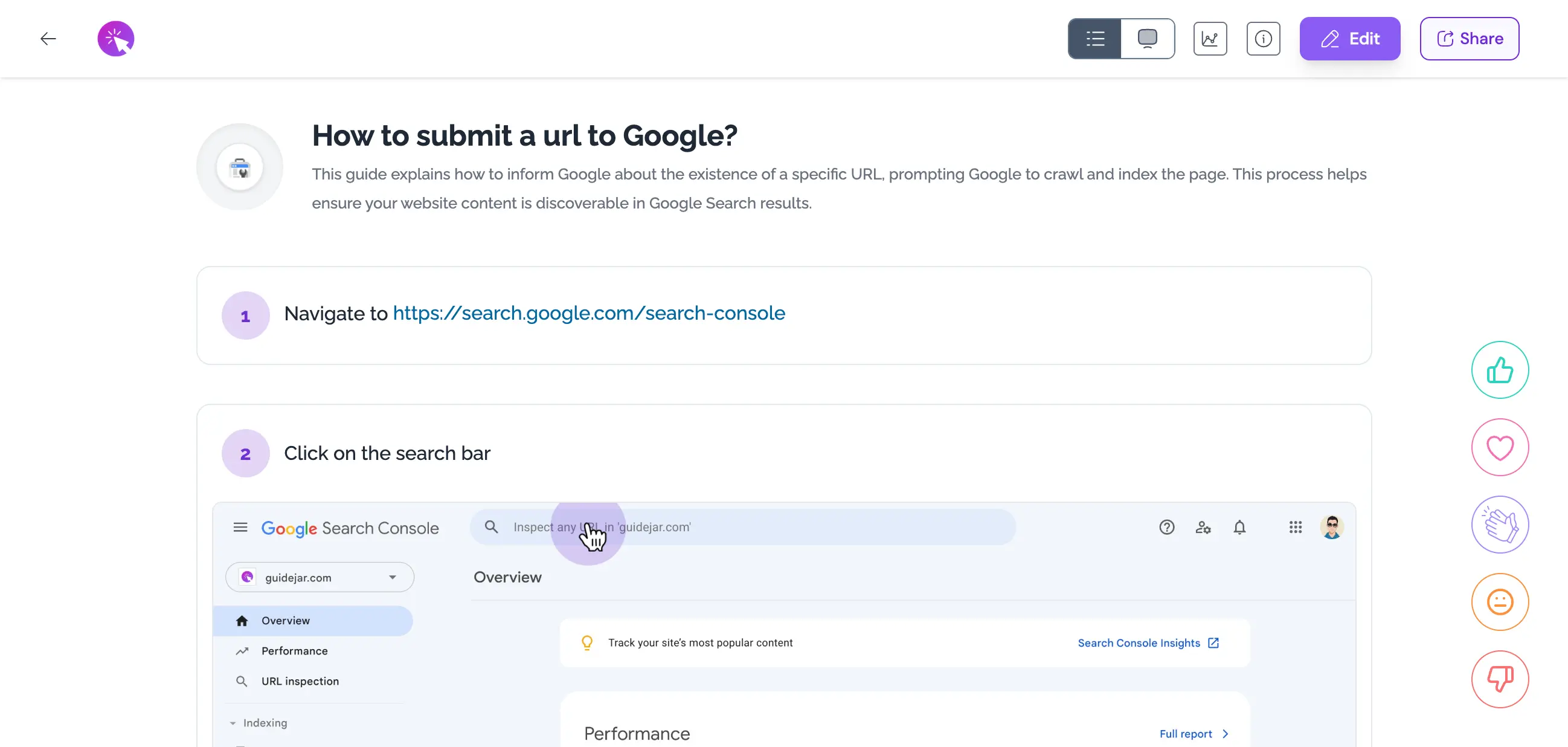
Guidejar turns a workflow into an SEO-ready how-to article.
Record the task once and get a step-by-step guide with screenshots, headings and alt text already in place. Publish it to your help center or export it anywhere.
FAQ
Questions, answered.
The number of times a keyword appears divided by the total number of words, shown as a percentage. If a term appears 10 times in 1,000 words, its density is 1%.
There is no official number, but most writers target roughly 1 to 2% for the primary keyword and lower for secondary terms. Anything above 3% tends to read as stuffing to both readers and search engines.
No. Matching is on whole words, so checking "guide" will not count "guidelines" or "guided". Add the variants you care about as separate keywords.
Yes. Enter a phrase such as "screenshot editor" and it is counted as a whole, not as two separate words.
No. The count runs in your browser and nothing you paste is uploaded, so unpublished drafts stay private.