Navattic vs Tourial in 30 seconds
These two chase the same job: no-code interactive product demos for marketing and sales teams. Navattic leads with “Make buying easier with demos.” Tourial leads with “Convert prospects with bingeable journeys.” Both capture your UI, build a clickable tour, and push engagement data into HubSpot, Salesforce, Marketo, or Pardot. Same buyer, same demand-gen motion, and genuinely close on the parts that overlap.
Where they part ways first is momentum. Navattic is the actively developed category leader. It ships high-fidelity HTML captures, AI voiceover, 35-language translation, autonomous agent demos (now a separately priced Navattic Agents product) that answer a prospect’s questions live, and an MCP server, and it adds features fast. Tourial still ships and still sells at tourial.com, but its maker rebranded to Navless in late 2025 and shifted its roadmap to a separate AI-answer product. Many of the demo tool’s docs have not been touched in a year or more. It is not dead, and we will credit exactly what it still does well, but a buyer today is picking a tool that is no longer its maker’s focus.
The second split is what you can see before you commit. Navattic shows its prices only as animated digit-reels, though the figures are its own: Base is $600/mo billed monthly or $500/mo billed annually for five seats, and it offers a free single-demo tier. Tourial publishes nothing at all, has no free plan, and routes every button to “Book a Demo.” The full table and pricing detail are below, along with a third option worth a look, since neither tool turns a demo into a written doc or hosts a branded support help center on your own domain.
Four differences that decide it
Both capture a UI, build a clickable demo, and sync lead capture and engagement into the CRM. From there, the gap opens up.
Momentum & roadmap
One tool is still shipping, the other has moved on
This is the difference most likely to bite you in a year. Navattic ships aggressively: high-fidelity Web Captures, AI voiceover, translation, autonomous agent demos (now sold separately as Navattic Agents), and a scoped MCP server all landed recently, and it carries a G2 Leader badge in demo automation. Tourial tells a different story. In late 2025 its company rebranded to Navless and pivoted to a separate AI-answer product, and the demo tool now lives on docs.navless.ai with many pages last updated a year or two ago. The tool still works and still sells, so this is a risk to weigh, not a reason to write it off. But if you want a demo platform that keeps growing with you, Navattic is the safer active bet.
AI & automation
Narrated, translated, and autonomous vs silent and visual
Navattic is betting hard on AI, and it shows in the demo itself. It narrates demos with AI voiceover from its Startup plan, auto-translates into 35 languages on Growth, and its flagship agent demos, sold separately as Navattic Agents, let an AI agent run a live demo and answer a buyer’s questions in real time. It also runs an MCP server that an AI tool like Claude or ChatGPT can use to read demo analytics and build demos. Tourial is a visual, silent click-through tool by design. Its AI builder, “Tori,” generates the storyboard, screens, and tooltips, but there is no audio voiceover, no translation, and no MCP anywhere in its docs. If narrated or multi-language demos are on your list, that is a hard line for Tourial, not a preference.
CRM & marketing automation
Where Tourial genuinely holds its own
This is the closest row on the page, and Tourial earns real credit here. Its native, bi-directional connectors to HubSpot, Salesforce, Marketo, and Pardot are the strongest part of the product: they push tour-engagement data onto lead and contact records, fire workflows and Slack alerts, and sync native Tourial Forms submissions. Deep marketing-automation integration has historically been Tourial’s calling card. Navattic is no slouch either, with native connectors to that same set plus Segment, ZoomInfo, Slack, and more, wired to advanced analytics, A/B testing, and account identification for pipeline attribution. Call it a draw on depth. Navattic covers more platforms and ties tighter to attribution; Tourial matches it on the core MAP tools that demand-gen teams live in.
Pricing & buying
Digit-reels and a free tier vs a closed quote
Neither tool wins many points for openness. Navattic renders its prices as animated digit-reels rather than static text, though the figures are its own: Base is $600/mo billed monthly or $500/mo billed annually for five seats, Growth $1,200 or $1,000 for ten, and a cheaper Startup plan for eligible seed-stage teams does not show a price. It does at least offer a free Starter tier capped at one demo and one seat, so you can kick the tyres without a contract. Tourial goes further into the dark: no published prices at all, no free plan, only a trial of unpublished length, and both Engage and Scale route straight to sales. Engage also caps you at five seats and three Tour Centers. If trying before you buy matters, Navattic’s free demo is the only self-serve door here.
Feature-by-feature comparison
Same job, different momentum and different depth. Grouped and side by side.
| Capability | Navattic | Tourial |
|---|---|---|
| Capture & demo building | ||
| Browser capture | Yes — Web Captures (HTML/DOM) | Yes — Chrome extension |
| HTML / DOM-cloned demos | Yes — Base, core capability | Yes — but flagged experimental |
| Sandbox / live-environment demos | Growth ($1,000/mo annual) | Experimental HTML demos |
| Desktop capture | No — media upload only | No — browser only |
| Interactive branching & hotspots | Yes — Flows, CTAs, interest paths | Yes — clickzones & hotspots |
| Sensitive-data blur | Blur, hide, or delete any element | Manual, in HTML-demo mode |
| Output & AI | ||
| AI voiceover narration | Yes — Startup+ | No — silent tours |
| Multi-language translation | 35 languages — Growth | Not available |
| Autonomous AI agent demos | Navattic Agents — separately priced | Not available |
| Downloadable MP4 file | Yes — capped at 15 steps | No — GIF only |
| Animated GIF export | Included | Included |
| Written step-by-step document | Static PDF export, up to 60 steps | No — visual tours only |
| PDF export | Yes — up to 60 steps | Not available |
| Publishing, integrations & security | ||
| Branded demo hub on your domain | Custom domain — Growth ($1,000/mo annual) | Tour Centers — from the entry Engage tier |
| Custom domain | Growth ($1,000/mo annual) | Yes — white-label CNAME |
| Hosted branded help center (support KB) | Not available | Not available |
| Native CRM / MAP connectors | HubSpot, Salesforce, Marketo, Pardot, Segment + more | Native, bi-directional — HubSpot, SF, Marketo, Pardot |
| Lead-capture forms | Embedded forms — Base | Yes — native Tourial Forms |
| Analytics | Basic free; advanced + A/B — Growth | Tour & Tour Center analytics + CRM sync |
| MCP server (AI tool access) | Startup+ — builds demos, reads analytics | Not available |
| SAML SSO | Growth | Paid add-on — Scale tier |
| Pricing | ||
| Free plan | Yes — 1 demo, 1 seat, default theme | No — free trial only |
| Entry paid plan | $600/mo — Base, 5 seats ($500 annual) | Quote-only — no public price |
| Billing | Monthly or annual | Quote-only, sales-led |
| Self-serve checkout | No — sales-assisted | No — book a demo |
| Branded-hub tier | Custom domain — Growth ($1,000/mo annual) | Tour Centers — entry Engage tier |
| Enterprise | Custom — offline demos, audit logs | Scale — quote, uncapped seats |
Both build clickable product demos wired into the CRM, so that job is a tie. Navattic wins on AI (voiceover, 35-language translation, autonomous agent demos via Navattic Agents, and an MCP server), on high-fidelity DOM capture, and on being actively developed. Tourial holds its own on deep native bi-directional marketing-automation integration and gives you branded Tour Centers on your own domain from the entry tier, where Navattic gates a custom domain to its Growth plan ($1,000/mo billed annually). Neither prices in plain text: Navattic uses digit-reels, Tourial a sales quote. And both leave the same two things on the table: no written SOP or help-article output, and no branded support help center on your own domain. One caveat sits only over Tourial: its maker has pivoted to Navless, and the demo tool is in maintenance.
Verified against both vendors’ public pages and docs, October 2026. Navattic renders its prices as animated digit-reels; the $500/$600 and $1,000/$1,200 figures come from its own pricing-page data. Tourial publishes no prices, and its docs live on docs.navless.ai. Spot something out of date? Tell us and we’ll correct it.
Pricing compared
Neither tool prices itself cleanly in public. Every number below states its billing interval.
$500/mo
Navattic Base billed annually for 5 seats — $600/mo billed monthly; Growth $1,000/mo ($1,200 monthly) for 10
Quoteonly
Tourial publishes no prices; Engage and Scale are both book-a-demo, with no free plan
$19/seat/mo
Guidejar Pro billed monthly — $16/seat/mo billed annually
Bottom line: neither of these prices in plain text. Navattic shows its numbers as animated digit-reels: Base is $600/mo billed monthly or $500/mo billed annually (5 seats), and Growth $1,200 or $1,000 (10 seats), landing between $100 and $120 a seat. Its saving grace is a free single-demo tier you can start on without a call. Tourial publishes nothing at all, has no free plan, and routes Engage and Scale straight to sales, with Engage capped at five seats and three Tour Centers. For comparison, five seats of Guidejar Business is $75/month billed monthly ($15/seat), or $59/month billed annually, and Guidejar Pro starts at $19/seat with the price on the page and a self-serve signup.
Prices as of October 2026. Navattic bundles 5 (Base) or 10 (Growth) seats, billed monthly or annually. Tourial does not publish prices. Guidejar Business bundles 5 seats.
Where each one genuinely wins
Neither is a strictly better version of the other. These are the real, checkable advantages.
Navattic: autonomous agent demos and high-fidelity capture
Navattic’s flagship is agent demos, now sold as a separate Navattic Agents product, where an AI agent interacts with a prospect, interprets their questions, and navigates your product live. Nothing in Tourial or Guidejar does that. Underneath it, Web Captures clone the real app with its scroll and hover states and let you edit any element, so the demos look and feel like the live product rather than a wall of screenshots. This is genuinely category-leading, and it is shipping today.
Navattic: AI narration, translation, attribution, and active development
Navattic narrates demos with AI voiceover from its Startup plan, auto-translates into 35 languages, and runs a scoped MCP server that an AI tool can use to read analytics and build demos. On the GTM side it ties native CRM connectors to advanced analytics, A/B testing, and account identification for real pipeline attribution. Add its shipping velocity and G2 Leader standing, and it is the more complete, more current platform of the two.
Tourial: deep native marketing-automation integration
Tourial’s strongest area is the CRM stack. Native, bi-directional connectors to HubSpot, Salesforce, Marketo, and Pardot push tour-engagement data onto lead and contact records, trigger workflows and Slack alerts, and sync native Tourial Forms submissions. Deep MAP integration has been its calling card since well before the newer demo tools showed up. For a demand-gen or RevOps team whose reporting runs through a marketing-automation platform, that depth is a real reason to keep it on the shortlist.
Tourial: branded Tour Centers on your own domain, early
Tour Centers group multiple micro tours into a hosted, white-labeled gallery with upfront prompts that route visitors by persona or use case, served on your own domain from the entry Engage tier. Navattic reserves custom domains for its Growth plan ($1,000/mo billed annually), so Tourial gives you a polished, ABM-friendly branded hub much earlier in the ladder. It is a genuine top-of-funnel conversion surface with no clean Navattic equivalent at the entry tier.
Which tool is right for you?
Same job, different shape. Honest recommendations based on how your team actually buys and builds.
Choose Navattic if
- You want a demo platform that is still actively developed and adding features every quarter
- AI voiceover, 35-language translation, or autonomous agent demos (Navattic Agents) that answer prospects live are on your list
- You need high-fidelity DOM captures that look and behave like the real product
- Demo engagement has to flow into HubSpot, Salesforce, or Marketo with real attribution and A/B testing
- Bundled five- or ten-seat plans fit how your mid-market or enterprise team buys
Choose Tourial if
- Deep native, bi-directional HubSpot, Salesforce, Marketo, and Pardot sync is central to your demand-gen reporting
- You want a branded Tour Center hub on your own domain early, without paying for a top tier
- Native Tourial Forms and per-tour CRM engagement data are how you score and route leads
- Silent, visual click-through tours suit your funnel and audio narration is not a requirement
- You are comfortable that its maker has pivoted to Navless and the demo tool is in maintenance mode
Teams that want AI, fidelity, and a tool that keeps shipping lean Navattic. Demand-gen teams deep in a marketing-automation stack can still make Tourial work, with eyes open on the Navless pivot.
They compete for the same demand-gen job, so the choice comes down to momentum and CRM depth. Navattic is the actively developed, higher-fidelity, AI-forward option, sold in seat bundles. Tourial matches it on native marketing-automation integration and gives you a branded Tour Center hub early, but you buy it quote-only and on a product its maker has stepped back from. One caveat sits over both: neither turns a demo into a written doc, neither hosts a support help center on your own domain, and neither has an MCP built to author docs. That is the gap the third option below fills.
Both of them stop at the same two places
Navattic and Tourial both build clickable demos, and both keep those demos hosted on their own servers. Neither turns one capture into a written step-by-step doc, and neither hosts a branded, searchable support help center on your own domain. If a sales demo is the whole job, either tool will serve you. If onboarding, support, and internal docs are part of the picture, here is a third option built for exactly that.
Guidejar
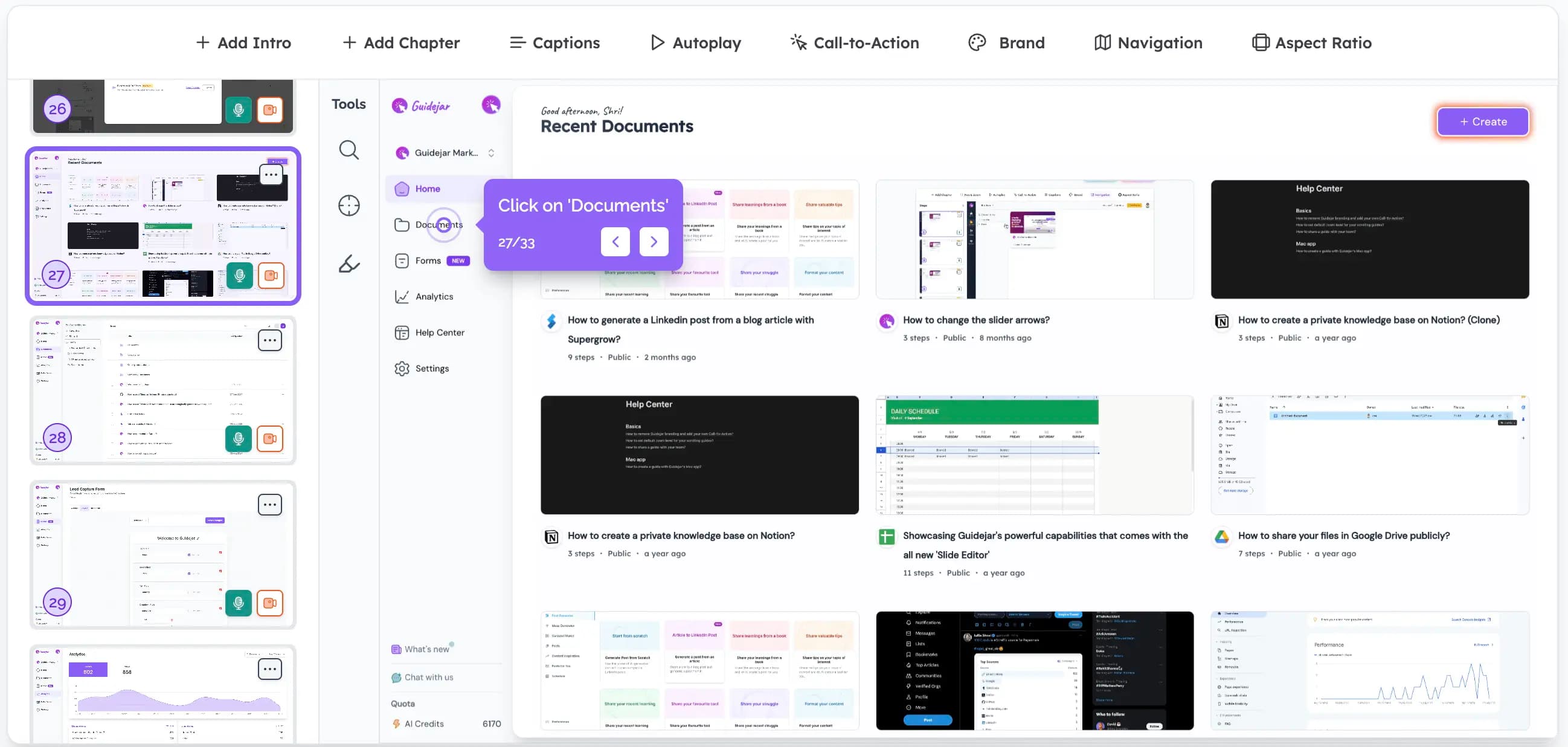
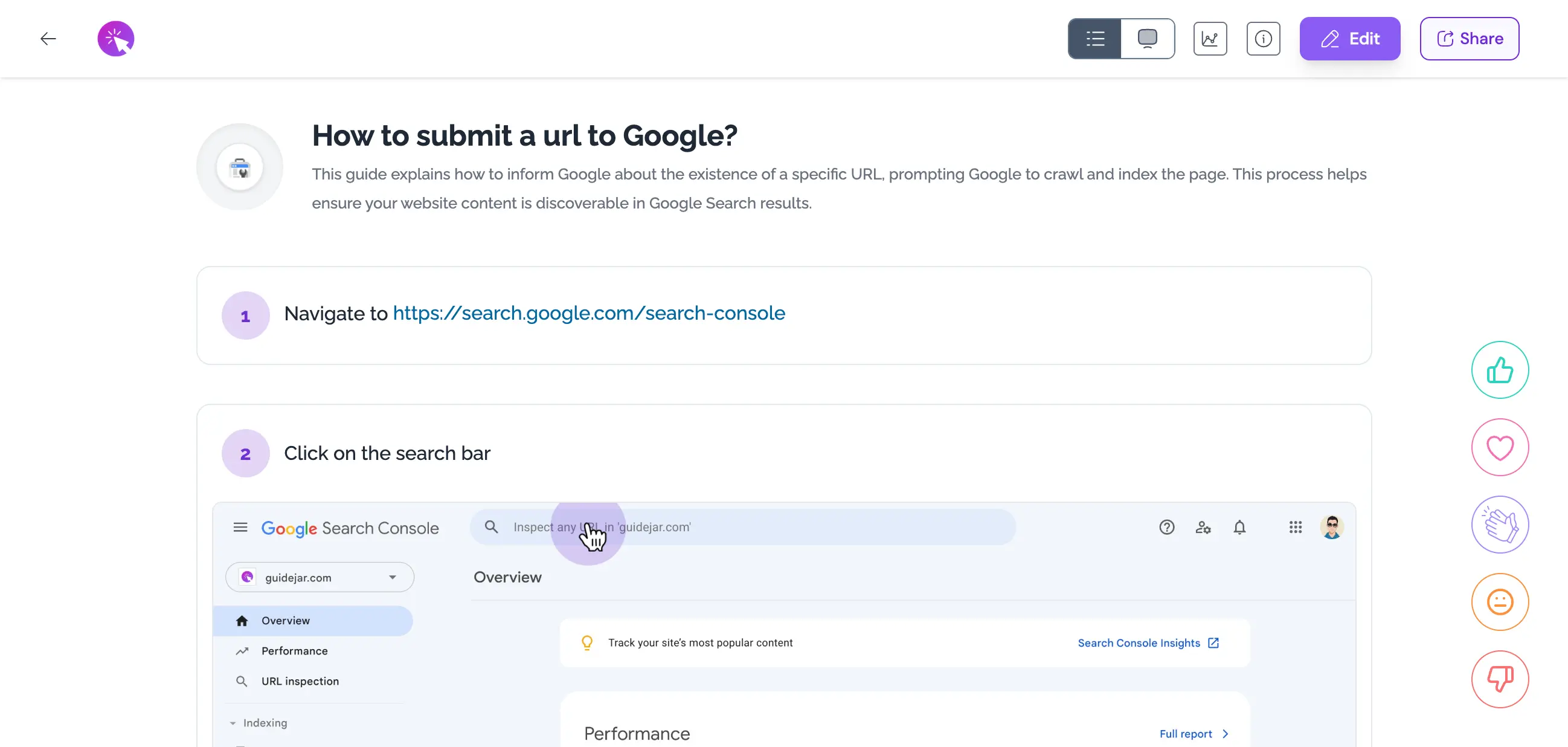
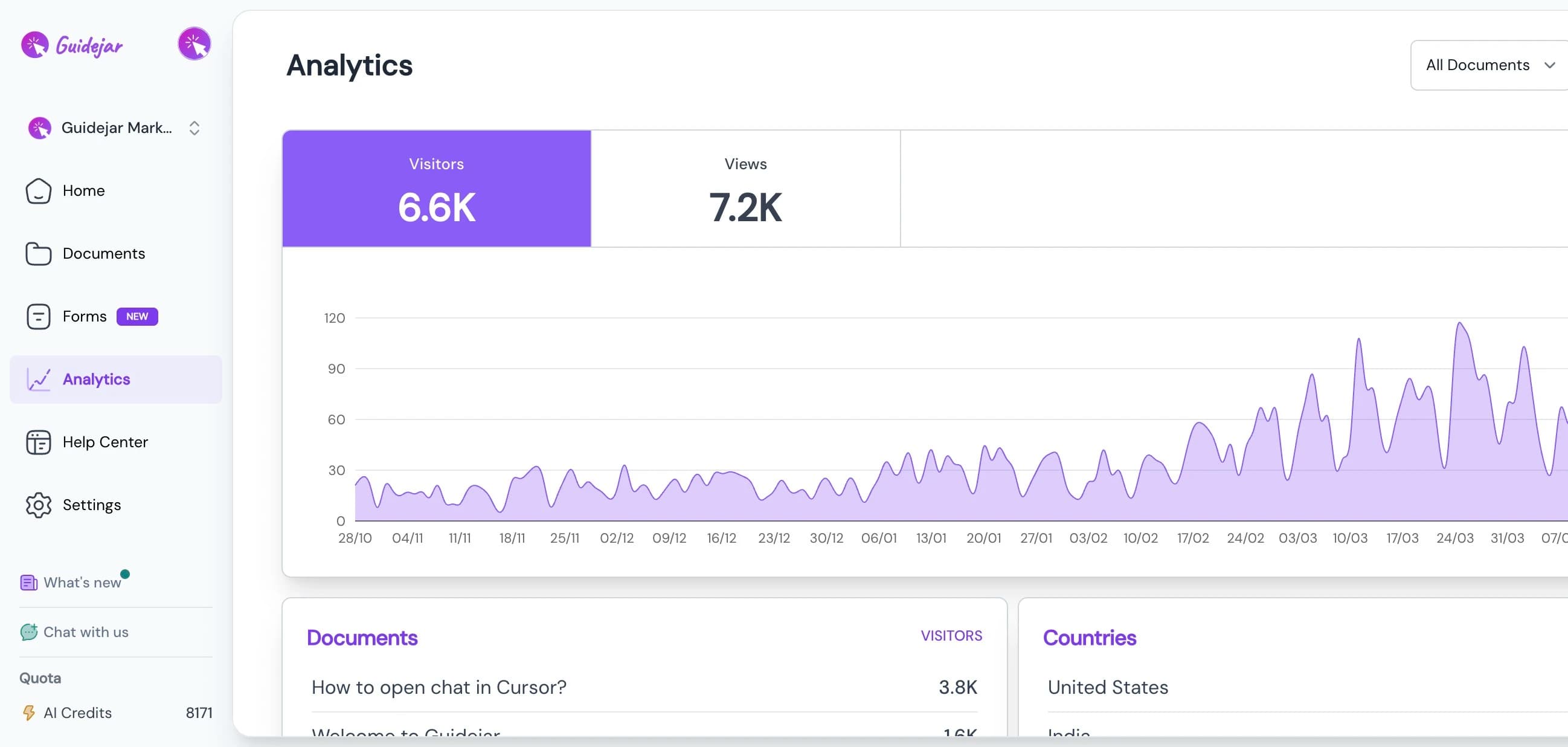
Guidejar takes one capture and publishes it two ways at once: a Walkthrough View people click through with hotspots and branching, and a Scroll View written step-by-step doc, like an SOP or help article. Both come from the same recording, chosen per guide. The whole library then lives in a searchable, branded help center at your own domain, and you can export MP4, PDF, HTML, and Markdown to keep. Prices are public, self-serve, from $19/seat/mo billed monthly.
- One capture published as a clickable walkthrough and a written doc, chosen per guide
- Searchable branded help center on your own custom domain, with Ask AI ticket deflection
- Own and export your content as MP4, PDF, HTML, or Markdown, not hosted-only lock-in
- Guidejar MCP lets an AI agent build your docs library and the team self-serve answers in ChatGPT or Claude
Starting at
$19/mo
per seat, billed monthly ($16 billed annually), self-serve
vs Navattic $600/mo Basevs Tourial quote-only
Try Guidejar freeAI voiceover from $19
Narrate on Pro and clone your own voice on Business, with translation into 30+ languages
A branded help center from $25
Put the whole library on your own domain on Plus, with Ask AI ticket deflection on Business
Prices you can read
A public per-seat rate and a self-serve signup, no digit-reels and no book-a-demo to learn the cost
Trusted by teams worldwide








How Guidejar stacks up
The rows that actually separate them, with the third column filled in.
| Capability | Navattic | Tourial | Guidejar |
|---|---|---|---|
| Interactive demo output | Yes — HTML demos | Yes — micro tours | Yes — Walkthrough View, from Pro |
| Written step-by-step doc | Static PDF export, up to 60 steps | No — visual tours only | Yes — live Scroll View, every plan |
| Branded support help center on your domain | Not available | No — Tour Centers are demo hubs | Yes — Plus plan |
| Downloadable MP4 export | Yes — capped at 15 steps | No — GIF only | Yes — Plus, up to 30 min |
| AI voiceover entry plan | Startup plan | No AI voiceover | Pro — $19/seat/mo |
| Native CRM / MAP connectors | Native — HubSpot, SF, Marketo, Pardot + more | Native, bi-directional — HubSpot, SF, Marketo, Pardot | No — embed & copy, not native OAuth |
| Autonomous AI agent demos | Navattic Agents — separate product | Not available | Not available |
| MCP server | Startup+ — builds demos, reads analytics | Not available | Plus — authors your docs library + team Q&A |
| Pricing you can read | Digit-reels, not plain text | No — quote-only | Yes — public, from $19/seat |
Switching to Guidejar
From either tool, most teams finish the move in a few days.
- 1
Export what you have
Navattic gives you flat files only: a PDF capped at 60 steps, an MP4 capped at 15, a GIF, and Copy-as-Text, with no HTML source and no bulk export. Tourial gives you even less, just a shareable link, an embed code, and an animated GIF per tour, with no source files, so most tours have to be rebuilt.
- 2
Import into Guidejar
Turn exported PDFs, Markdown docs, or your existing screenshots into guides with our importer in a few clicks, with no all-time import cap. Anything interactive takes a couple of minutes to re-capture with our Chrome extension or desktop app.
- 3
Publish it properly
Choose Walkthrough View or Scroll View or both per guide, add AI voiceover, translate into 30+ languages, and put the whole library on a branded help center at your own domain.
“One of the best tools I’ve got for my webdesign.”
Karlo Rivera Velasquez, Web Designer
Frequently asked questions
The questions people actually search before picking one of the two.Something else on your mind? Talk to us
Neither, in the abstract. They compete for the same job of building no-code interactive demos for GTM teams, so it comes down to momentum and CRM depth. Navattic wins if you want AI voiceover, translation, autonomous agent demos (via Navattic Agents), high-fidelity captures, and a tool that keeps shipping. Tourial holds its own if deep native HubSpot, Salesforce, Marketo, and Pardot integration and a branded Tour Center hub early in the ladder are what you need. The one thing to know before you pick Tourial: its maker rebranded to Navless in late 2025, and the demo tool is now in maintenance mode.
It still ships and still sells at tourial.com, but the company behind it rebranded to Navless in late 2025 and moved its focus to a separate AI-answer product. The demo tool’s docs now live on docs.navless.ai, many pages have not been updated in a year or more, and as of October 2026 tourial.com carries a “Tourial is now part of Navless.ai” banner. It is not dead, and its CRM integration is genuinely strong, but a buyer choosing Tourial today should know the tool is no longer its maker’s roadmap priority.
Neither publishes clean prices. Navattic shows its prices as animated digit-reels and bills monthly or annually: Base is $600/mo billed monthly or $500/mo annually (5 seats), Growth $1,200 or $1,000 (10 seats), and there is a free Starter tier limited to one demo; a Startup plan for eligible seed-stage teams does not display its price. Tourial publishes no numbers at all, has no free plan, and routes its Engage and Scale plans to “Book a Demo,” with Engage capped at five seats and three Tour Centers. For comparison, Guidejar Pro is $19/seat/mo billed monthly, with Business bundling five seats for $75/month, and the price is on the page.
No to both. Tourial builds silent, visual click-through tours. Its AI builder generates the storyboard and tooltips, but there is no audio voiceover, no voice cloning, and no translation anywhere in its docs. For sharing, its only outputs are a link, an embed, and a downloadable animated GIF, so there is no MP4 or video-file export. Navattic narrates demos with AI voiceover from its Startup plan and can export a short MP4, though capped at 15 steps, and Guidejar adds AI voiceover on Pro and MP4 export up to 30 minutes on Plus.
Both do, and this is genuinely close. Tourial ships native, bi-directional connectors to HubSpot, Salesforce, Marketo, and Pardot that push tour-engagement data onto lead records and sync form submissions, and deep marketing-automation integration is its strongest area. Navattic covers the same set plus Segment, ZoomInfo, and Slack, and wires it into advanced analytics, A/B testing, and account identification for attribution. Tourial matches Navattic on the core MAP tools; Navattic reaches a bit wider and ties tighter to pipeline reporting.
Navattic has both, though its agent demos are now sold as a separate product, Navattic Agents; Tourial has neither. Navattic’s agents run a live demo and answer a prospect’s questions in real time, and its MCP server, from the Startup plan, lets a tool like Claude or ChatGPT read your demo analytics and build demos. It authors demos, though, not documentation. Guidejar’s MCP does a different job: an AI agent builds your SOP and docs library from existing files, and your whole team self-serves answers from it inside their own chatbot, on the Plus plan.
Not really. Navattic’s written output is a static PDF export capped at 60 steps, and Tourial produces no written document at all. Neither hosts a searchable support help center on your own domain: Tourial’s Tour Centers are branded demo galleries, not a how-to knowledge base, and Navattic has no help-center product. Guidejar publishes the same capture as a living written Scroll View, puts the whole library on a branded help center at your domain from the Plus plan, and answers questions over your content with Ask AI on Business.