Navattic vs Consensus in 30 seconds
These two are direct competitors, and both are good at what they do. Navattic leads with “Make buying easier with demos.” Consensus calls itself “#1 in Demo Automation” and leads with “Demos That Sell.” Both build interactive product demos for B2B go-to-market teams, and both are category leaders their buyers rate highly. The difference is the buyer motion each one is built around.
Navattic is built for the self-navigated demo. A prospect clicks through a high-fidelity, no-code HTML demo on your website, in an ad, or in a follow-up, and Navattic tells you how they engaged with the product. Its 2026 headline is agent demos, an AI agent that runs a live demo and answers questions in real time, now sold separately as Navattic Agents, and it ships a real MCP server and native CRM connectors from its entry paid tiers. Consensus is built for the async buying committee. Buyers self-serve interactive and AI-video demos, then Demolytics tracks who on the committee watched, what they replayed, and who they forwarded it to internally, and auto-multi-threads the deal. That buyer-group intelligence is the founding differentiator, and it has no real equal here.
So the honest question is not which tool makes a better demo. It is whether you want product-level engagement analytics on a self-navigated demo (Navattic) or stakeholder-level intelligence across a buying committee (Consensus), and how each one is priced. Both are enterprise-priced: Navattic in five- and ten-seat bundles, Consensus through sales quotes. The full table and pricing math are below. There is also a third option worth a look, because neither of these publishes a written step-by-step SOP or hosts a branded help center on your own domain.
Four differences that decide it
Both capture your live app as an interactive HTML demo and both sell to enterprise GTM teams. From there, they diverge on price, on the buyer motion, and on how each one measures a deal.
Pricing & buying model
A free demo to start vs sales-gated from day one
Both are enterprise-priced, but you get into them very differently. Navattic has a free Starter tier, one published demo on one seat, so a team can build something real before paying, and its cheapest publicly priced plan, Base, is $600/mo billed monthly or $500/mo billed annually for five seats. Its pricing page renders those figures as animated digit-reels rather than static text, and a Startup plan for eligible seed-stage teams costs less but does not display its price. Consensus has no free plan and no self-serve trial, and as of October 2026 it no longer publishes prices: licenses are per user and quoted by sales. Until July 2026 its page listed Starter at $600/mo for five users and Pro at $1,250/mo for ten, both billed annually, and third-party trackers put real Consensus contracts in the tens of thousands per year. If you want to kick the tyres first, Navattic lets you; Consensus asks you to talk to sales.
How the demo measures a deal
Product-level analytics vs stakeholder-level Demolytics
This is the real fork. Navattic measures the demo: advanced analytics, A/B testing, and account identification at Growth tell you which demos convert and which accounts engaged. Consensus measures the buying committee. Demolytics (its Buyer Signals layer) tracks which stakeholder watched, which sections they replayed, and, crucially, who they forwarded the demo to inside their own company, then surfaces those hidden stakeholders and auto-multi-threads the deal. One tool optimises the demo asset; the other maps the people around the deal. For a complex, multi-stakeholder enterprise sale, that stakeholder discovery is genuinely hard to replicate, and it is why Consensus keeps its category lead.
Demo format & capture
No-code HTML demos vs video demos and live sandboxes
Navattic centres on editable HTML Web Captures that clone the live app with scroll and hover states, edited element by element in a no-code editor, and it can spit out flat exports, a PDF up to 60 steps and an MP4 up to 15. Consensus is broader on format but more locked in: HTML capture tours, AI-generated video demos with avatars, a built-in Screen Recorder, and Sandbox Tours plus a newer Live Demos line with real-time data injection that give a buyer a fully tailored live environment for a real try-before-you-buy. The trade-off is ownership. Navattic gives you at least a static export to take with you; Consensus demos are hosted interactive assets with no documented export, partly because downloading them would break the Demolytics tracking that is the whole point.
AI agents & integration depth
Autonomous agent demos vs a deep sales-tech stack
Both are betting hard on AI agents, in different shapes. Navattic’s agent demos let an AI run a live demo and field a prospect’s questions in real time, now sold as a separate product, Navattic Agents, and it ships a read-and-write MCP server from its Startup plan plus native HubSpot, Salesforce, and Marketo connectors from Base. Consensus’s AI Agents qualify, educate, and demonstrate on demand, and its integration stack goes deeper into the enterprise revenue workflow: Salesforce, Outreach, SalesLoft, Gong, Highspot, and Seismic, with API access and an Early Access MCP server. If you want autonomous demos wired to marketing attribution from a cheaper entry tier, Navattic gets you there; if you want demo engagement threaded through a full presales and sales stack, Consensus reaches further.
Feature-by-feature comparison
Same category, different buyer motion and different gating. Grouped and side by side.
| Capability | Navattic | Consensus |
|---|---|---|
| Capture & demo creation | ||
| Browser / HTML capture | Yes — Web Captures (DOM) | Yes — HTML capture tours |
| Desktop / screen recorder | No — media upload only | Yes — built-in Screen Recorder |
| Sandbox / live-environment demos | Sandbox demos — Growth | Sandbox Tours + Live Demos |
| Manual blur / element edits | Blur, hide, delete any element | Manual Blur PII |
| Dynamic personalization | Personalization variables — Base | Merge Links personalization |
| AI & interactivity | ||
| Interactive clickable demo | Included | Included |
| Interactive branching | Yes — flows & CTAs | Yes — Demo Creator branching |
| AI video demos | Not available | Yes — AI Video + avatars |
| AI avatar / voice cloning | Avatar cloning — Growth | AI Avatars, no voice clone |
| Multi-language translation | 35 languages — Growth | 65+ languages |
| Autonomous AI demo agents | Navattic Agents — separately priced | AI Agents — 2026 flagship |
| MCP server (AI tool access) | Startup+ — builds demos, reads analytics | Early Access — AI Agent Connect |
| Analytics & GTM | ||
| Product / demo analytics | Advanced analytics + A/B — Growth | Marketing + sales analytics |
| Buyer / stakeholder analytics | Account identification — Growth | Demolytics — stakeholder-level, multi-threading |
| Native CRM / sales-tech connectors | HubSpot, Salesforce, Marketo — Base | Salesforce, Outreach, Gong, Highspot |
| Lead-capture forms | Embedded forms — Base | Yes — lead forms |
| Output & export | ||
| Written step-by-step document | Static PDF export (≤60 steps) | No — hosted demos only |
| Downloadable MP4 video | MP4 — capped at 15 steps | No — hosted, not downloadable |
| PDF export | Yes — Document (≤60 steps) | Not available |
| HTML / Markdown export | Not available | Not available |
| Interactivity preserved on export | No — static PDF, MP4, GIF | No — nothing exports |
| Publishing, help center & security | ||
| Hosted branded help center / KB | Not available | Not available |
| Help center AI answers over your content | Not available | Not available |
| Custom domain | Custom domains — Growth | No — branded DemoBoards only |
| SAML SSO | Growth | Included |
| Pricing | ||
| Free plan or trial | 1 demo, 1 seat, default theme | None — no free plan or trial |
| Entry paid plan | $600/mo — Base, 5 seats ($500 annual) | Not published — last listed $600/mo for 5 (July 2026) |
| Billing | Monthly or annual | Sales-quoted contract only |
| Higher tier | Growth — $1,200/mo ($1,000 annual), 10 seats | Not published — per-user licenses |
| Enterprise | Custom — offline demos, audit logs | Custom — every plan is quoted |
Both build interactive HTML product demos for enterprise GTM teams, so that job is close to a tie. Navattic wins the entry: a free 1-demo tier to start, a published Base price ($500/mo billed annually, $600 monthly) against Consensus’s sales-quoted licenses, product analytics with A/B, and at least a flat export you can keep. Consensus wins the buyer motion: Demolytics stakeholder-level analytics and automated multi-threading have no real equal here, and its Sandbox Tours, Live Demos, and deeper Salesforce-Gong-Outreach stack fit a structured presales sale. Both are enterprise-priced, both keep your demos hosted with little or no export, and neither one produces a written SOP or hosts a branded help center on your own domain.
Verified against both vendors’ public pricing and documentation, October 2026. Navattic renders its prices as animated digit-reels; the $500/$600 and $1,000/$1,200 figures come from its own pricing-page data. Consensus no longer publishes prices (per-user licenses, sales-quoted); reported real contracts run into the tens of thousands per year. Spot something out of date? Tell us and we’ll correct it.
Pricing compared
Every number below states its billing interval. Navattic publishes bundle prices; Consensus no longer does.
$500/mo
Navattic Base billed annually for 5 seats — $600/mo billed monthly; Growth $1,000/mo ($1,200 monthly) for 10
Quoteonly
Consensus — per-user licenses, sales-quoted, no free plan; last listed $600/mo for 5 users billed annually (July 2026)
$19/seat/mo
Guidejar Pro billed monthly — $16/seat/mo billed annually
Bottom line: these are two enterprise price tags. Navattic is the cheaper way in and the only one you can try for free: Base is $500/mo billed annually or $600/mo billed monthly for five seats, shown as animated digit-reels rather than static prices. Consensus no longer publishes prices and gates every deal behind sales, with per-user licenses, no free plan, and no trial; third-party trackers put real contracts in the tens of thousands per year. On a five-seat team, Navattic lands at $100 to $120 per seat; for Consensus you will need a quote. Guidejar sits in a different bracket entirely: Pro is $19/seat/month billed monthly, and Business bundles five seats for $75/month, self-serve, no contract.
Prices as of October 2026. Navattic bundles 5 (Base) or 10 (Growth) seats, billed monthly or annually; Consensus publishes no prices and sells per-user licenses by quote; Guidejar Business bundles 5 seats.
Where each one genuinely wins
Neither tool is a strictly better version of the other. These are the real, checkable advantages.
Navattic: a cheaper, try-before-you-buy entry
Navattic is the lower-friction way in. It has a free Starter tier, one demo on one seat, so you can build a real interactive demo before paying anyone, and its Base plan is a published $500/mo billed annually ($600 monthly) for five bundled seats, while Consensus quotes every deal. It also gives you high-fidelity DOM Web Captures that clone the live app with scroll and hover states, native CRM connectors from Base, a real MCP server from its Startup plan, and autonomous agent demos through Navattic Agents. For a marketing or growth team that wants a self-navigated demo on the website without a sales call, that is an easier start.
Navattic: product analytics, A/B, and MCP from the entry tier
Navattic wires demo engagement into the pipeline early. Advanced analytics, A/B testing, and account identification arrive at Growth, native connectors to HubSpot, Salesforce, Marketo, and Segment sit on Base, and it runs a scoped MCP server that lets an AI tool read your demo analytics and build demos. Auto-translation covers 35 languages. It is a strong pick when a product-marketing team needs to attribute demo activity to revenue and iterate on the demo itself, all from a plan a mid-market team can actually buy.
Consensus: Demolytics and buyer-committee intelligence
This is Consensus’s founding differentiator and it is genuinely category-defining. Demolytics tracks which stakeholder watched, which sections they replayed, and who they forwarded the demo to inside their own company, then surfaces hidden stakeholders and auto-multi-threads the deal. BuyerBoards give a champion something to share internally. For a complex, multi-stakeholder enterprise sale, that stakeholder discovery has no real equal in Navattic or Guidejar, and it is why Consensus holds its lead in demo automation with a G2 rating built on around 1,661 reviews.
Consensus: sandbox and live demos and a deep enterprise sales stack
Consensus reaches further into a structured presales motion. Its Sandbox Tours and newer Live Demos line, with real-time data injection and AI-generated demo data, give a buyer a fully tailored live environment for a real try-before-you-buy POC, which Navattic’s sandbox demos approximate but do not match in depth. Its integration list runs Salesforce, Outreach, SalesLoft, Gong, Highspot, and Seismic with API access, and named customers include SAP, Oracle, and Atlassian. If your revenue org lives inside that sales-tech stack, Consensus fits how you already sell.
Which demo platform is right for you?
Same category, different buyer motion. Honest recommendations based on how your GTM org actually sells.
Choose Navattic if
- You run a self-navigated demo motion: demos on the website, in ads, and in follow-ups that prospects explore on their own
- You want to try before you buy, since a free Starter tier lets you build one real demo without a sales call
- High-fidelity no-code HTML/DOM captures and autonomous agent demos matter more than buyer-committee tracking
- You want product analytics, A/B testing, native CRM connectors, and a real MCP server from the entry paid tier
- A published $500/mo Base (billed annually) with bundled seats fits your budget better than a five-figure enterprise contract
Choose Consensus if
- You sell complex products to multi-stakeholder buying committees and need to know who watched and who they forwarded it to
- Demolytics stakeholder discovery and automated multi-threading are the point, not a nice-to-have
- You want Sandbox Tours or Live Demos, fully tailored live POC environments for try-before-you-buy
- Your revenue org lives inside Salesforce, Outreach, Gong, and Highspot and you want demo engagement threaded through it
- A sales-quoted enterprise contract with a dedicated CSM matches how your org already buys software
Self-navigated demos with product analytics lean Navattic. Buyer-committee selling with stakeholder intelligence leans Consensus.
They compete for the same demo job, so the choice comes down to the buyer motion and the price you can live with: a cheaper, try-first, self-serve-ish entry with product analytics and agent demos on Navattic, or category-leading Demolytics, sandbox and live demos, and a deep sales stack on a sales-quoted Consensus contract. But neither one turns that capture into a written step-by-step SOP, and neither hosts your content in a branded, searchable help center on your own domain. That is the gap the third option below fills.
Both of them stop at the same two places
Navattic and Consensus both build interactive demos, and both keep those demos hosted on their platform. Neither turns one capture into a written step-by-step SOP or help article, and neither hosts a branded, searchable help center on your own domain. If a sales demo is your only job, either tool will serve you. If support, onboarding, and internal docs are part of the picture, here is the third option.
Guidejar
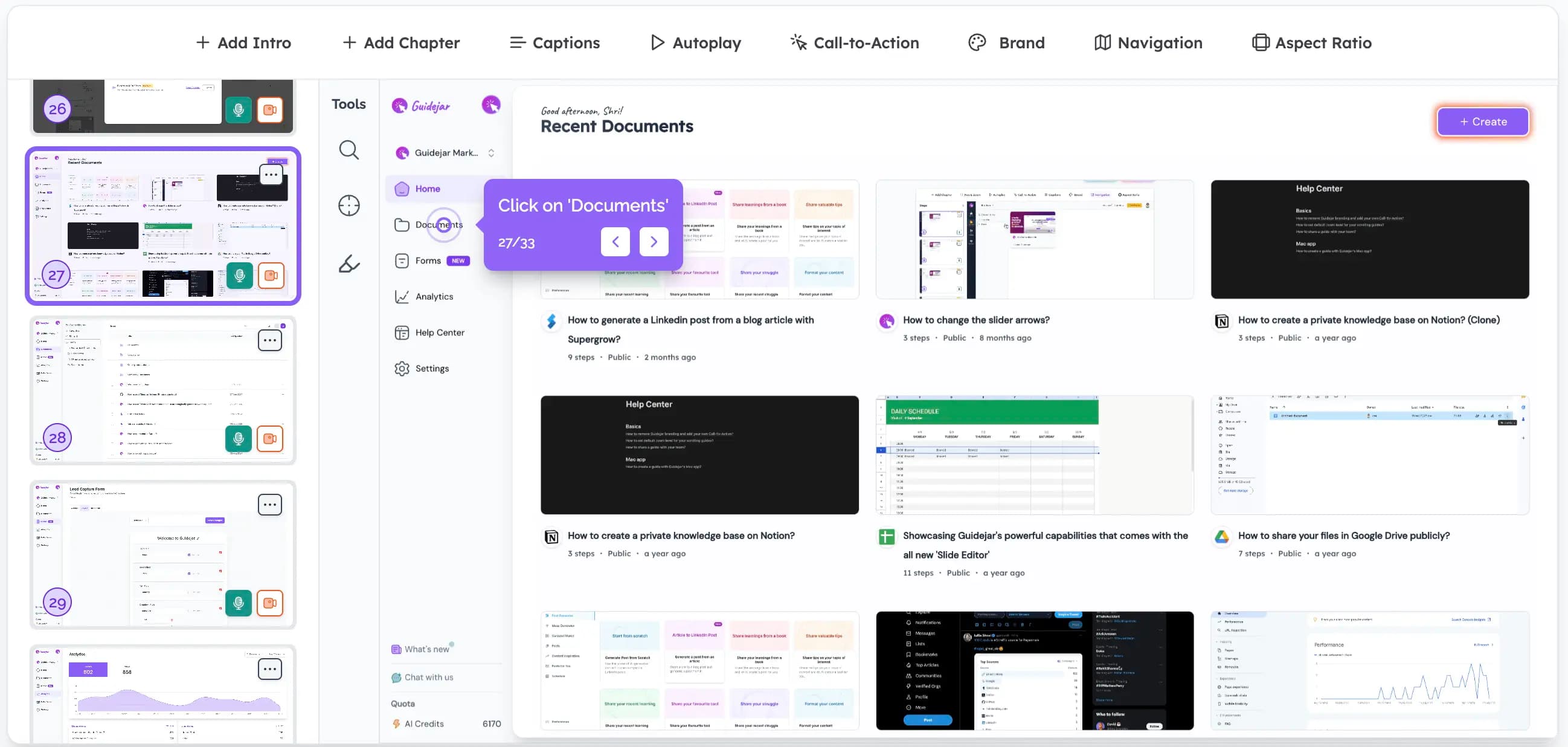
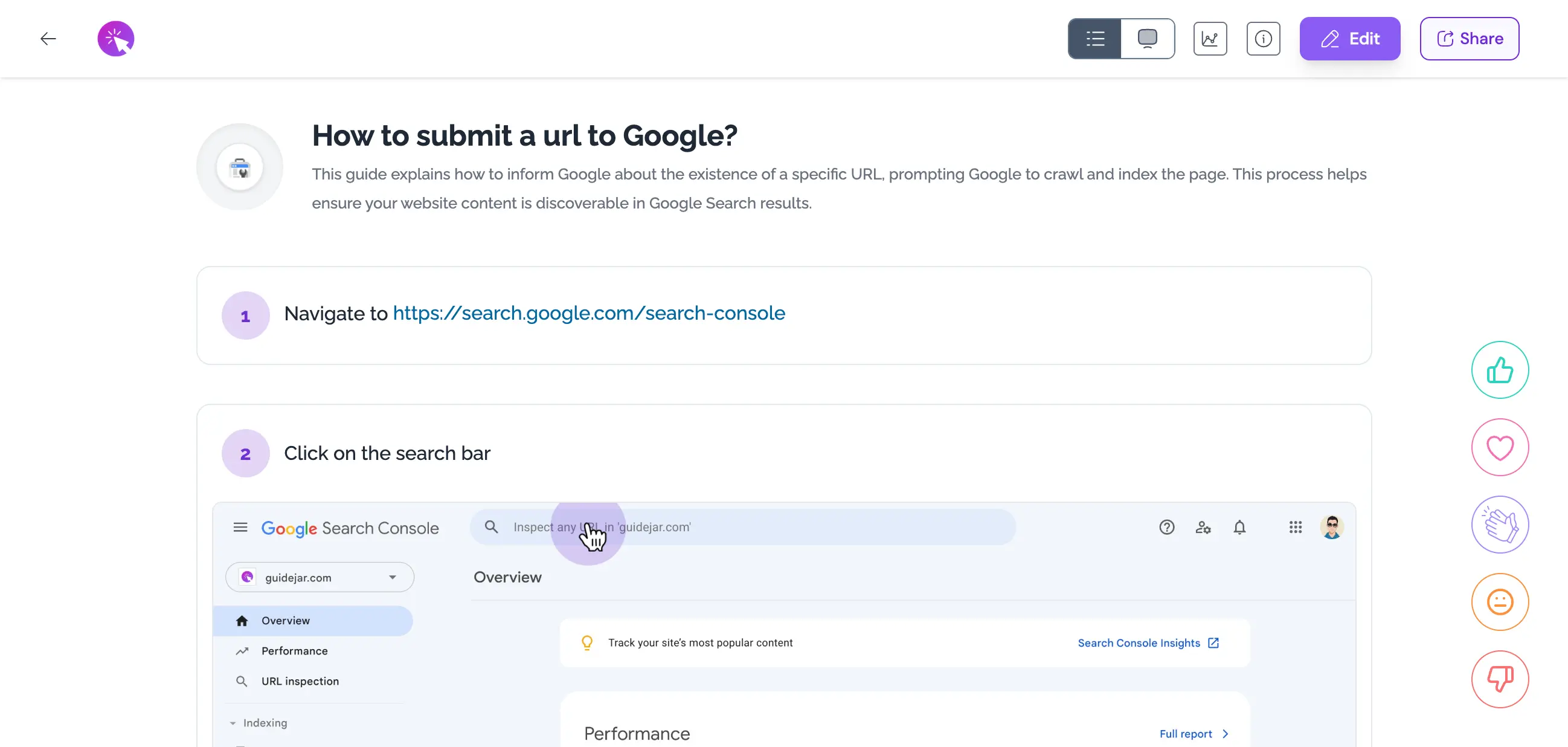
Guidejar takes one capture and publishes it two ways: a Walkthrough View people click through with hotspots and branching, and a Scroll View written step-by-step doc, like an SOP or help article. Both come from the same recording, chosen per guide. The whole library then lives in a searchable, branded help center at your own domain, and you export it as MP4, PDF, HTML, or Markdown whenever you want. Self-serve from $19/seat/mo billed monthly, no annual commitment.
- One capture published as a clickable walkthrough and a written SOP, chosen per guide
- Searchable branded help center on your own custom domain, with Ask AI ticket deflection
- MP4 export up to 30 minutes on Plus, with AI voiceover from the Pro plan
- Guidejar MCP builds your SOP library and answers team questions inside ChatGPT or Claude, on Plus
Starting at
$19/mo
per seat, billed monthly ($16 billed annually)
vs Navattic $600/mo Basevs Consensus quote-only
Try GuidejarYou own and export your content
Take guides out as MP4, PDF, HTML, or Markdown, instead of demos locked to a hosted link
Translate into 30+ languages
From the Pro plan, not a top-tier gate or an enterprise contract
Transparent, self-serve pricing
Published per-seat rates, monthly or yearly, as plain numbers with no sales gate
Trusted by teams worldwide








How Guidejar stacks up
The rows that actually separate them, with the third column filled in.
| Capability | Navattic | Consensus | Guidejar |
|---|---|---|---|
| Interactive clickable demo | Yes — HTML Web Captures | Yes — HTML + video tours | Yes — Walkthrough View |
| Written step-by-step SOP / doc | Static PDF export (≤60 steps) | No — hosted demos only | Yes — hosted Scroll View, all plans |
| Branded help center on your domain | Not available | Not available | Yes — Plus plan |
| Downloadable MP4 export | Yes — capped at 15 steps | No — hosted, not downloadable | Yes — Plus, up to 30 min |
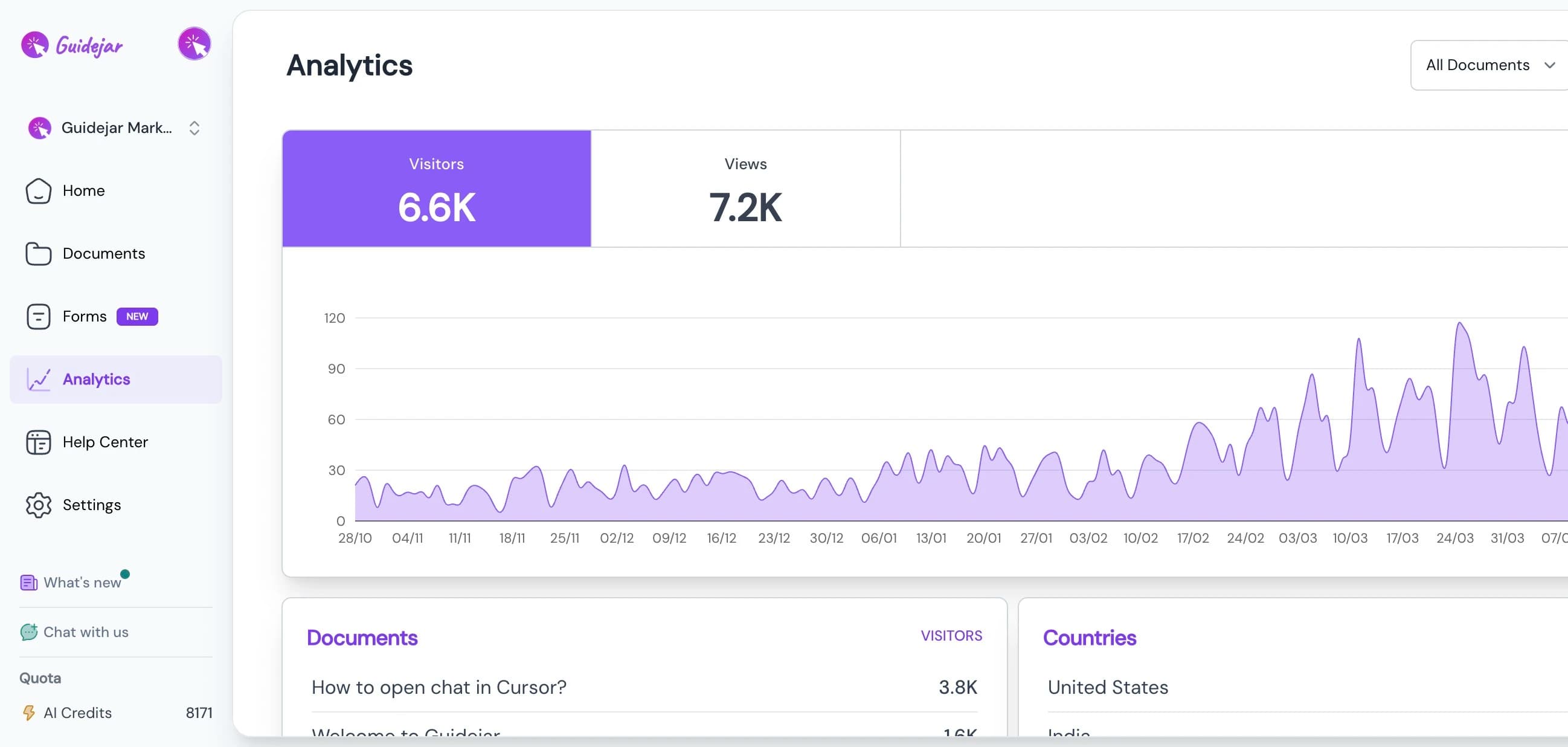
| Buyer / stakeholder analytics | Product analytics, account ID — Growth | Demolytics — stakeholder-level | No — guide-level analytics only |
| Sandbox / live-environment demos | Sandbox demos — Growth | Sandbox Tours + Live Demos | Not available |
| MCP server | Startup+ — builds demos, reads analytics | Early Access — recommends demos | Plus — authors your docs library + team Q&A |
| Multi-language translation | 35 languages — Growth | 65+ languages | 30+ languages — Pro |
| Entry paid price | $600/mo — Base, 5 seats, monthly | Not published — sales-quoted | $19/seat/mo — Pro, monthly |
Switching to Guidejar
From either tool, most teams finish the move in a few days.
- 1
Export what you have
Navattic gives you flat exports only: a PDF capped at 60 steps, an MP4 capped at 15, a GIF, and Copy as Text, with no HTML source and no bulk workspace export. Consensus is harder still, with no documented demo export at all; its “Content Downloads” attaches PDFs for buyers rather than exporting your own content. Either way the interactive demos stay behind and the flat content comes with you.
- 2
Import into Guidejar
Turn those exported PDFs, your existing screenshots, or a recorded video into guides with our importer and AI Video-to-Guide Maker in a few clicks, with no all-time import cap. Anything interactive takes a couple of minutes to re-capture with our Chrome extension or desktop app.
- 3
Publish it properly
Choose Walkthrough View or Scroll View or both per guide, add AI voiceover, translate into 30+ languages, and put the whole library on a branded help center at your own domain.
“Guidejar is a total gamechanger for my teaching academy!”
Terence, Founder
Frequently asked questions
The questions people actually search before picking one of the two.Something else on your mind? Talk to us
Neither, in the abstract. They compete for the same demo job, so it comes down to your buyer motion. Navattic wins the self-navigated demo: high-fidelity no-code HTML captures, product analytics with A/B testing, autonomous agent demos (sold separately as Navattic Agents), a free 1-demo tier, and a published entry at $500/mo billed annually. Consensus wins the buying committee: Demolytics tracks which stakeholder watched and who they forwarded the demo to internally, then auto-multi-threads the deal, and it adds Sandbox Tours, Live Demos, and a deep Salesforce-Gong-Outreach stack. Both are enterprise-priced, and neither produces a written SOP or hosts a branded help center on your own domain, which is where Guidejar comes in.
Both are enterprise-priced. Navattic shows its prices as animated digit-reels and bills monthly or annually: Base is $600/mo billed monthly or $500/mo annually for 5 seats, Growth $1,200 or $1,000 for 10, plus a free Starter tier limited to one demo; a Startup plan for eligible seed-stage teams does not display its price, and Navattic Agents is priced separately. Consensus no longer publishes prices: licenses are per user and quoted by sales, with no free plan and no trial. Until July 2026 it listed Starter at $600/mo for 5 users and Pro at $1,250/mo for 10, both billed annually, and reported real contracts run into the tens of thousands per year. For comparison, Guidejar Pro is $19/seat/mo billed monthly, and Business bundles five seats for $75/month.
Only Navattic does, and it is tightly capped. Navattic’s free Starter tier gives you one published demo on one seat with the default theme only, no custom branding, integrations, or forms, but it lets you build something real before paying. Consensus has no free plan and no self-serve trial at all; every deal is a sales-quoted contract that starts with a conversation. Guidejar’s free plan gives you 5 guides with browser capture, PDF export, sharing, and embedding, with the Guidejar watermark shown.
Demolytics is Consensus’s buyer-group analytics layer, and it is the platform’s founding differentiator. It tracks which stakeholder on a buying committee watched a demo, which sections they replayed, and who they forwarded it to inside their own company, then surfaces those hidden stakeholders and automatically multi-threads the deal. Navattic has strong analytics too, but they are product-level: advanced demo analytics, A/B testing, and account identification at Growth. That measures the demo and the account; it does not map the individual people around the deal the way Demolytics does. Guidejar has neither; its analytics are guide-level engagement, not buyer-committee intelligence.
Barely, and the interactivity does not survive either way. Navattic exports a PDF capped at 60 steps, an MP4 capped at 15, a GIF, and Copy as Text, with no HTML source and no bulk export, so the interactive demos stay locked to the platform. Consensus is more locked in still: there is no documented export of your demos, partly because downloading them would break the Demolytics tracking, and its “Content Downloads” only attaches PDFs for buyers. Guidejar exports MP4, PDF, HTML, and Markdown, and you own the content rather than renting a hosted link.
Both, in different shapes. For agents, Navattic’s agent demos let an AI run a live demo and answer questions in real time, now sold as a separate product, Navattic Agents, while Consensus’s AI Agents qualify, educate, and demonstrate on demand. For sandboxes, Navattic offers sandbox demos at Growth and Consensus offers Sandbox Tours plus a Live Demos line with real-time data injection. Both have a real MCP server too: Navattic’s reads analytics and builds demos from its Startup plan, and Consensus’s AI Agent Connect searches and recommends demos in Early Access. Guidejar has no autonomous agent demo or live sandbox; its MCP does a different job, authoring a written SOP library your whole team queries from ChatGPT or Claude.
Yes. Consensus launched as DemoChimp in 2013 and rebranded to Consensus in April 2016 alongside its Series A, so old search results and links under the DemoChimp name point to the same company. It is also frequently written “GoConsensus” after its goconsensus.com domain. Today it positions as the #1 demo-automation platform for enterprise GTM teams.
Not really. Navattic can export a demo as a static PDF or Copy-as-Text, but that is a flat download, not a hosted, searchable document, and Consensus has no written-doc output at all; its content is interactive demos, video, and tours. Neither tool hosts a branded, searchable help center or knowledge base on your own domain; their nearest concepts, Navattic Launchpad and Consensus DemoBoards, are sales assets, not a support KB. Guidejar publishes the same capture as a living Scroll View doc and puts the whole library on a help center at your own domain from the Plus plan.