Guidejar vs Consensus in 30 seconds
Consensus (it launched as DemoChimp and rebranded in 2016) is the category leader in demo automation, and it earned that. Around 1,661 G2 reviews average 4.7 out of 5, it has raised roughly $143M, and its customer list runs to SAP, Oracle and Atlassian. The product is built for one job and does it well: a buyer navigates an interactive or AI-video demo on their own time, while the seller watches Demolytics to see who in the buying committee watched, what they replayed, and who they forwarded it to. Sandbox POC environments, conversational AI demo agents, and native ties into Salesforce, Gong and Highspot sit behind that. For an enterprise sales-led motion, it is very good.
The catch is who it is built and priced for. There is no free plan, no trial, and no published price. Licenses are per user and quoted by sales, with optional usage-based add-ons. The last published entry tier, in July 2026, was $600 a month billed annually for 5 users, and the pricing page no longer lists any figure. It is also outward-facing sales software only. There is no written how-to output, no knowledge base, and no help center, and the demos themselves are hosted with no bulk export, so leaving means leaving the content behind.
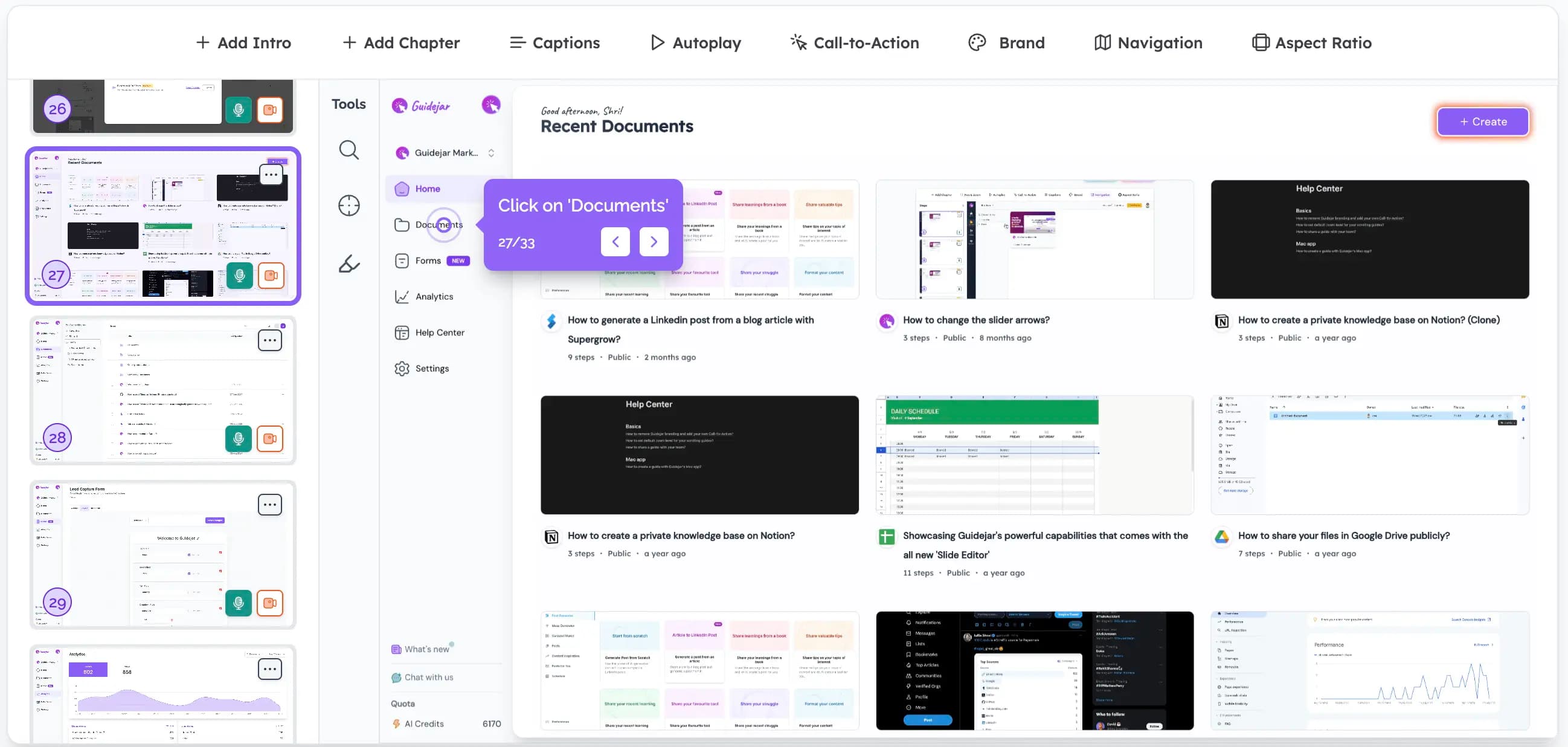
Guidejar builds the same kind of interactive walkthroughs and product tours, self-serve, from $19 a seat, billed monthly or yearly, with the price on the pricing page. The same capture also publishes as a written step-by-step guide, exports as a file you own, and lives in a branded, searchable help center on your own domain. What Guidejar does not have is the buyer-committee analytics, the sandbox environments, or the deep sales-stack integrations, so if those are the reason you are shopping, Consensus is the pick. The full feature table and the pricing math are below, and where Consensus wins, we say so.
Four reasons demo teams pick Guidejar over Consensus
Both tools capture a product and publish an interactive walkthrough a buyer can click through. Guidejar does that job self-serve, for a fraction of the price, and gives the finished walkthroughs somewhere to live once they exist.
Price & access
$19 a seat on the pricing page, not a sales-quoted contract
Guidejar Pro is $19 a seat per month, or $16 billed yearly, bought with a card, and every paid plan comes with a 7-day free trial. Consensus has no free plan, no trial and no published price. Licenses are per user and quoted by sales, with optional usage-based add-ons, and the last figure it published, in July 2026, was $600 a month billed annually for a 5-user entry tier. That is enterprise software priced for enterprise budgets. If you want to evaluate interactive walkthroughs this week without a sales call, that gap is the whole story.
See Guidejar pricingOwn your content
Your walkthroughs are files you keep, not assets you rent
A Consensus demo is a hosted, proprietary asset shared by link, embed or DemoBoard. There is no bulk export and no way to take the interactive demos, the branching logic, or the analytics history with you, so the switching cost compounds the longer you stay. Its “Content Downloads” feature attaches your PDFs for buyers to grab, which is the reverse of an export. Guidejar lets you download the same guide as PDF, HTML, Markdown or an MP4 video, so the work you produce is yours to move, back up, or repurpose.
Help center
Somewhere for the walkthroughs and docs to live
Consensus is sales-facing only. A DemoBoard is a per-buyer landing page, not a searchable site, and there is no knowledge base or help center anywhere in the product. Guidejar publishes the whole library to a branded help center at help.yourcompany.com, with an in-app help widget and Ask AI answering from your own content on Business. So the walkthroughs you build for prospects become the same self-serve site your support and onboarding teams point customers to, instead of a pile of links to keep track of.
Explore the help centerOne capture, two views
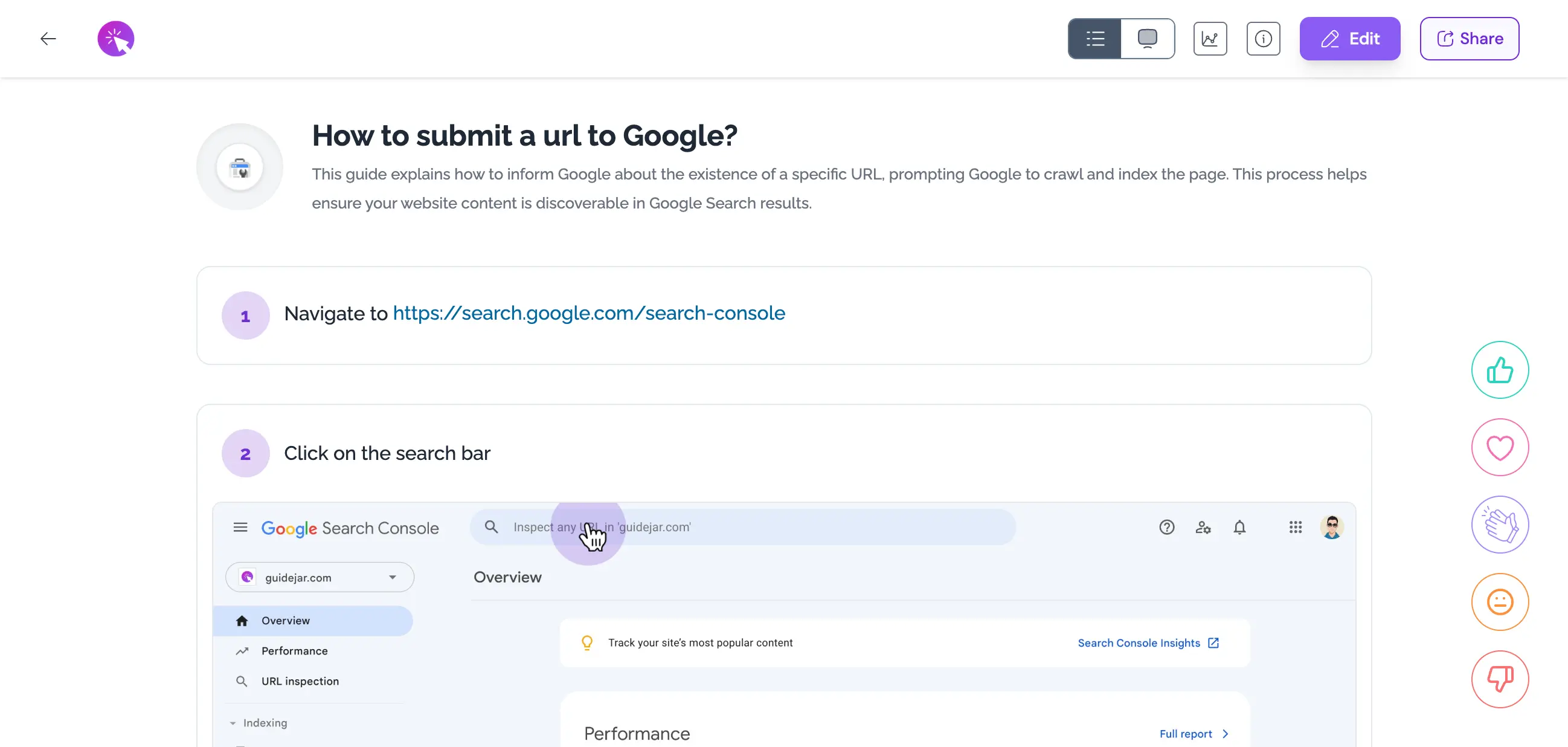
The same walkthrough is also a written guide
Consensus produces interactive demos, product tours and video. It does not produce a written step-by-step document, so onboarding docs and support articles need a separate tool. Every Guidejar capture renders two ways from a single recording: a clickable Walkthrough View for the interactive version, and a Scroll View that reads as a written guide, both live, embeddable and tracked. Point our MCP server at that library on the $25 Plus plan and an AI agent can build and update guides for you while your team asks it questions in plain language. So a product walkthrough, an onboarding SOP, and a support article become one piece of work rather than three subscriptions.
Feature-by-feature comparison
Side by side on the demo job first: capture, interactivity and analytics, then written output, publishing, and terms. Consensus leads on buyer intelligence; Guidejar leads on price, docs and ownership.
| Capability | Guidejar | Consensus |
|---|---|---|
| Building the demo | ||
| Browser capture | Yes — free plan | Yes — HTML capture tours |
| Desktop / screen recording | Plus plan | Yes — built-in screen recorder |
| Interactive branching | Pro plan | Yes — branching questions |
| Per-buyer personalization | Dynamic variables (Pro) | Merge Links, per-recipient at scale |
| Multi-language translation | Translate into 30+ languages, Pro ($19) | Yes — AI translations, up to 65+ languages |
| Lead-capture forms | Plus plan | Included |
| Sandbox / live-environment demos | Not available | Yes — Sandbox Tours & Live Demos |
| Buyer / stakeholder analytics | Guide-level analytics (Pro) | Yes — Demolytics buyer signals |
| Written output & exports | ||
| Written step-by-step doc | Yes — Scroll View, free plan | No — interactive demos only |
| In-app help widget | Help Center Widget (Plus) | Not available |
| PDF export | Yes — free plan | No — hosted only |
| Downloadable MP4 export | Plus plan | No — hosted only |
| HTML / Markdown export | Pro plan | No — hosted only |
| Import from PDF / Word | Pro plan | Not available |
| Video-to-guide import | Plus plan | Not available |
| Publishing, platform & AI | ||
| Hosted branded help center | Plus plan | No help center product |
| Custom domain | Plus plan | No — branded DemoBoards only |
| AI answers from your own content | Help Center Ask AI, Business plan | No help center |
| MCP server (AI integration) | Builds & queries your docs, Plus ($25) | Searches & recommends demos, Early Access |
| Native sales-stack integrations | Insta Copy paste, not native | Salesforce, Gong, Highspot, Outreach — native |
| SAML SSO | Business plan (help center), Enterprise org-wide | Included |
| Pricing & terms | ||
| Free plan | 5 guides, 1 user, watermarked | None — no free plan or trial |
| Price published | Yes — on the pricing page | No — sales-quoted |
| Seat model | From 1 seat, up to 50 in-app | Per-user licenses, plus usage-based add-ons |
| Starting paid price | $19/seat/mo (Pro) | Not published; $600/mo annual last listed (July 2026) |
| Team plan | $75/mo flat — Business, 5 seats | Sales-quoted |
| Enterprise | Custom, from 10 users | Custom |
These two overlap on one thing: both build an interactive walkthrough a buyer can click through, with hotspots and branching, and both do AI translation. Everything else pulls apart. Consensus wins the enterprise buyer motion outright. Demolytics buyer-committee analytics, sandbox and live-demo environments, conversational AI demo agents, and native Salesforce, Gong and Highspot integrations have no Guidejar equivalent. Guidejar wins on everything around the demo: a $19 seat you can buy today against a sales-quoted contract, a written Scroll View and a branded help center that Consensus has no product for, and exports you own where Consensus is hosted-only with no bulk export. The question is not which is the better demo tool. It is whether you are buying an enterprise sales platform or an accessible walkthrough-and-docs tool.
Verified against Consensus’s public pricing and product pages, October 2026. Consensus no longer publishes prices, and its help docs are login-gated, so some limits are graded from its July 2026 pricing matrix. Spot something out of date? Tell us and we’ll correct it.
Pricing compared
Interactive walkthroughs and tours, self-serve, at a fraction of an enterprise contract.
$19/seat/mo
Guidejar Pro, published on the pricing page and bought self-serve
$600/mo
Consensus’s last published entry price, billed annually (July 2026); it no longer lists prices
7-dayfree trial
on Guidejar’s paid plans; Consensus has no free plan or trial
Bottom line: Consensus is enterprise software priced like it. It no longer publishes prices: licenses are per user and quoted by sales, with optional usage-based add-ons, and the last listed entry tier (July 2026) was $600 a month billed annually for five users. There is no free plan and no trial, so there is no low-commitment way in. A five-person team on Guidejar Business is $75 a month flat, and $19 Pro seats are there if that is all you need. This is not a like-for-like swap: the Consensus price buys Demolytics, the sales-stack integrations and the sandbox and live demos. If those are on your must-have list, the higher number is buying something real.
Prices as of October 2026. Guidejar prices are standing monthly rates; Business bundles 5 seats. Consensus publishes no prices (per-user licenses, sales-quoted, no free plan or trial); $600/mo billed annually was its last published entry tier, in July 2026. See full Guidejar pricing →
Where Consensus genuinely wins
Consensus is the category leader in demo automation, and four of the things it does, Guidejar cannot do at all.
Demolytics and buyer-committee intelligence
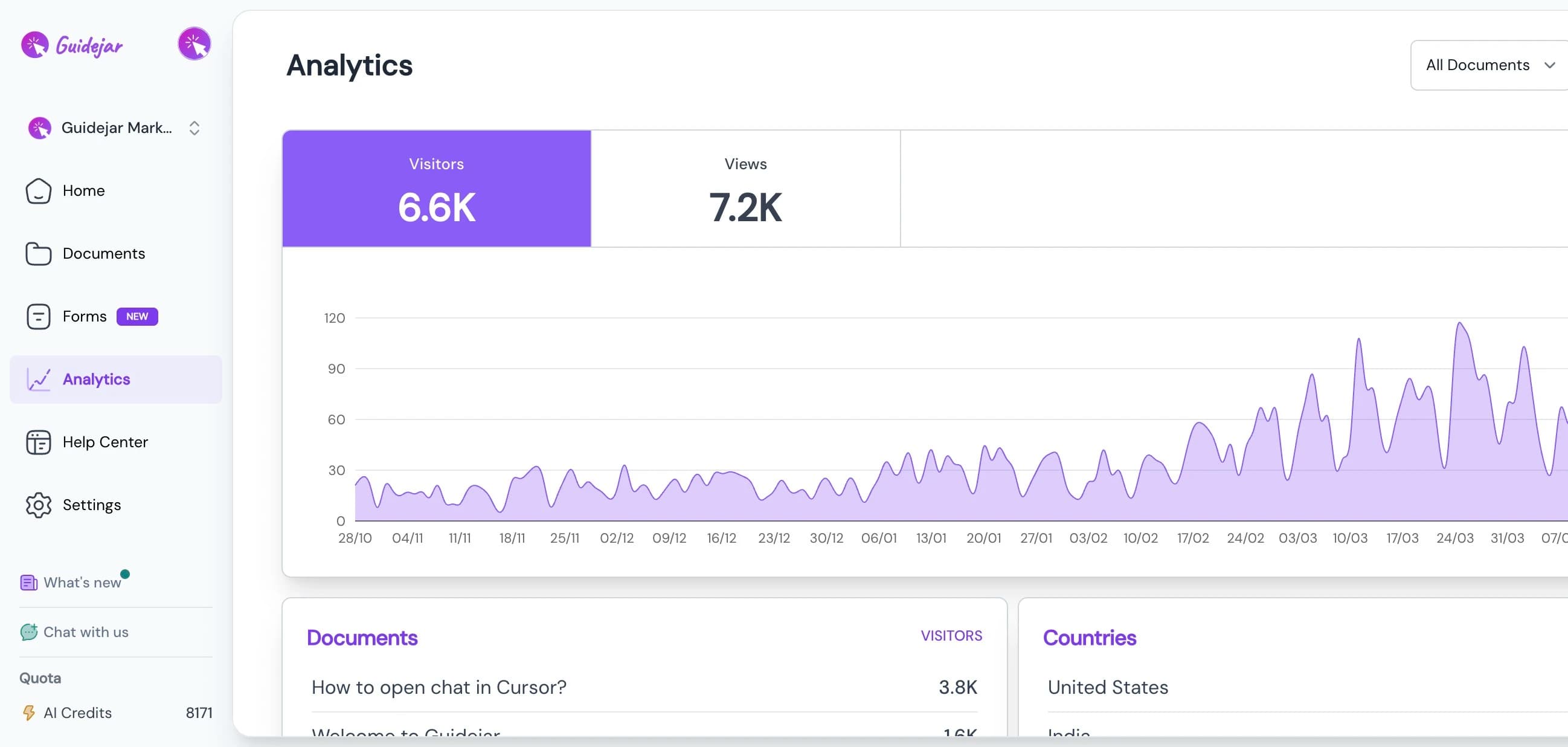
This is why Consensus exists, and it has no Guidejar analogue. Demolytics tracks which stakeholder in the buying committee watched the demo, which sections they replayed, and who they forwarded it to internally, then surfaces the hidden stakeholders and multi-threads the deal automatically. Heatmaps, stakeholder discovery and a rep leaderboard sit on top. If tying demo engagement to a named buying committee and a pipeline number is the job, Consensus is built for it end to end and Guidejar only counts guide views.
Sandbox Tours and Live Demos for real POCs
Beyond screenshot and HTML tours, Consensus offers fully tailored live sandbox environments and, newer, Live Demos with real-time data injection and AI-generated demo data, so a prospect can explore a complete try-before-you-buy experience rather than a guided recording. It is a genuine capability. Guidejar captures and annotates screenshots and recordings, with no live sandbox at any price. For a real POC environment, Consensus wins that requirement outright.
Conversational AI demo agents
Consensus’s 2026 flagship is AI Agents that qualify, educate and demonstrate on demand, adapting the conversation to each buyer and answering questions in real time rather than replaying a fixed path. A Live Demo Agent now runs interactive demos around the clock, and Consensus has agreed to acquire Peel, which builds conversational agents from webpages, PDFs and videos. It is the kind of autonomous, buyer-facing demo agent Guidejar has no equivalent for. If you want a demo that talks back and tailors itself to each viewer without a rep on the call, that is a real reason to choose Consensus.
A deep enterprise sales-tech stack
Consensus wires demo engagement into the revenue engine. Native connectors reach Salesforce, Outreach, SalesLoft, Gong, Highspot, Seismic, HubSpot, Marketo and Slack, with API access, so demo signals land where your sales team already works. Guidejar’s integrations are Insta Copy paste rather than native OAuth connectors. For a sales-led org that needs the demo to feed the CRM and the enablement stack, Consensus is built for that and Guidejar is not.
Which tool is right for your team?
Honest recommendations based on whether you are running an enterprise sales motion or building accessible walkthroughs and docs.
Choose Guidejar if
- You want interactive walkthroughs and product tours at $19 a seat, billed monthly, instead of a sales-quoted contract
- You do not want a sales call just to evaluate the tool
- You need a written step-by-step guide and a searchable branded help center on your own domain, not just sales-facing demos
- You want to own and export your content as PDF, HTML, Markdown or MP4, rather than rent hosted assets with no bulk export
- One capture doubling as a product walkthrough, an onboarding SOP and a support article matters more than buyer-committee analytics
- You want an AI agent to build your docs library and answer your team’s questions through an MCP server on a $25 plan, where Consensus’s MCP recommends demos and is in Early Access
Choose Consensus if
- You sell complex products to multi-stakeholder buying committees and need stakeholder-level engagement analytics
- Demolytics, stakeholder discovery and automated multi-threading are the reason you are shopping
- You want live sandbox POC environments and Live Demos a prospect can freely explore
- Conversational AI demo agents that qualify and demonstrate on demand are on your requirements list
- Demo engagement has to flow natively into Salesforce, Gong, Highspot and Outreach
- You are an enterprise revenue org with the budget for a sales-led, enterprise demo-automation platform
It depends on the job, and for most teams that is Guidejar.
Consensus is the category leader in demo automation, and if you are running an enterprise sales motion, buyer-committee analytics, sandbox POCs, AI demo agents and a deep sales-stack are worth the enterprise contract, and it is the better tool for that. But most teams shopping for a “Consensus alternative” want interactive walkthroughs and product tours without a sales-quoted enterprise price. Guidejar builds those self-serve from $19 a seat, adds a written guide and a branded help center from the same capture, and lets you export and own the result. Buy Consensus for the buyer intelligence and the sandbox. Buy Guidejar for accessible interactive walkthroughs that also cover your docs and support.
Switching from Consensus to Guidejar
Get what you can out first, then rebuild the demos that matter.
- 1
Export what you have
This is the hard part with Consensus, and worth knowing up front. Demos and tours are hosted, proprietary assets shared by link, embed or DemoBoard, with no bulk export. Its “Content Downloads” only attaches your own PDFs for buyers, so the interactive demos and analytics history stay behind.
- 2
Import into Guidejar
Bring in any PDFs or existing screenshots in a few clicks, and run recorded videos through our AI Video-to-Guide Maker, with no all-time import cap. Interactive flows re-capture in a couple of minutes with our extension or desktop app.
- 3
Publish it properly
Choose Walkthrough View or Scroll View or both per guide, add AI voiceover, translate into 30+ languages, and put the whole library on a branded help center at your own domain.
Trusted by teams worldwide








“Pricing is reasonable and value for money is high.”
Guido Appels, Project Manager
Frequently asked questions
The questions people actually search before picking one of the two.Something else on your mind? Talk to us
Consensus no longer publishes prices. Its pricing page now describes per-user licenses plus optional usage-based capabilities, with integrations included, and the only way to get a number is a sales conversation. Until July 2026 it listed an entry tier at $600 a month billed annually for five users, but that figure is gone from the page. There is no self-serve checkout, free plan or trial. Guidejar Pro is $19 a seat per month, or $16 billed yearly, published on the pricing page and bought with a card.
No on both. Consensus has no free plan and no free trial. The only no-cost touch is a sample “try a demo” experience; a real workspace requires a sales conversation and a contract. Guidejar has a 7-day free trial on its paid plans. Its free plan is small: 5 guides for 1 user with browser capture, sharing, embedding and PDF export, and it shows a Guidejar watermark until you move to Pro.
Yes, same company. It launched as DemoChimp in 2013 and rebranded to Consensus in 2016, so older searches for DemoChimp point here. It is an enterprise demo-automation and buyer-enablement platform: buyers self-navigate interactive and AI-video demos and product tours on their own time, while sellers get stakeholder-level engagement analytics to multi-thread and move the deal. It is a sales tool, not a documentation or SOP tool.
Demolytics is Consensus’s buyer-group engagement analytics, and it is genuinely the best thing about the product. It tracks which stakeholder in a buying committee watched a demo, which parts they replayed, and who they forwarded it to internally, then surfaces hidden stakeholders and multi-threads the deal automatically. Guidejar has guide-level analytics for views and engagement, but nothing at the buying-committee level. If that intelligence is why you are shopping, Consensus is the better pick.
No. Consensus is outward-facing sales and marketing software, and there is no hosted help center, knowledge base or written how-to output anywhere in its product lineup. Its DemoBoards are per-buyer sales landing pages, not a searchable site. Guidejar publishes a branded, searchable help center on your own domain from Plus at $25 a seat, with an in-app widget and Ask AI answering from your own content on Business, so the same captures serve prospects, support and onboarding from one place.
Not really, and it is worth knowing before you commit. Consensus demos and tours are hosted, proprietary assets shared only by link, embed or DemoBoard, with no bulk export and no PDF, HTML, Markdown or MP4 download of the demos themselves. Its “Content Downloads” feature attaches your PDFs for buyers, which is the opposite of an export. Combined with a sales-led enterprise contract, that makes the switching cost real. Guidejar lets you download the same guide as PDF, HTML, Markdown or MP4, so your content stays yours.
For different jobs, so it depends. For an enterprise sales motion that needs buyer-committee analytics, sandbox POCs, AI demo agents and native Salesforce and Gong integrations, Consensus is the category leader and the better tool. For teams that want accessible interactive walkthroughs and product tours, plus written docs and a branded help center, at a self-serve price, Guidejar wins: $19 a seat on the pricing page against a sales-quoted contract, with content you can export and own. Match the tool to whether you are buying a sales platform or a walkthrough-and-docs tool.