Supademo vs Consensus in 30 seconds
These two both make interactive demos, but they sell to different buyers. Supademo leads with “The AI demo platform for the full customer journey” and a self-serve model: a free plan, a 14-day trial, and $38 to $50 per creator. Consensus leads with “#1 in Demo Automation” and “Demos That Sell,” and sells to enterprise revenue teams. Same core artefact, a demo a buyer navigates on their own. Different segment entirely.
What differs is price and depth. Supademo is the accessible toolkit: guided screenshot and video demos, a searchable in-app Demo Hub from Scale, SCORM export, guided HTML demos from Business ($199 a month billed annually), and sandbox demos at Growth ($350 a month for five creators, billed annually). Consensus is the enterprise buyer-enablement platform: Demolytics stakeholder tracking, Sandbox Tours, a new Live Demos line, AI Agents, and a deep Salesforce, Outreach, and Gong integration stack, with no free plan and no published price. One you buy with a card this afternoon. The other starts with a sales call and a quoted contract.
So the choice is really about your size and how you sell. The full table and the pricing math are below. There is also a third option worth a look, since neither tool turns a capture into a written SOP or hosts a branded help center on your own domain.
Four differences that decide it
Both capture a workflow and turn it into a self-navigated interactive demo. From there, they aim at completely different customers.
Who it is built for
Self-serve toolkit vs enterprise contract
Supademo sells itself. You start on a free plan, add a 14-day trial, and pay $50 per creator each month or $38 billed annually, with a card and no sales call. Consensus does not work that way. There is no free plan and no self-serve trial, and as of October 2026 it publishes no prices: per-user licenses, plus optional usage-based add-ons, quoted by sales. Its last published entry point, now removed, was $600 a month for five users billed annually (July 2026), roughly $120 per user against Supademo’s $38 to $50, so the two are not really shopping in the same aisle.
Output & ownership
Content you can carry out vs hosted-only
Both produce a self-navigated interactive demo, but they treat the file very differently. A Supademo capture also becomes a written step-by-step guide through Copy Steps and the Steps view, exports to PDF or MP4, and wraps into a free SCORM package for an LMS, so you can carry the content out. Consensus keeps everything hosted. There is no PDF, HTML, Markdown, or MP4 export of the demos and no documented bulk export, which means the interactive assets and the Demolytics history stay on the platform. If portability matters, Supademo gives you far more ways out.
Buyer intelligence
Viewer analytics vs buying-committee signals
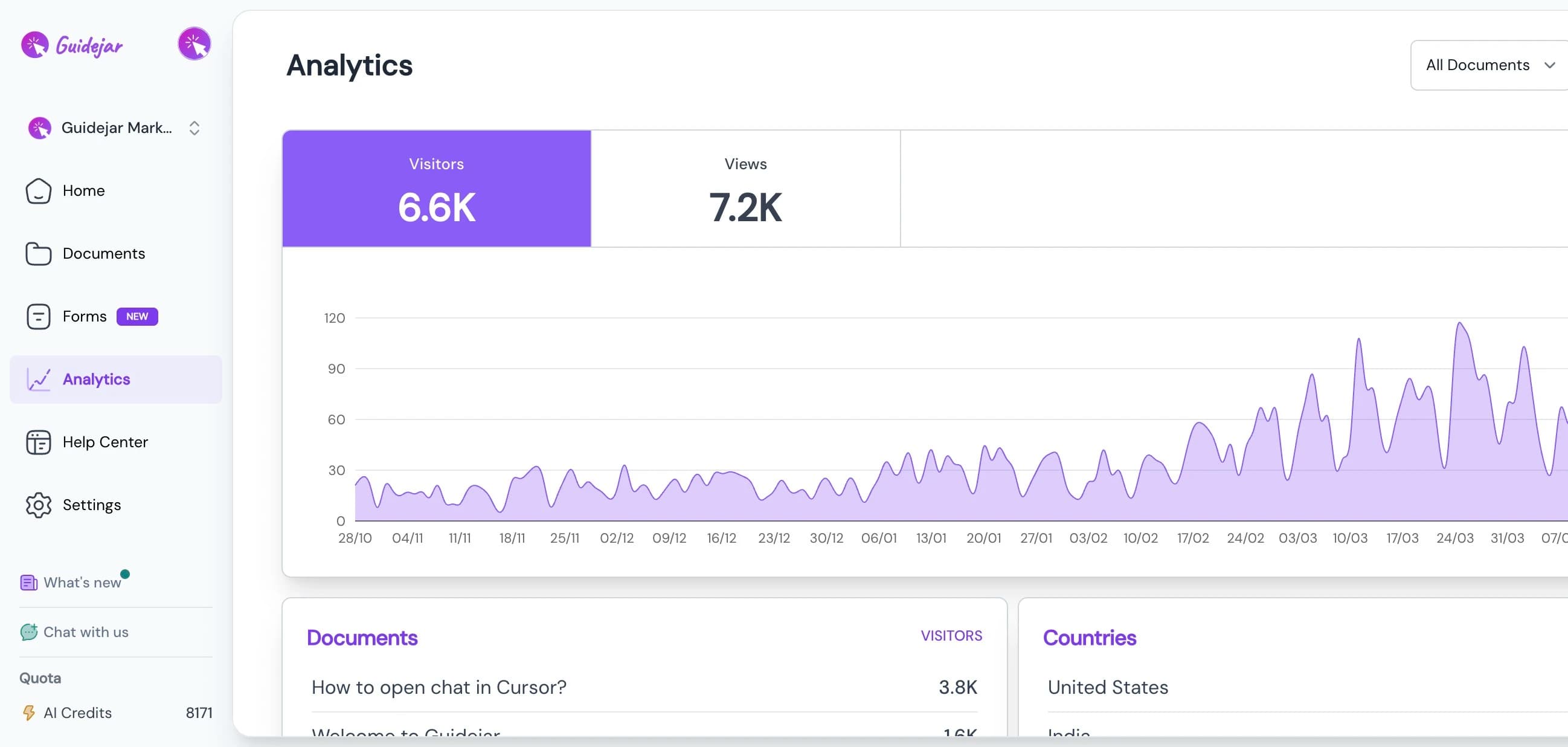
This is Consensus’s founding idea and its clearest advantage. Demolytics, its buyer-signal layer, tracks which stakeholder in a buying committee watched, what they replayed, and who they forwarded the demo to inside their own company, then surfaces hidden decision-makers and helps reps multi-thread the deal. Supademo has real analytics too, with viewer insights, lead tracking, and CRM sync from the Scale plan, but it reports on viewers and leads, not on a buying committee. If you sell complex software to a group of people, that difference is the whole reason Consensus exists.
Capability depth
Enterprise depth vs a full toolkit on a budget
The headline capabilities sit at opposite ends of the price range. Consensus offers Sandbox Tours, a new Live Demos line with real-time data injection, and its 2026 AI Agents, built for presales teams running POC-grade demos into a Salesforce and Outreach stack. Supademo puts guided HTML demos on Business at $199 a month billed annually ($249 monthly, one creator), free-exploration sandbox demos on Growth at $350 a month for five creators, gives unlimited view-only collaborators away for free from Business, and ships real connectors from Scale. One is enterprise depth on a quoted contract. The other is most of the toolkit on a self-serve budget.
Feature-by-feature comparison
Same core artefact, different price and depth. Grouped and side by side.
| Capability | Supademo | Consensus |
|---|---|---|
| Capture | ||
| Browser capture | Yes — Chrome extension, Free | Yes — Capture / SNAP extension |
| Desktop capture | Scale — Mac & Windows apps | Yes — built-in screen recorder |
| Sensitive data redaction | Smart blur auto-redact — Scale | Manual blur PII |
| Video-to-guide import | Yes — Video Splitting, Free | Not available |
| Demos & output | ||
| Interactive demo output | Yes — guided demos | Yes — interactive tours |
| Written step-by-step document | Yes — Copy Steps / Steps view, Free | No — hosted demos only |
| HTML / sandbox demos (front-end clone) | HTML Business ($199/mo); sandbox Growth | Sandbox Tours & Live Demos |
| Interactive branching | Conditional branching — Scale | Yes — branching questions |
| Dynamic variables | Variables & Tokens — Scale | Merge Links personalization |
| Voice cloning | Growth | Not available |
| Multi-language translation | Scale — 50+ languages | Yes — 65+ languages |
| AI demo agent (conversational) | AI Demo Agent — prepaid credits, Scale+ | Yes — AI Agents |
| Downloadable MP4 export | Free — 1080p watermark; 4K on Scale | No — hosted only |
| Import & export | ||
| Import from PDF / DOCX | Not available | Not available |
| PDF export | Yes — Free | Not available |
| HTML export (downloadable file) | No — clipboard only | Not available |
| SCORM / LMS package | Yes — free, no account | Not available |
| Export to Confluence / Notion | Copy Steps paste — Free | Not available |
| Bulk workspace export | Enterprise only | No — hosted only |
| Publishing, delivery & analytics | ||
| Hosted branded help center | No — Showcase is a demo gallery, not an article KB | No — per-buyer sales landing pages |
| Custom domain | Scale — demos & showcases | Not available |
| In-app contextual delivery | Demo Hub — Scale, searchable widget | No — marketing site & email only |
| Buyer / stakeholder analytics | Viewer & lead analytics — Scale | Demolytics — stakeholder-level, multi-threading |
| Lead-capture forms | Scale | Included |
| MCP server | Scale — demo editing | Early Access — AI Agent Connect |
| Native GTM integrations | HubSpot, Salesforce, Marketo, Seismic — Scale | Adds Salesforce, Outreach, SalesLoft, Gong, Highspot |
| Free view-only seats | Unlimited on Business+; 5 on Scale | Per-user licenses |
| SSO / SAML | Enterprise | Included |
| Pricing | ||
| Free plan | 5 demos, watermark, no analytics | No free plan |
| Entry paid (billed monthly) | $50/creator — Scale | Quote-only |
| Entry paid (billed annually) | $38/creator — Scale | Quote-only |
| HTML-demo plan | $249/mo ($199 annual) — Business, 1 creator | Quote-only |
| Team plan | $450/mo ($350 annual) — Growth, 5 creators | Quote-only |
| Billing model | Monthly or annual, self-serve | Sales-quoted contract |
| Seat model | Per creator; free view-only seats | Per-user licenses + usage add-ons |
| Enterprise | Custom — min 10 creators | Custom |
Both build self-navigated interactive demos, so that job is a genuine tie. Supademo wins on access: a free plan, a 14-day trial, $38 to $50 per creator, a written-doc and SCORM export path, and free viewer seats. Consensus wins on enterprise depth: Demolytics buyer-committee analytics, Sandbox Tours and Live Demos, AI Agents, and a deep Salesforce, Outreach, and Gong integration stack that ties demo engagement to pipeline. The split is segment, not quality. What neither one does is publish the same capture as a hosted written Scroll View in a searchable help center on your own domain, and Consensus exports nothing at all.
Verified against both vendors’ public pricing and documentation, re-checked October 2026. Consensus no longer publishes prices or a plan matrix, so its feature calls come from its product pages and its last published matrix (July 2026). Consensus was formerly DemoChimp. Spot something out of date? Tell us and we’ll correct it.
Pricing compared
Every number below states its billing interval. Mixing them is how comparisons mislead.
$38/creator/mo
Supademo Scale billed annually ($50 monthly); free plan + 14-day trial
Quote
Consensus: per-user licenses, sales-quoted; no free plan, no trial, no published price
$19/seat/mo
Guidejar Pro billed monthly — $16/seat/mo billed annually
Bottom line: these two live in different price leagues. Supademo is self-serve from $38 per creator billed annually ($50 monthly), with a free plan and a 14-day trial. HTML demos start on Business at $199 a month billed annually ($249 monthly) for one creator, and the team tier, Growth, is $350 a month for five creators billed annually ($450 monthly). Consensus is enterprise-priced and sales-gated, with no free plan, no trial, and no published price: per-user licenses, quoted by sales. Its last published entry point, removed since, was $600 a month for five users billed annually (July 2026), and third-party trackers put real Consensus contracts near a $45,750 median a year. Guidejar sits below both on a transparent self-serve model, $19 per seat billed monthly, with Business bundling five seats for $75 a month.
Prices as of October 2026. Supademo bills per creator (Business and Growth bundle 1 and 5 creators); Consensus no longer publishes prices; Guidejar Business bundles 5 seats.
Where each one genuinely wins
Neither tool is a strictly better version of the other. These are the real, checkable advantages.
Supademo: SCORM export, free and without an account
Any Supademo, or in fact any URL, can be wrapped as a SCORM 1.2 course module that reports completion, score, and session time back to your LMS, and the generator is free with no sign-in. For an L&D or enablement team that has to deliver into Cornerstone, Docebo, or Moodle, that is a hard requirement Consensus does not meet and Guidejar cannot either. The honest caveat is that the package is an iframe wrapper, so the module needs live access to Supademo’s hosted demo.
Supademo: real capability on a self-serve budget
Supademo packs a lot into low tiers. The free plan includes video-to-guide splitting and PDF and SOP export. Scale at $38 a creator adds a searchable in-app Demo Hub, smart-blur redaction, analytics, and native HubSpot, Salesforce, Marketo, and Seismic connectors, and view-only seats are free and unlimited from Business. For a small or mid-market team, that is genuine reach without an enterprise quote, which is exactly what Consensus asks for.
Consensus: Demolytics buyer intelligence
Consensus more or less invented buyer-group analytics. It tracks each stakeholder’s engagement, surfaces people in the account you did not know were involved, and multi-threads the deal automatically, with BuyerBoards that champions share internally. Nothing in Supademo, and nothing in Guidejar, does this. If your sale runs through a committee, it is a category of its own.
Consensus: enterprise depth, sandbox, and AI Agents
Beyond analytics, Consensus offers Sandbox Tours for full POC experiences, a new Live Demos line with real-time data injection, conversational AI Agents that qualify and demo on demand, SSO, and a deep native stack across Salesforce, Outreach, SalesLoft, Gong, and Highspot with API access. It is built to sit inside an enterprise revenue workflow, a depth neither Supademo nor Guidejar reaches. Its long-standing category leadership on G2 reassures cautious buyers.
Which tool is right for you?
Same artefact, different market. Honest recommendations based on your size and motion.
Choose Supademo if
- You want to start today on a free plan or a 14-day trial, self-serve, with no sales call or annual contract
- Your budget is per-creator and mid-market, at $38 to $50 a creator rather than an enterprise deal
- You need SCORM packages for an LMS, or an in-app Demo Hub on the entry paid plan, which Consensus does not offer
- You want guided HTML and sandbox demos plus real CRM connectors without an Enterprise quote
- Free view-only seats matter, since your reader audience is far larger than your creator team
Choose Consensus if
- You sell complex software to multi-stakeholder buying committees and need to see who engaged
- Demolytics, stakeholder discovery, and automated multi-threading are the point, not a nice-to-have
- You want Sandbox Tours and live demos for try-before-you-buy POC experiences
- Your demo engagement has to flow into a Salesforce, Outreach, Gong, and Highspot sales stack
- A sales-quoted enterprise contract is fine, and a category-leading track record reassures your buyers
Mid-market teams that want self-serve interactive demos pick Supademo. Enterprises selling to buying committees pick Consensus.
They aim at the same artefact from opposite ends of the market, so the honest split is budget and motion. Supademo fits a team that wants to make good demos this afternoon without a sales call, and to export or repurpose them freely. Consensus fits a revenue org that needs buyer-committee analytics, sandbox POC environments, and a deep sales-tech stack, and can sign an enterprise contract for it. Neither one turns a capture into a hosted written SOP or puts your library in a branded help center on your own domain, which is where the third option below comes in.
Both make the demo. Neither hosts your docs.
Supademo and Consensus both turn a capture into a self-navigated interactive demo and keep it hosted on their platform. Neither publishes that same capture as a hosted written guide in a searchable, article-based help center on your own domain. Consensus exports no written doc at all, and Supademo’s Showcase is a demo gallery, not a knowledge base. If support and onboarding are part of the job, here is the third option.
Guidejar
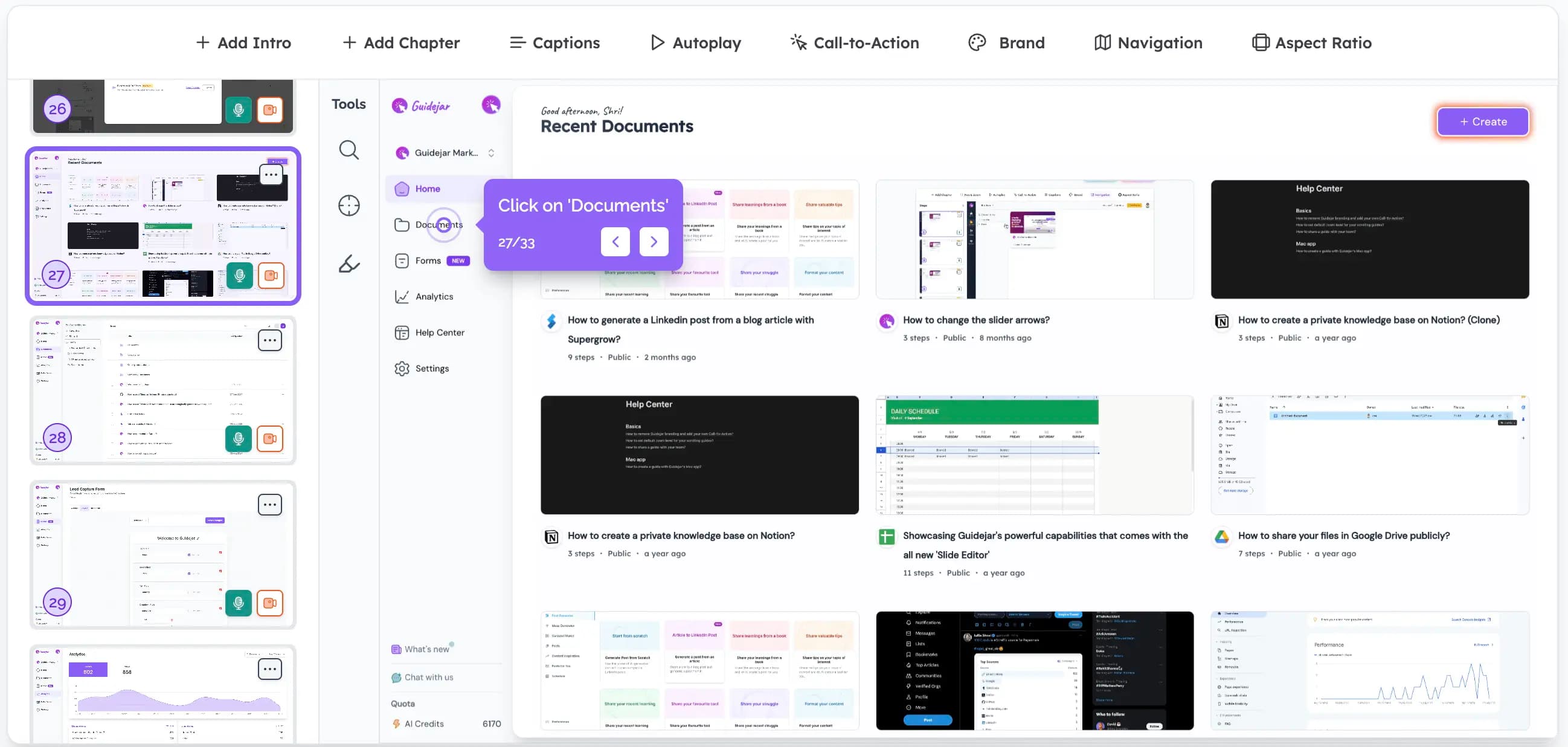
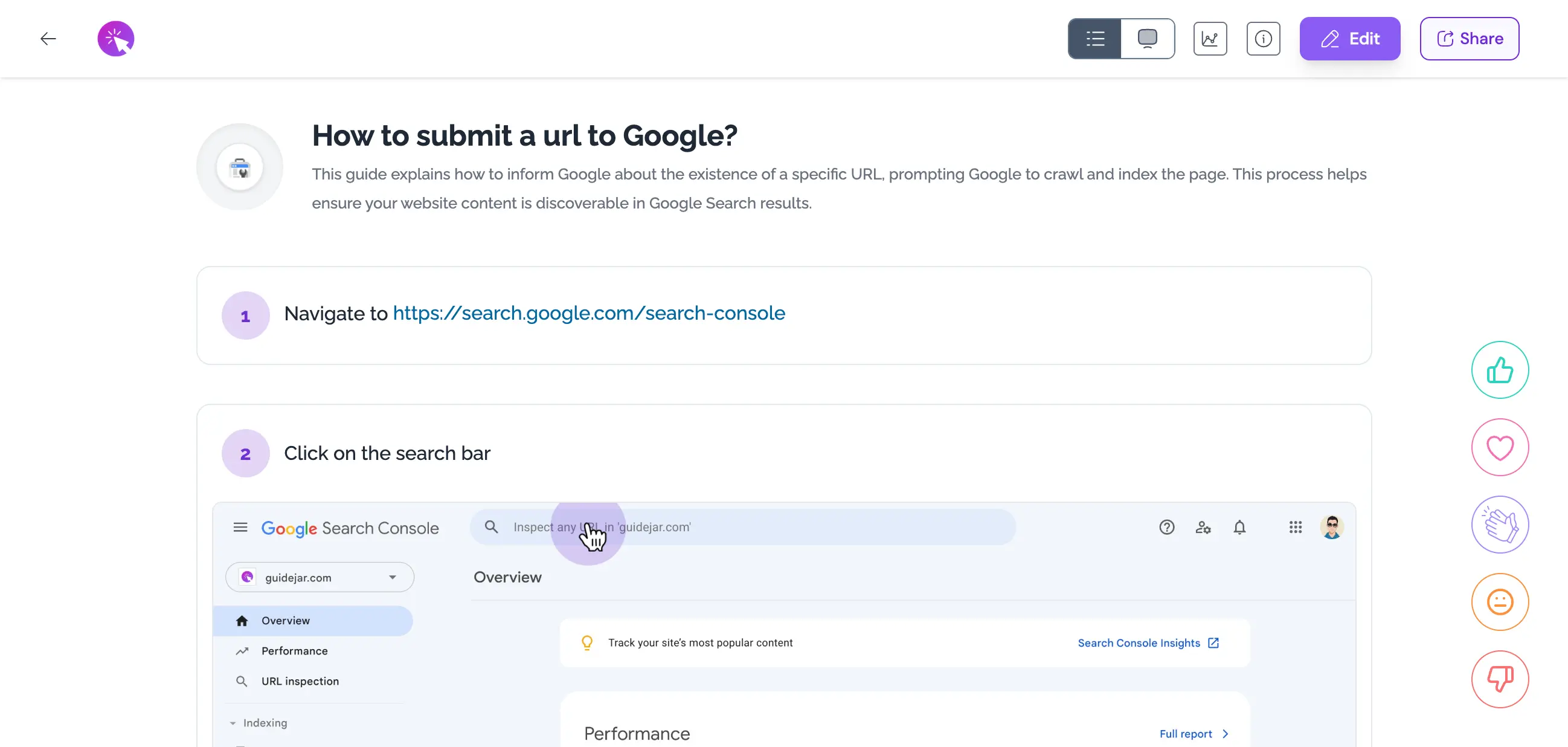
Guidejar takes one capture and publishes it as a Walkthrough View people click through with hotspots and branching, as a written Scroll View that reads like an SOP, or as an MP4 with AI voiceover. The whole library then lives in a searchable, branded help center at your own domain, and you can export all of it. Self-serve from $19 per seat billed monthly.
- One capture, published as a clickable walkthrough and a written Scroll View doc, chosen per guide
- Searchable branded help center on your own custom domain, with Ask AI
- Transparent self-serve pricing from $19 a seat, no annual contract or sales call
- Guidejar MCP: an AI agent builds your SOP library, and the team self-serves answers in ChatGPT or Claude, from the Plus plan
Starting at
$19/mo
per seat, billed monthly ($16 billed annually)
vs Supademo $50/creator/movs Consensus, quote-only
Try Guidejar freeOwn and export everything
Export as PDF, HTML, Markdown, or MP4, so your content is never locked to the platform
AI voiceover and 30+ languages
Narrate on the Pro plan and translate with one click, no Enterprise tier required
MP4 export on Plus
Turn any Walkthrough View into a downloadable video with AI voiceover baked in
Trusted by teams worldwide









How Guidejar stacks up
The rows that actually separate them, with the third column filled in.
| Capability | Supademo | Consensus | Guidejar |
|---|---|---|---|
| Interactive click-through output | Yes — guided demos | Yes — interactive tours | Yes — Walkthrough View, all plans |
| Written step-by-step document | Yes — Copy Steps, Free | No — hosted demos only | Yes — Scroll View, all plans |
| Branded help center on your domain | No — Showcase is a demo gallery | No — per-buyer landing pages | Yes — Plus plan |
| Self-serve, no sales call | Yes — self-serve from $38/creator | No — quoted contract, sales-gated | Yes — $19/seat self-serve |
| Entry paid price | $50/creator/mo — Scale | Quote-only | $19/seat/mo — Pro |
| Own & export your content | Per-demo export; bulk on Enterprise | No export — hosted only | PDF, HTML, Markdown, MP4 |
| MCP server purpose | Scale — edits & publishes demos | Early Access — searches & recommends demos | Plus — authors a docs library your team queries |
Switching to Guidejar
From either tool, most teams finish the move in 1–2 weeks.
- 1
Export what you have
Supademo lets you carry content out per demo: Copy Steps as HTML or text, PDF and PNG, MP4 or GIF, and a free SCORM wrapper, though bulk workspace export sits on Enterprise, so free, Scale, and Growth teams move demo by demo. Consensus is harder, with hosted interactive assets and no PDF, HTML, or MP4 export to take with you.
- 2
Import into Guidejar
Bring exported PDFs, Markdown, or existing screenshots straight in with our importer, with no all-time import cap. Anything captured live takes a couple of minutes to redo with our Chrome extension or desktop app.
- 3
Publish it properly
Choose Walkthrough View or Scroll View or both per guide, add AI voiceover, translate into 30+ languages, and put the whole library on a branded help center at your own domain.
“I'm super amazed by Guidejar's functionality.”
Mirza Iqbal, Entrepreneur
Frequently asked questions
The questions people actually search before picking one of the two.Something else on your mind? Talk to us
It depends on your size and how you sell. Supademo is the better pick for a mid-market or self-serve team: it has a free plan and a 14-day trial, costs $38 to $50 per creator, exports to SCORM and PDF, and you can buy it with a card. Consensus is the better pick for an enterprise selling complex software to buying committees, where Demolytics stakeholder analytics, Sandbox Tours, and a deep Salesforce and Outreach stack justify a sales-quoted enterprise contract. Neither publishes a written SOP or hosts a branded help center on your own domain, which is where Guidejar comes in.
No. Consensus has no free plan and no self-serve trial, and as of October 2026 it publishes no prices. Every purchase is gated behind a sales conversation for per-user licenses. You can try a sample demo on their site, but a real workspace needs a contract. Supademo, by contrast, has a free forever plan for one creator plus a 14-day trial on paid plans, and Guidejar has a 7-day free trial and self-serve checkout from $19 a seat.
Supademo is self-serve: a free plan, then Scale at $50 per creator monthly or $38 billed annually, Business at $249 a month or $199 billed annually for one creator (where HTML demos start), and Growth at $450 a month or $350 billed annually for five creators. Consensus is enterprise and no longer publishes prices: it sells per-user licenses plus optional usage-based add-ons, quoted by sales. Until July 2026 its page listed Starter at $600 a month for five users and Pro at $1,250 for ten, both billed annually, roughly $120 to $125 per user. Guidejar starts at $19 per seat billed monthly.
Supademo, by a wide margin. Its paid entry is $38 to $50 per creator, while Consensus quotes per-user licenses and last listed $600 a month for five users (July 2026), and Supademo adds a free plan and a trial that Consensus does not offer at all. Consensus is enterprise-priced on purpose, with third-party trackers reporting real contracts near a $45,750 median a year. If cost and self-serve access are what you are optimising for, Supademo wins it clearly, and Guidejar starts lower still at $19 per seat.
Supademo does, Consensus does not. Supademo offers a free SCORM 1.2 wrapper, with no account required, that reports completion, score, and session time to Cornerstone, Docebo, Moodle, and other systems. The honest caveat is that it wraps a hosted demo in an iframe rather than packaging a self-contained file, so the LMS module needs live access to Supademo. Consensus is a sales tool with no SCORM or LMS export. Guidejar has no SCORM support either, so if an LMS is central, Supademo is the pick here.
Demolytics is Consensus’s buyer-signal analytics: it tracks which stakeholder in a buying committee watched a demo, what they replayed, and who they forwarded it to internally, then surfaces hidden decision-makers and multi-threads the deal. It is the feature Consensus was built around. Supademo has real analytics, including viewer insights, lead tracking, and CRM sync from the Scale plan, but it reports on viewers and leads rather than a buying committee. Guidejar has no equivalent buyer-group layer.
Only in part. Supademo can export a written step-by-step guide through Copy Steps and its Steps view, but its hosted destinations are demo galleries, not an article-based help center. Consensus produces interactive demos and per-buyer landing pages with no written-doc export at all. Neither hosts a searchable, article-based knowledge base on your own domain. Guidejar publishes the same capture as both a clickable Walkthrough View and a written Scroll View, then puts the whole library on a branded help center at your own domain from the Plus plan.