Navattic vs Supademo in 30 seconds
These two are direct competitors, not opposites. Navattic leads with “Make buying easier with demos.” Supademo leads with “The AI demo platform for the full customer journey.” Both are no-code interactive product-demo platforms aimed at B2B go-to-market teams. Same job, same buyer.
What differs is depth against breadth. Navattic goes deep for revenue teams: its core is a high-fidelity HTML clone of your app, wired into HubSpot, Salesforce and Marketo with advanced analytics, A/B testing and account identification, plus autonomous agent demos, now sold separately as Navattic Agents, that run a live demo and answer questions on their own. Supademo spreads wider for less: a genuinely usable free plan, desktop capture on Mac and Windows, video splitting, translation into 50+ languages, an in-app Demo Hub, and free SCORM packaging for an LMS. Its own flagship HTML demos, though, start on its Business plan at $199/month billed annually for one creator, and sandbox demos need Growth at $350/month for five.
The buying experience splits them further. Navattic sells five-seat bundles, billed monthly or annually, with prices shown as animated digit-reels: Base is $600/month billed monthly or $500 billed annually. Supademo lists $50 a creator and lets you start with one seat. The full table and pricing math are below. There’s also a third option worth a look, since neither tool publishes the same capture as a written doc that lives in a searchable, branded help center on your own domain.
Four differences that decide it
Both capture a web app and turn it into a clickable interactive demo. From there, they diverge on fidelity, price, breadth, and seat model.
Capture & fidelity
HTML-clone fidelity vs a broader capture toolkit
Navattic’s Web Captures clone your app’s real HTML and CSS, so scroll and hover states behave like the live product, and that fidelity is central to every paid tier. Supademo captures screenshots and video by default and reserves its own front-end HTML clone for Business at $199/month billed annually, one creator, with sandbox demos on Growth at $350/month for five. Supademo counters with capture methods Navattic has no answer for: desktop apps on Mac and Windows, video splitting that turns an existing recording into a step-by-step demo, and a Figma plugin. Navattic goes deep on one capture method; Supademo spreads across many.
Pricing model
Per-creator pricing vs five-seat bundles
Supademo prints its price as plain numbers. Scale is $50 per creator billed monthly ($38 annually), the free plan is genuinely usable, and you can start with one seat. Navattic now offers monthly billing too, but it sells bundles: Base is $600/month billed monthly or $500 billed annually for five seats, Growth $1,200 or $1,000 for ten, and the pricing page renders those figures as animated digit-reels rather than static text. A one-seat Startup plan exists, but only for eligible seed-stage teams and without a displayed price. For a small team evaluating on a card, that one-seat start matters as much as the dollars.
Depth vs breadth
Depth for revenue teams vs reach for everyone else
Navattic is built for a sales-led motion. Its agent demos, sold separately as Navattic Agents, put an autonomous AI in front of the prospect to run a live demo and answer questions, and advanced analytics, A/B testing, account identification and native CRM connectors tie demo engagement to pipeline. Supademo trades some of that depth for reach: free SCORM 1.2 packaging for an LMS, an in-app searchable Demo Hub from Scale, translation into 50+ languages, and unlimited free view-only seats from Business up. If the demo has to feed a CRM, Navattic wins. If it also has to reach training, support and onboarding, Supademo covers more ground.
Seat model
Who pays for a seat, and how many you must buy
Navattic sells seats in bundles: five on Base, ten on Growth, so a three-person team still pays for five unless it qualifies for the Startup plan. Supademo bills only creators and admins, and view-only collaborators are free, though capped at five on Scale and unlimited from Business up. The free plan gets none. So Supademo is the friendlier shape for a small authoring team with a large read-only audience, while Navattic assumes you are buying for a whole GTM function up front.
Feature-by-feature comparison
Same job, different depth and different gating. Grouped and side by side.
| Capability | Navattic | Supademo |
|---|---|---|
| Capture | ||
| Browser capture | Yes — HTML web capture | Yes — free plan |
| Desktop capture | No — media upload only | Scale plan (Mac & Windows) |
| Turn an existing video into a demo | Not available | Yes — free plan (Video Splitting) |
| High-fidelity HTML / DOM clone | Yes — core Web Captures | Business plan |
| Sensitive-data redaction | Manual blur, hide, delete | Smart blur (Scale) |
| Import steps from PDF / DOCX | Not available | Not available |
| Interactive demo | ||
| Interactive branching | Yes — interactive demos | Scale plan |
| Chapters | Yes — via Flows | Yes — free plan |
| Dynamic variables | Base plan | Scale plan |
| Sandbox / live-environment demos | Growth plan | Growth plan |
| Autonomous AI demo agent | Navattic Agents — separately priced | AI Demo Agent — prepaid credits, Scale+ |
| AI voiceover | Startup plan | Scale plan |
| Voice / avatar cloning | Avatar cloning — Growth | Voice cloning — Growth |
| Multi-language translation | 35 languages — Growth | 50+ languages — Scale |
| Lead-capture forms | Base plan | Scale plan |
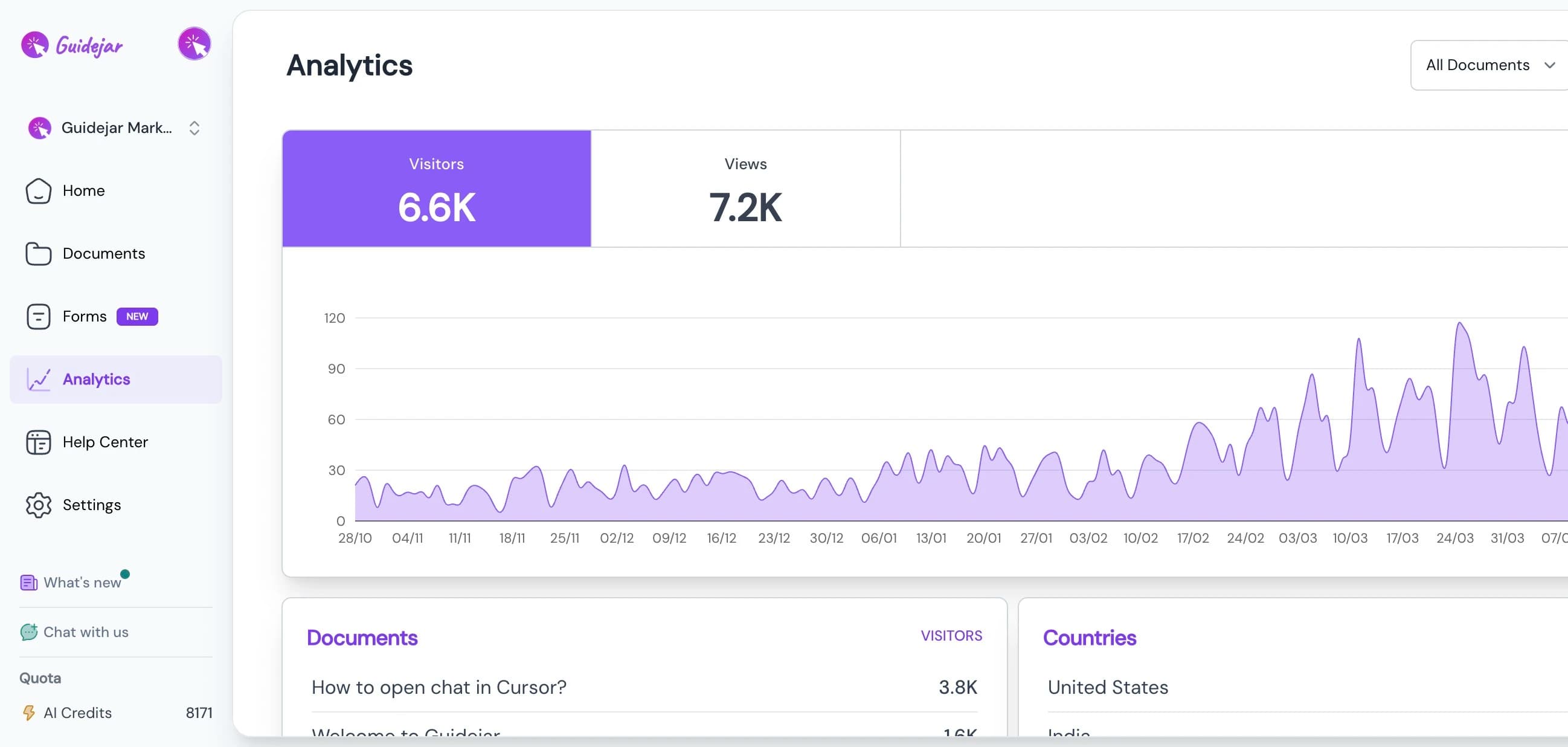
| Analytics | Basic free; advanced + A/B — Growth | Scale plan |
| Written output & exports | ||
| Written step-by-step document | PDF Document — ≤60 steps | Copy Steps & Steps view — free plan |
| Downloadable MP4 export | Yes — capped at 15 steps | Free at 1080p watermarked, 4K on Scale |
| PDF export | Yes — Document export | Yes — free plan (PDF & PNG) |
| HTML file export | Not available | Clipboard HTML only, no file |
| Markdown export | Not available | Not available |
| SCORM / LMS package | Not available | Yes — free, no account |
| Bulk export of workspace data | No — per-demo flat files only | Enterprise only |
| Publishing, AI & GTM | ||
| Hosted branded help center (articles) | No help center product | No — Showcase galleries, not an article KB |
| Custom domain | Growth plan | Scale plan |
| In-app guidance widget | In-app demo suggestions — Base | Demo Hub — Scale plan |
| MCP server (AI tool access) | Builds demos, reads analytics — Startup+ | Edits demos — Scale |
| Native CRM & GTM connectors | HubSpot, Salesforce, Marketo + more — Base | HubSpot, Salesforce, Marketo, Intercom + more — Scale |
| SAML SSO | Growth plan | Enterprise only |
| Pricing | ||
| Free plan | Starter — 1 demo, 1 seat, default theme | Free — 5 demos, watermarked |
| Entry paid plan (billed monthly) | $600/mo — Base, 5 seats | $50/creator — Scale |
| Entry paid plan (billed annually) | $500/mo — Base, 5 seats | $38/creator — Scale |
| Tier with HTML & sandbox demos | HTML from Base; sandbox on Growth ($1,000/mo annual) | HTML on Business ($199/mo annual); sandbox on Growth ($350/mo annual) |
| Seat model | Bundled 5 then 10; 1-seat Startup if eligible | Per creator; free view-only seats (5 on Scale, unlimited from Business) |
| Enterprise | Custom | Custom, from 10 creators |
Both build no-code interactive product demos, and both do it well, so the choice is depth versus breadth and what each plan gates. Navattic wins on HTML-clone fidelity as its core capture, advanced analytics with A/B testing and account identification, native CRM attribution, and autonomous agent demos through its separately priced Navattic Agents product. Supademo wins on price, a usable free plan, desktop capture, video splitting, 50+ language translation, and free SCORM packaging Navattic has no answer for. Navattic sells five- and ten-seat bundles shown as digit-reels; Supademo lists $50 a creator and starts at one seat. Both keep demos hosted, and neither publishes a written doc into a branded help center on your own domain — the gap the third option below fills.
Verified against both vendors’ public pricing and documentation, October 2026. Navattic’s plan prices come from its own pricing-page data; the page renders them as animated digit-reels, not static numbers. Spot something out of date? Tell us and we’ll correct it.
Pricing compared
Every number below states its billing interval. Mixing them is how comparisons mislead.
$600/mo
Navattic Base billed monthly for 5 seats — $500/mo billed annually; shown as digit-reels
$50/creator/mo
Supademo Scale billed monthly — $38 billed annually, listed on the page
$19/seat/mo
Guidejar Pro billed monthly — $16 billed annually
Bottom line: Supademo is the cheaper, more transparent way in. Scale is $50 per creator billed monthly ($38 annually), with a genuinely usable free plan below it. Navattic sells bundles: Base is $600/month billed monthly or $500 billed annually for five seats, shown as animated digit-reels, and a cheaper Startup plan for eligible seed-stage teams does not display its price. Depth costs on both sides, though. Supademo’s HTML demos start on Business at $199/month billed annually ($249 monthly) for one creator, its sandbox demos need Growth at $350/month for five ($450 monthly), and Navattic holds advanced analytics, A/B testing and custom domains on its ten-seat Growth tier. Five seats of Guidejar Business is $75/month billed monthly, or $59 billed annually, with voiceover and 30+ language translation already on the $19 Pro plan.
Prices as of October 2026. Navattic bundles 5 (Base) or 10 (Growth) seats, billed monthly or annually, with prices shown as digit-reels; Supademo bills per creator, with Business at $249/mo ($199 annually) for 1 creator and Growth at $450/mo ($350 annually) for 5; Guidejar Business bundles 5 seats.
Where each one genuinely wins
Neither tool is a strictly better version of the other. These are the real, checkable advantages.
Navattic: agent demos and a full GTM stack
Navattic’s agent demos, now sold as a separate Navattic Agents product, put an autonomous AI in front of the prospect. It interprets questions, understands intent, and navigates the product live instead of replaying a fixed path. Behind it sits a real revenue engine: native connectors to HubSpot, Salesforce and Marketo from Base, plus advanced analytics, A/B testing and account identification from Growth, all tying demo engagement to pipeline. Supademo’s AI Demo Agent runs on prepaid credits and is built for discovery and routing, and Supademo has no A/B testing. For a sales-led motion, this is Navattic’s territory.
Navattic: high-fidelity HTML capture as the core
Navattic’s Web Captures clone the real page markup, so scroll and hover states behave like the live product, and every element is editable in a no-code editor. That fidelity is central to every paid tier rather than an upsell. Supademo can clone front-end HTML too, but only from its Business plan ($199/month billed annually), and its sandbox demos wait for Growth. If a pixel-identical demo is your core capture method rather than an add-on, Navattic is built around it.
Supademo: free SCORM, video splitting, and a usable free plan
Supademo wraps any demo, or in fact any URL, as a SCORM 1.2 module reporting completion, score and session time back to Cornerstone, Docebo, Moodle or TalentLMS, and the tool is free with no sign-in. Its free plan is a real workspace, not a trial: 5 demos, video splitting to turn a recording into steps, and chapters. Navattic has no SCORM at all, and its Starter plan is a single published demo. One caveat: the SCORM package is an iframe wrapper, so it needs live access to Supademo and breaks if you cancel.
Supademo: transparency, breadth, and free viewer seats
Supademo lists plain per-creator prices from one seat, where Navattic sells five-seat bundles shown as digit-reels. It also covers more of the job at the entry paid tier: desktop capture on Mac and Windows, translation into 50+ languages, smart-blur redaction, and native connectors including Intercom and Seismic, all on Scale at $38 a creator annually. From Business up, view-only collaborators are unlimited and free. For a team watching budget and reach rather than deep CRM attribution, Supademo is the more forgiving buy.
Which tool is right for you?
Same job, different shape. Honest recommendations based on what your demos have to do.
Choose Navattic if
- You want autonomous agent demos (Navattic Agents) that run a live demo and answer a prospect’s questions in real time
- Demo engagement has to flow into HubSpot, Salesforce or Marketo with A/B testing and account identification behind it
- You need a high-fidelity HTML clone of your app as the core capture method on every paid tier
- A sandbox demo a prospect can freely explore, on Growth, is on your requirements list
- A deep sales-led GTM motion across the buyer journey is the core job, and a five- or ten-seat bundle is a fit
Choose Supademo if
- You want plain per-creator pricing from one seat rather than five-seat bundles behind digit-reels
- An LMS mandate is a hard requirement and you need free SCORM 1.2 packaging
- You record desktop apps, or want to turn an existing video into a demo with video splitting
- You have a large read-only audience and want unlimited free view-only seats from Business up
- You want breadth on a smaller budget: 50+ language translation, an in-app Demo Hub, and a usable free plan
Revenue teams that need depth pick Navattic. Teams that want breadth for less pick Supademo.
They compete for the same job, so the choice comes down to depth versus breadth and which pricing model you can live with: Navattic’s bundled, HTML-deep, CRM-wired stack, or Supademo’s per-creator, broader toolkit. Both keep the finished demos hosted behind links, embeds and galleries, and neither publishes the same capture as a written doc that lives in a searchable, branded help center on your own domain. That is the gap the third option below fills.
Both of them stop at the same place
Navattic and Supademo build good interactive demos, then keep them locked to links, embeds and hosted galleries. Neither publishes the same capture as a written doc that lives in a searchable, branded help center on your own domain. If your team is happy with that, either tool will serve you. If it isn’t, here’s the third option.
Guidejar
Guidejar takes one capture and publishes it as a Walkthrough View people click through with hotspots and branching, as a written Scroll View doc, or both per guide, then puts the whole library in a searchable branded help center at your own domain. Export any of it as MP4, PDF, HTML or Markdown, so you own the content instead of renting a hosted link. From $19/seat/mo billed monthly.
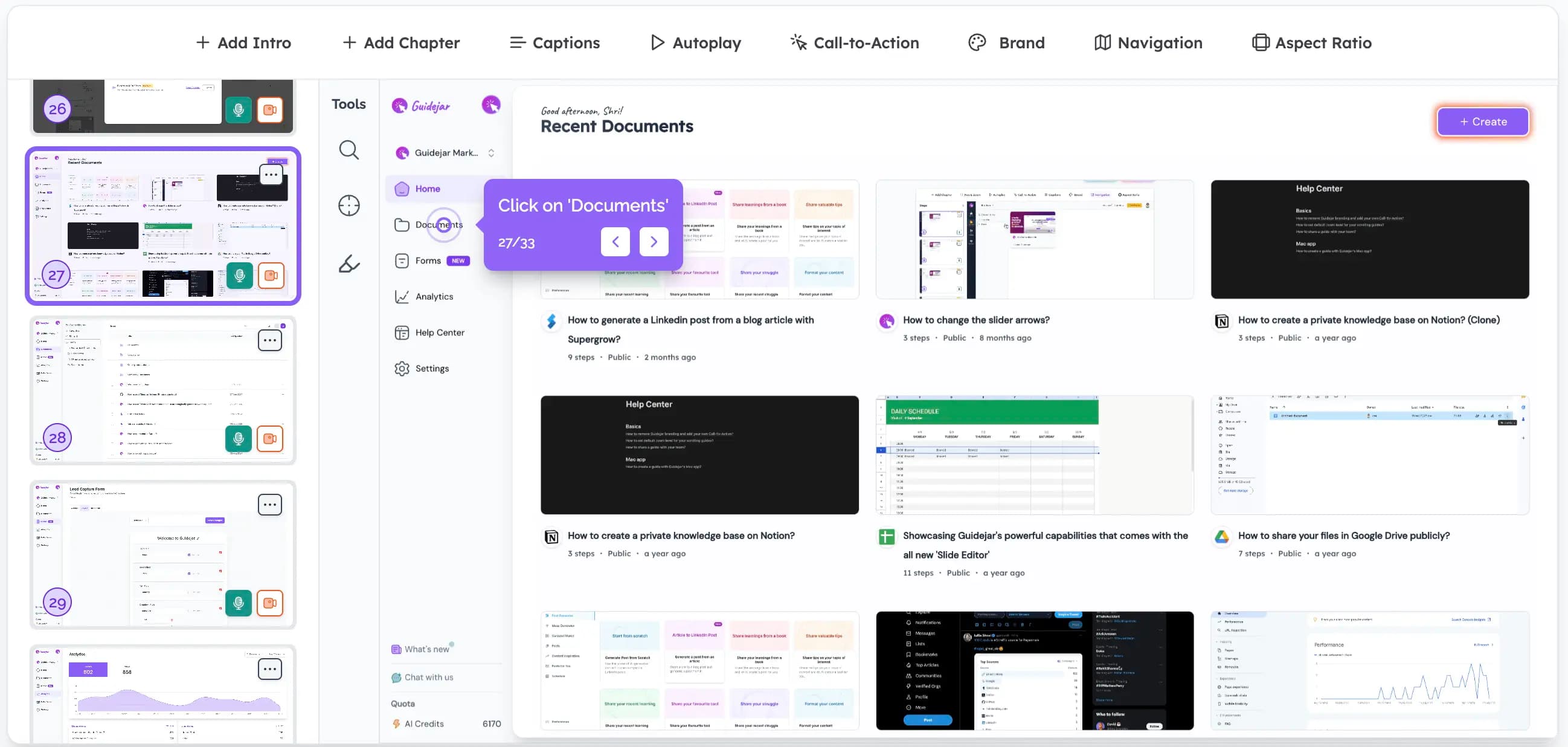
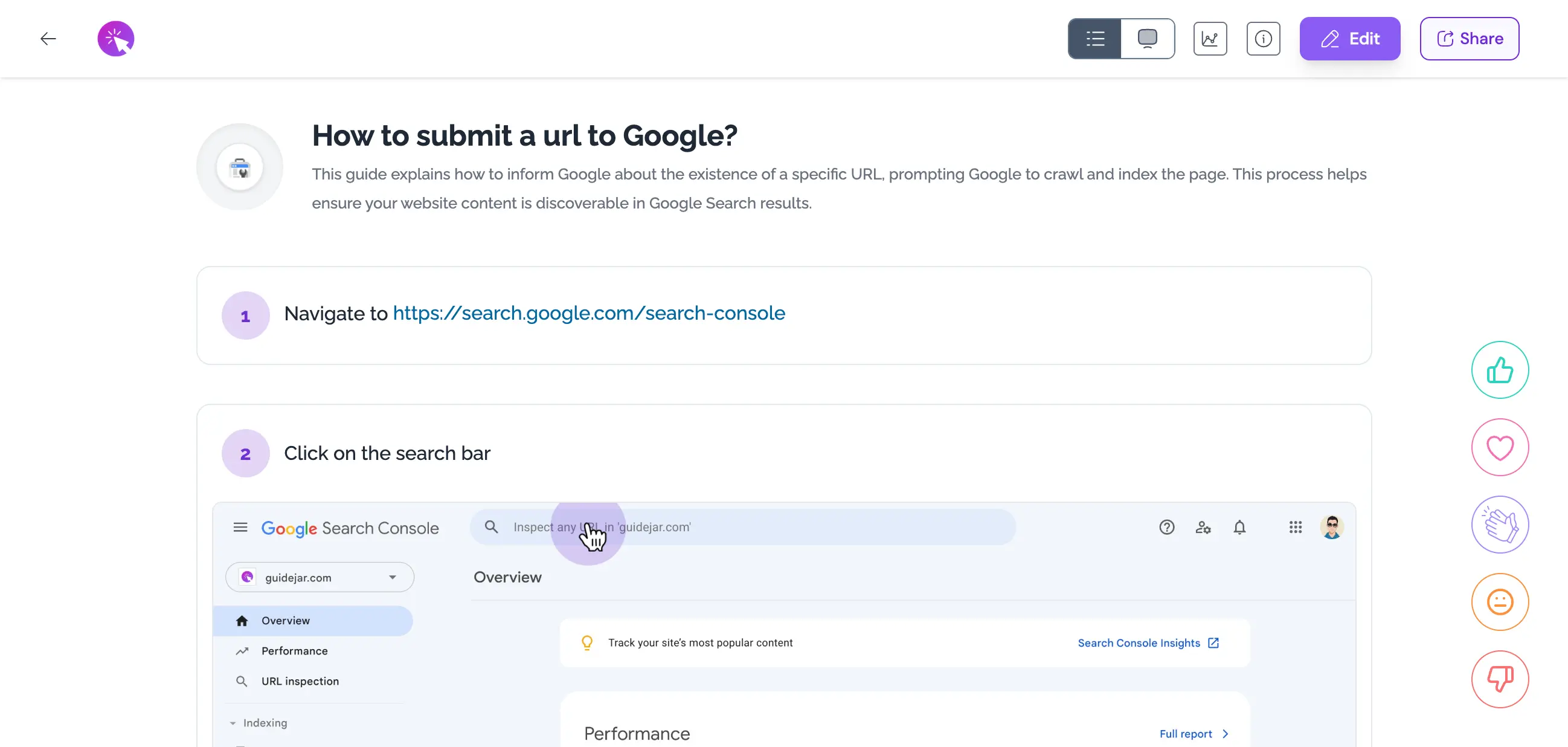
- One capture, published as a clickable Walkthrough View or a written Scroll View doc, chosen per guide
- Searchable branded help center on your own custom domain, with Ask AI
- Export as MP4, PDF, HTML or Markdown, so you own the content rather than a hosted-only link
- Guidejar MCP builds an SOP library from your docs and answers the team’s questions in ChatGPT or Claude, from the Plus plan
Starting at
$19/mo
per seat, billed monthly ($16 billed annually)
vs Navattic $600/mo Basevs Supademo $50/creator/mo
Try Guidejar freeAI voiceover from $19
Pick a voice on Pro and clone your own on Business, where both rivals hold cloning for Growth
Translate into 30+ languages
From the Pro plan, not a Growth bundle or a Navattic ten-seat tier
A price you can read
$19 a seat listed on the page, billed monthly, no annual lock-in and no seat minimum
Trusted by teams worldwide









How Guidejar stacks up
The rows that actually separate them, with the third column filled in.
| Capability | Navattic | Supademo | Guidejar |
|---|---|---|---|
| Interactive demo output | Yes — core Web Captures | Yes — HTML on Business, screenshots on Scale | Yes — Walkthrough View, Pro plan |
| Front-end HTML clone & sandbox demos | Yes — core capture | HTML on Business; sandbox on Growth | Not available |
| Written step-by-step document | PDF Document — static file, ≤60 steps | Copy Steps & Steps view | Yes — Scroll View, a live hosted page, all plans |
| Branded help center on your domain | No help center product | No — Showcase galleries, not an article KB | Yes — Plus plan |
| Export as MP4 / PDF / HTML / Markdown files | PDF, MP4, GIF, text — no HTML or Markdown | PDF, PNG, MP4 — HTML clipboard only | PDF, HTML, Markdown & MP4 files |
| SCORM / LMS package | Not available | Yes — free, no account | Not available |
| AI voiceover entry plan | Startup plan | Scale plan — $50/creator/mo | Pro — $19/seat/mo |
| MCP server purpose | Builds demos, reads analytics — Startup+ | Edits demos — Scale | Authors a docs library the team queries — Plus |
| Entry paid price | $600/mo — Base, 5 seats | $50/creator — Scale | $19/seat — Pro |
Switching to Guidejar
From either tool, most teams finish the move in 1–2 weeks.
- 1
Export what you have
Navattic exports a PDF Document (a screenshot and narration per step, up to 60), an MP4 capped at 15 steps, a GIF, and Copy as Text, with no HTML or Markdown. Supademo exports Copy Steps, PDF or PNG, and MP4 or GIF one demo at a time, and bulk workspace export is Enterprise-only.
- 2
Import into Guidejar
Turn those exported PDFs, videos, or existing screenshots into guides with our importer and AI Video-to-Guide Maker, in just a few clicks and with no all-time import cap. Anything interactive takes a couple of minutes to re-capture with our extension or desktop app.
- 3
Publish it properly
Choose Walkthrough View or Scroll View or both per guide, add AI voiceover, translate into 30+ languages, and put the whole library on a branded help center at your own domain.
“Truly revolutionized the way our team operates daily.”
Eduards Leimanis, Senior WordPress Developer
Frequently asked questions
The questions people actually search before picking one of the two.Something else on your mind? Talk to us
Neither, in the abstract. They compete for the same job, no-code interactive product demos, so it comes down to depth versus breadth and pricing model. Navattic wins if you need a sales-led motion: HTML-clone fidelity as the core capture, advanced analytics with A/B testing and account identification, native CRM attribution, and autonomous agent demos (sold separately as Navattic Agents). Supademo wins if you want breadth for less: a listed monthly price, a usable free plan, desktop capture, video splitting, 50+ language translation, and free SCORM packaging. Neither hosts a branded article help center on your own domain, which is where Guidejar comes in.
Supademo lists its price: Scale is $50 per creator billed monthly, or $38 billed annually; the newer Business plan, where HTML demos start, is $249/month or $199 billed annually for one creator; and Growth is $450/month, or $350 billed annually, for five bundled creators. Navattic shows its prices as animated digit-reels and now bills monthly or annually: Base is $600/month billed monthly or $500 billed annually for five seats, and Growth $1,200 or $1,000 for ten. A Startup plan for eligible seed-stage teams does not display its price. Guidejar Pro is $19 a seat monthly ($16 annually), listed on the page.
Supademo, clearly. Its free plan is a real workspace: 5 guided interactive demos, 50 screen and camera recordings, video splitting, chapters, and export as link, embed, PDF, PNG or MP4, with the MP4 watermarked at 1080p. Navattic’s free Starter plan is an evaluation, not a workspace: one published demo, one seat, and the default theme only, with custom branding and integrations starting on the paid Base tier. Guidejar’s free plan is 5 guides for 1 user with browser capture, sharing, embedding and PDF export, with a Guidejar watermark until you move to Pro.
Supademo does; Navattic doesn’t. Supademo runs a free browser-based generator that wraps a demo link or iframe in a SCORM 1.2 package for Cornerstone, Docebo, Moodle, TalentLMS, SCORM Cloud, LearnDash, Litmos and Absorb, reporting completion, score and session time, with no plan or sign-in required. Navattic exports only PDF, MP4, GIF and text, so there is no LMS package at all. One caveat on the Supademo side: the SCORM file wraps an iframe rather than bundling the content, so the module needs live access to Supademo and breaks if the account goes away. Guidejar has no SCORM support either.
Supademo does, natively. It ships Mac and Windows desktop apps on the Scale plan that record desktop software, code editors and mobile emulators. Navattic has no native desktop screen recorder: desktop and mobile apps are demoed through Media Captures, meaning uploaded images, GIFs or video rather than a live recording. If capturing a desktop app is on your list, Supademo does it directly. Guidejar includes desktop capture on its Plus plan.
Both do, with real native connectors rather than clipboard tricks. Navattic connects HubSpot, Salesforce, Marketo, Pardot, Segment, Slack and ZoomInfo from Base, and adds A/B testing, account identification and CRM attribution on Growth. Supademo connects HubSpot, Salesforce, Marketo, Intercom, Seismic, Slack, Zapier, Google Analytics and webhooks from Scale, syncing identified viewers back as leads. Navattic goes deeper on pipeline attribution; Supademo offers a broad connector set at a lower entry tier.
Not as an article-based one. Navattic has no hosted help center anywhere in its product lineup, pricing matrix or docs, and shares demos only by link, embed or its JavaScript. Supademo has no article knowledge base either; its nearest surfaces are Showcase Collections, a themeable custom-domain gallery of demos and videos, and the in-app Demo Hub. Both are demo galleries, not a searchable article CMS, and their own docs tell you to embed into a knowledge base you already run. Guidejar publishes the same capture as a written guide inside a branded, searchable help center on your own domain from Plus, with Ask AI answering from your content on Business.