Tango vs iorad in 30 seconds
These two are direct competitors, not opposites. Tango leads with “The person everyone asks just got backup.” iorad leads with “Your tools are ready. Your team isn’t.” Both aim at internal SOPs, software adoption, and training. Neither is a product-demo tool. Same job, same buyer.
What differs is how they train. Tango produces a screenshot SOP, then delivers guidance live on the app. Guide Me overlays an on-screen walkthrough that runs inside the real software, and sending one takes the Pro plan. iorad turns one capture into six learning modes (Watch, Try, Scroll, Slide, Quiz, and Do), and the learner picks how to consume it. Its Quiz and Try modes make people perform the correct on-screen action to advance, which is assessment, not just documentation. So the question is whether you want to guide people through the live tool, or test that they actually learned it.
Then there is price, and the two could hardly be further apart. Tango is per-seat and cheap to start: Pro Team is $20/user billed monthly. iorad is a flat platform fee with a high floor: $200/month for a single creator, and $500/month before you can export or brand anything. Both push their headline features to a top tier. The full table and pricing math are below. There is also a third option worth a look, since neither tool hosts a branded help center on your own domain, and both keep their MCP server in an Enterprise-only beta.
Four differences that decide it
Both capture a workflow and both produce a step-by-step tutorial. From there, they train, price, and gate very differently.
Training style
Guide them through the app vs test that they learned it
This is the core split. Tango turns a capture into a clean, annotated screenshot SOP, then adds Guide Me, an on-screen walkthrough that runs on top of the live app so people follow along in the real software. iorad renders the same capture into six modes at once: Watch (video), Scroll (a step list), Slide, Try and Do (the learner performs the steps in a safe simulation or on the real app), and Quiz (the learner must take the correct on-screen action to advance). Tango is about adoption in the moment. iorad is about assessment, proving the person can actually do the task.
Pricing model
Cheap per seat vs a high flat platform fee
The two price on opposite models. Tango charges per seat: Pro Team is $20/user billed monthly ($15 annually) once you have three or more, or $26 for one to two users. iorad charges a flat platform fee: $200/month buys a single creator, and the Team plan is $500/month plus $50 for each extra seat. iorad throws in unlimited learners at every tier, so a training org with few authors and an enormous audience gets predictable costs. But for a small team, Tango is a fraction of the price, and iorad’s floor is steep before you have exported a thing.
What each plan gates
The features in each pitch live behind the top tier
Read past the sticker price and both tools reserve their headline work for the top of the ladder. Tango keeps multi-path branching, translation into 15 languages, SSO with SCIM, automatic Secure Blur redaction, and a beta MCP server on custom-quote Enterprise. iorad is stricter about exports than almost anyone: there is no export at all on Free or Individual, MP4, Word, and GIF arrive only on the $500 Team plan, and HTML, SharePoint, SCORM, and 100-plus-language translation are Enterprise. On both, the self-serve tier is capture, view, and light sharing.
Where guidance lives
A live overlay from Pro vs a hosted player and library
Tango pushes guidance into the software itself. Guide Me runs a walkthrough on the live app (sending one takes Pro), and Enterprise adds persistent Pins, Nuggets, and Automations anchored inside Salesforce, Workday, or ServiceNow, which is real digital-adoption-platform territory. iorad delivers through its own hosted player, which is free but public on the free plan, then adds Widget and Extension Libraries that surface tutorials inside your app on Team, and a true in-app overlay, Live Guidance, only on Enterprise, where it is still marked beta. If live in-app guidance is the job, Tango does it on plans a small team can actually buy.
Feature-by-feature comparison
Same job, different training style and very different pricing. Grouped and side by side.
| Capability | Tango | iorad |
|---|---|---|
| Capture | ||
| Browser capture | Yes — all plans | Yes — all plans |
| Desktop capture | Pro plans | Yes — free plan |
| Sensitive data redaction | Manual blur — Pro; auto Secure Blur — Enterprise | Mask Data — Individual+, one-way edit |
| Output | ||
| Written step-by-step document | Yes — the core output | Yes — Scroll mode, all plans |
| Video playback | Auto-updating video embed — Pro plans | Yes — Watch mode, all plans |
| Downloadable MP4 file | No — auto-updating embed, not a file | Team+ plan |
| AI text-to-voice narration | Pro — two AI voices, on video embeds | Individual+; neural voices on Team+ |
| Record your own voiceover | Not available | Individual+ |
| AI voice cloning | Not available | Not available |
| Interactive try-it / practice mode | Not available | Try & Do modes — all plans |
| Knowledge check / quiz | Not available | Quiz mode — all plans |
| Interactive branching | Enterprise — multi-path workflows | Not available |
| Chapters | Not available | Not available |
| Dynamic variables | Not available | Not available |
| Multi-language translation | Enterprise only — 15 languages | Enterprise only — 100+ languages |
| Import & export | ||
| Video-to-guide import | Not available | Not available |
| PDF export | Pro plans | Individual+ |
| Word / Google Docs export | Not available | Team+ plan |
| HTML export | Pro plans | Enterprise only |
| Markdown export | Pro plans | Not available |
| SCORM / LMS package | Not available | Enterprise — SCORM 1.2 |
| Publish-to-KB connectors | Rich paste or embed — Pro plans | ~40+ real connectors — free plan |
| Publishing, AI & security | ||
| Hosted branded help center | No — link, embed, or export only | Web Library — Team+, capped at 10 |
| Custom domain | Not available | Not available |
| In-app contextual delivery | Guide Me sending Pro+; Pins & Nuggets on Enterprise | Widget/Extension Libraries — Team+; Live Guidance — Enterprise, beta |
| Help center AI answers | Not available | Team+ — the Librarian, beta |
| MCP server (AI tool access) | Enterprise only — Beta | Enterprise only — beta |
| Lead-capture forms | Not available | Not available |
| SAML SSO + SCIM | Enterprise | Team+ |
| Analytics | Viewership on Pro; org-wide on Enterprise | Dashboard on Individual+; Analytics on Team+ |
| Pricing | ||
| Free plan | 5 workflows, no export, Tango-branded | Unlimited public tutorials, no privacy, no export |
| Entry paid plan (billed monthly) | $26/user — Pro Personal (1–2) | $200/mo — Individual, 1 creator |
| Team plan (billed monthly) | $20/user — Pro Team, from 3 seats | $500/mo — Team, +$50/mo per extra seat |
| Team plan (billed annually) | $15/user — Pro Team | ~$458/mo — Team, one month free |
| Charges for viewers / learners | Every workspace user is a paid seat below Enterprise | No — unlimited learners, creator-only pricing |
| Enterprise | Custom — platform fee by user count | Custom — 20+ creators |
Both tools capture a workflow and hand you a step-by-step tutorial, so that part is a tie. Tango wins on delivery and price: Guide Me overlays run on the live app from the Pro plan, and per-seat pricing starts far below iorad. iorad wins on pedagogy and packaging: Quiz and Try modes test that people actually learned the task, one capture yields six modes, and it exports SCORM 1.2 for an LMS, which Tango cannot. The gap in cost is stark. A five-person team is $100/month on Tango Pro Team billed monthly, against $700/month on iorad Team. And both leave the same two things on the table: no branded help center on your own domain, and no MCP server outside an Enterprise-only beta.
Verified against both vendors’ public pricing and documentation, July 2026; re-checked October 2026. Spot something out of date? Tell us and we’ll correct it.
Pricing compared
Every number below states its billing interval. Mixing them is how comparisons mislead.
$20/user/mo
Tango Pro Team (3+) billed monthly — $15/user/mo billed annually; $26 for 1–2 users
$200/mo
iorad Individual, one creator — Team is $500/mo, +$50/mo per extra seat
$19/seat/mo
Guidejar Pro billed monthly — $16/seat/mo billed annually
Bottom line: Tango is dramatically cheaper for almost any team. A five-person team billed monthly is $100 on Tango Pro Team against $700 on iorad Team, and a single creator is $26 on Tango against iorad’s $200. iorad’s flat fee only starts to make sense for a large L&D org with a handful of authors and an enormous learner base, since extra iorad seats are just $50 and learners are free at every tier. But you cannot export or brand anything on iorad until the $500 plan, and Tango’s branching, translation, SSO, and automatic redaction all sit on custom-quote Enterprise. Five seats of Guidejar Business is $75/month billed monthly, or $59/month billed annually, with MP4, AI voiceover, 30-plus-language translation, and a branded help center on your own domain included.
Prices as of October 2026. Tango Pro Team needs 3+ seats; iorad Team includes one seat plus $50 per extra; Guidejar Business bundles 5.
Where each one genuinely wins
Neither tool is a strictly better version of the other. These are the real, checkable advantages.
Tango: in-app guidance without an Enterprise contract
Guide Me overlays a step-by-step walkthrough directly on the live app; sending one takes Pro, and anyone in the workspace can follow it. Enterprise adds persistent Pins, Nuggets, and Automations anchored inside Salesforce, Workday, and HubSpot. This is genuine digital-adoption-platform territory, the kind of thing WalkMe and Whatfix charge for. iorad’s equivalent, Live Guidance, is Enterprise only and still marked beta, so Tango puts live guidance on plans an ordinary team can afford.
Tango: governance depth, and a far cheaper start
Tango is built for IT and security buyers: SSO with SCIM, central extension deployment through Active Directory or Google Identity, 365-day version history, and audit logs, with named customers like Lockheed Martin, Salesforce, and Rockwell. It is also the cheaper way in by a wide margin. Pro Team is $15/user/mo billed annually, so a small team spends less in a year than iorad charges in a month.
iorad: six learning modes with real assessment
One iorad capture becomes Watch, Try, Scroll, Slide, Quiz, and Do, and the learner chooses how to consume it, all on the free plan. Quiz mode makes the learner take the correct on-screen action to advance, and Try and Do build muscle memory in a simulation or on the real app. If “did they actually learn it” is a requirement, iorad is purpose-built for it. Neither Tango nor Guidejar has any quiz or scored practice at all.
iorad: SCORM export and a deep connector bench
iorad Enterprise produces SCORM 1.2, HTML, and SharePoint packages you can self-host in Cornerstone, Docebo, or Moodle, and its roughly 40 integrations are mostly real authenticated connectors that publish finished articles into Zendesk, Salesforce Knowledge, Guru, Confluence, and a long LMS roster. Tango works on top of those apps as an overlay but ships no data connectors, and Guidejar has no SCORM at any tier. For a regulated or LMS-driven buyer, that can be the whole decision.
Which tool is right for you?
Same job, different shape. Honest recommendations based on how your team actually trains.
Choose Tango if
- Your job is internal software adoption at scale, and in-app Guide Me overlays on the live app matter more than quizzes or exports
- You want IT-grade governance: SSO, SCIM, central extension deployment, audit logs, and 365-day version history
- Your teams live inside Salesforce, Workday, or ServiceNow and you want persistent Pins and Nuggets anchored there on Enterprise
- Budget is real: Pro Team is $15/user/mo billed annually, a fraction of iorad’s $200 floor
- A screenshot SOP plus a live guided overlay is the shape of training you need, and scored assessment is not a requirement
Choose iorad if
- You need assessment, not just documentation: Quiz mode makes learners perform the correct on-screen action, and Try and Do build practice
- You need SCORM 1.2 or self-hosted HTML packages to drop into Cornerstone, Docebo, Moodle, or SharePoint
- Your audience is enormous relative to your author count, since learners are free and unlimited at every tier
- You publish into an existing helpdesk or LMS, and want real connectors into Zendesk, Salesforce Knowledge, Guru, Canvas, or Litmos
- You document native desktop software and want to trial it before paying, since desktop capture is on the free plan
Enterprise adoption teams that want live in-app guidance pick Tango. L&D teams that need assessment and SCORM pick iorad.
They compete for the same training job, so the choice comes down to method and money: adoption in the moment with Tango’s Guide Me, or assessment and LMS packaging with iorad’s Quiz and SCORM, at a fraction of the price on Tango or a steep floor on iorad. Both push their headline features to a top tier. And neither one hosts your library on a branded help center at your own domain, or lets an AI agent work with it outside an Enterprise-only beta. That is the gap the third option below fills.
Both of them stop at the same two places
Tango reserves branching, translation, and SSO for Enterprise; iorad hides every export and library behind its $500 Team plan. And neither puts your guides on a help center at your own domain, and both keep their MCP server in an Enterprise-only beta. If that fits your team, either tool will serve you. If it does not, here is the third option.
Guidejar
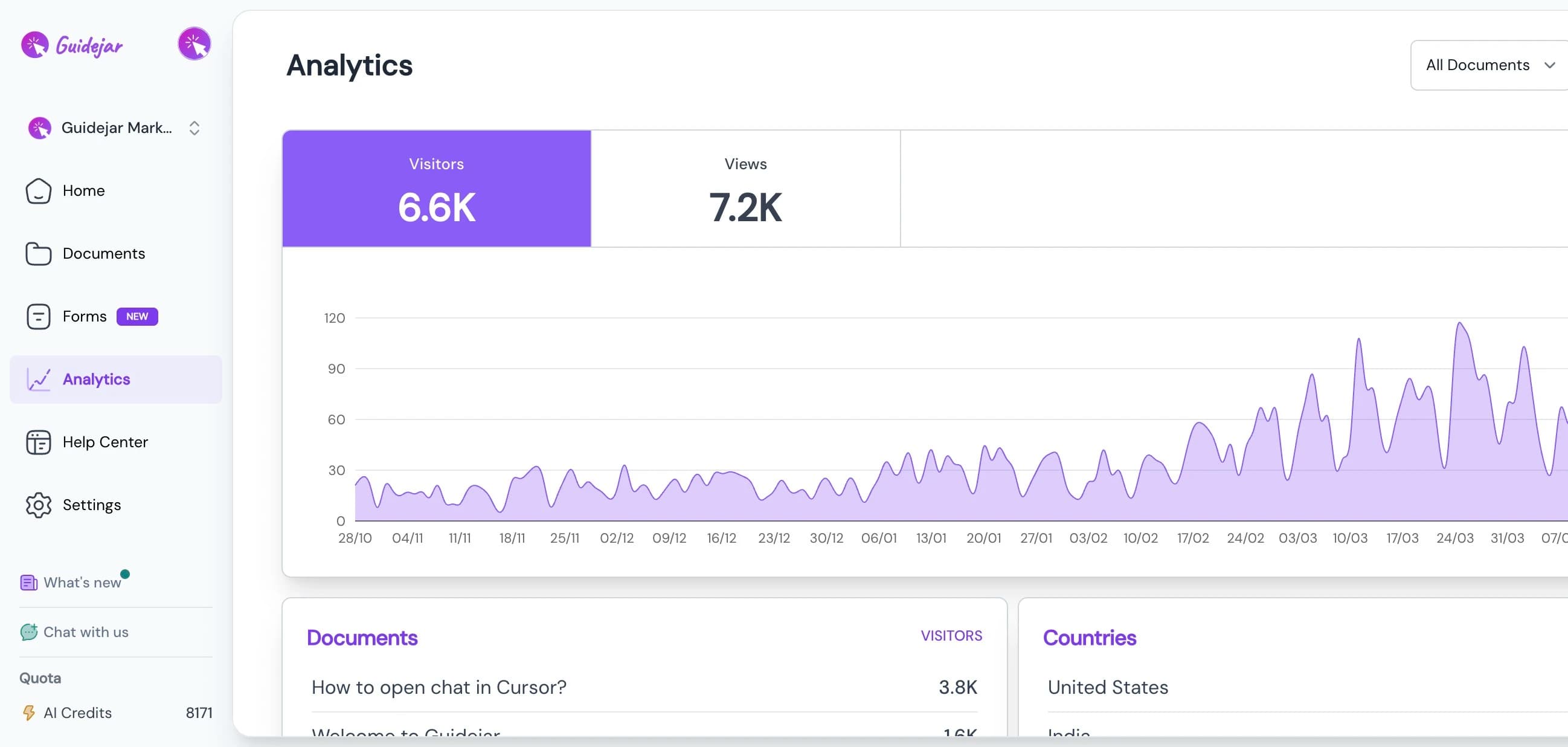
Guidejar takes one capture and publishes it as a Scroll View written SOP, as a Walkthrough View people click through with hotspots and branching, or as an MP4 export with AI voiceover. The whole library then lives in a searchable, branded help center at your own domain, and an AI agent can build and answer from it over MCP. From $19/seat/mo billed monthly.
- One capture, published as a written SOP or a clickable walkthrough, chosen per guide
- MP4 export on the Plus plan, with AI voiceover from the Pro plan
- Searchable branded help center on your own custom domain, with Ask AI
- Guidejar MCP lets an AI agent build your SOP library and your whole team self-serve answers from ChatGPT or Claude, on the Plus plan
Starting at
$19/mo
per seat, billed monthly ($16 billed annually)
vs Tango $20/user/movs iorad $200/mo
Try Guidejar freeAI voiceover from $19
Per-step voiceover with a voice you pick on Pro, baked into a downloadable MP4 on Plus, and your own cloned voice on Business
Translate into 30+ languages
From the Pro plan, not a custom Enterprise contract
Own your help center
Put the whole library on your own custom domain, something neither tool offers at any tier
Trusted by teams worldwide










How Guidejar stacks up
The rows that actually separate them, with the third column filled in.
| Capability | Tango | iorad | Guidejar |
|---|---|---|---|
| Written step-by-step document | Yes — the core output | Yes — Scroll mode, all plans | Yes — Scroll View, all plans |
| Downloadable MP4 export | No — auto-updating embed, not a file | Team+ — $500/mo | Yes — Plus plan |
| Branded help center on your domain | No — link, embed, or export | Web Library, but no custom domain | Yes — Plus plan, your own domain |
| Knowledge check / quiz | Not available | Yes — Quiz mode, all plans | Not available |
| AI voiceover entry plan | Pro — two voices, embed only | Individual — $200/mo | Pro — $19/seat/mo billed monthly |
| In-app contextual guidance | Guide Me — sending from Pro | Live Guidance — Enterprise, beta | Help Center Widget — Plus, popover not live overlay |
| Multi-language translation | Enterprise only — 15 languages | Enterprise only — 100+ languages | Pro plan — 30+ languages |
| MCP server | Enterprise only — Beta | Enterprise only — beta | Plus, $25 — full read and write |
| Entry paid price (billed monthly) | $20/user — Pro Team, 3+ seats | $200 — Individual, 1 creator | $19/seat — Pro |
Switching to Guidejar
From either tool, most teams finish the move in 1–2 weeks.
- 1
Export what you have
Tango exports PDF, HTML, and Markdown on Pro, and nothing at all on its free plan, where guides are locked to link and embed. iorad is stricter still: real exports start at its $500 Team tier, and Free and Individual give you only a learner-side one-click PDF.
- 2
Import into Guidejar
Turn exported PDFs, Markdown docs, or existing screenshots into guides with our importer, with no all-time import cap. Anything else takes a couple of minutes to re-capture with our extension or desktop app.
- 3
Publish it properly
Choose Scroll View or Walkthrough View or both per guide, add AI voiceover, translate into 30+ languages, and put the whole library on a branded help center at your own domain.
“Very easy to use and works wonderfully!”
Jas, Founder
Frequently asked questions
The questions people actually search before picking one of the two.Something else on your mind? Talk to us
Neither, in the abstract. They compete for the same job, internal SOPs and software training, so it comes down to method and budget. Tango wins if you want guidance delivered live on the app, since Guide Me overlays a walkthrough on the real software from the Pro plan, and it is far cheaper per seat. iorad wins if you need assessment, since Quiz mode makes learners perform the correct on-screen action and Try and Do modes build practice, and it exports SCORM for an LMS. Neither hosts a branded help center on your own domain, and both keep MCP in an Enterprise-only beta, which is where Guidejar comes in.
iorad is a flat platform fee, not a per-seat price. Individual is $200/month for a single creator, Team is $500/month plus $50 for each extra seat, and Enterprise is a custom quote. The catch is that there is no export or custom branding at all until the $500 Team plan. In return you get unlimited learners at every tier, so the model rewards a large audience with few authors. Tango is much cheaper to start at $15 to $26 per user per month, and Guidejar starts at $19/seat/mo billed monthly.
Yes, in a limited form. On Pro, Tango’s Video Embeds can carry optional AI narration generated from your step titles and descriptions, with a choice of two AI voices. It plays inside the embed, with no downloadable MP4 and no voice cloning. Voice Transcription is separate: it turns your speech into step text during capture. iorad has more audio options: text-to-speech and your own recorded voiceover from Individual, and neural voices from Amazon and Google on Team. Guidejar includes per-step AI voiceover on its Pro plan at $19/seat/mo billed monthly, bakes it into a downloadable MP4 on Plus, and adds voice cloning on Business.
Yes, on Enterprise. iorad’s Advanced Exports produce SCORM 1.2, HTML, and SharePoint packages you can self-host in an LMS like Cornerstone, Docebo, or Moodle. It is a genuine strength for a regulated or LMS-driven training team. Tango has no SCORM or LMS package export at any tier, and neither does Guidejar, so if SCORM is a hard requirement, iorad is the pick here.
Yes, and it is Tango’s real differentiator. Guide Me sends an on-screen guided walkthrough that runs on top of the live app; sending one takes Pro, and anyone in the workspace can follow it. Enterprise adds persistent Pins, Nuggets, and Automations anchored inside tools like Salesforce and Workday, which is genuine WalkMe and Whatfix digital-adoption territory. iorad’s equivalent live overlay, Live Guidance, is Enterprise only and still in beta. Guidejar’s Help Center Widget surfaces guides inside a web app too, but it is a popover launcher, not a live overlay on the UI.
Tango, by a wide margin, for almost any team. Pro Team is $20/user/mo billed monthly ($15 annually) for three or more seats, so a five-person team is $100/month, against $700/month on iorad Team once you add the $50 seats. A single creator is $26 on Tango and $200 on iorad. iorad only pulls level for a large org with few authors and a huge learner base, since its learners are free. Both keep their headline features on a top tier. Guidejar starts at $19/seat/mo billed monthly, with Business bundling five seats for $75/month.
Only iorad. Its Quiz mode requires the learner to perform the correct on-screen action to advance, and Try and Do modes let them practice the steps in a simulation or on the real app, all on the free plan. Tango has no quiz, assessment, or scoring anywhere in its product. Guidejar has no scored quiz either, so if testing that people learned the task is central to your training, iorad is genuinely purpose-built for it and the other two are not.
Neither runs on your own domain. Tango shares by link, embed, or export and has no help-center product. iorad has a hosted Web Library on Team, but it lives on iorad.com with theme-and-logo branding only, and there is no custom-domain option at any tier. Both now have an MCP server, but only on Enterprise and labelled beta: iorad’s searches and answers from your tutorials and pulls analytics, and Tango hasn’t published what its covers. Guidejar puts a searchable, branded help center on your own domain from the Plus plan, and on the same $25 plan its MCP server lets an agent build the library and your team self-serve answers from ChatGPT or Claude.