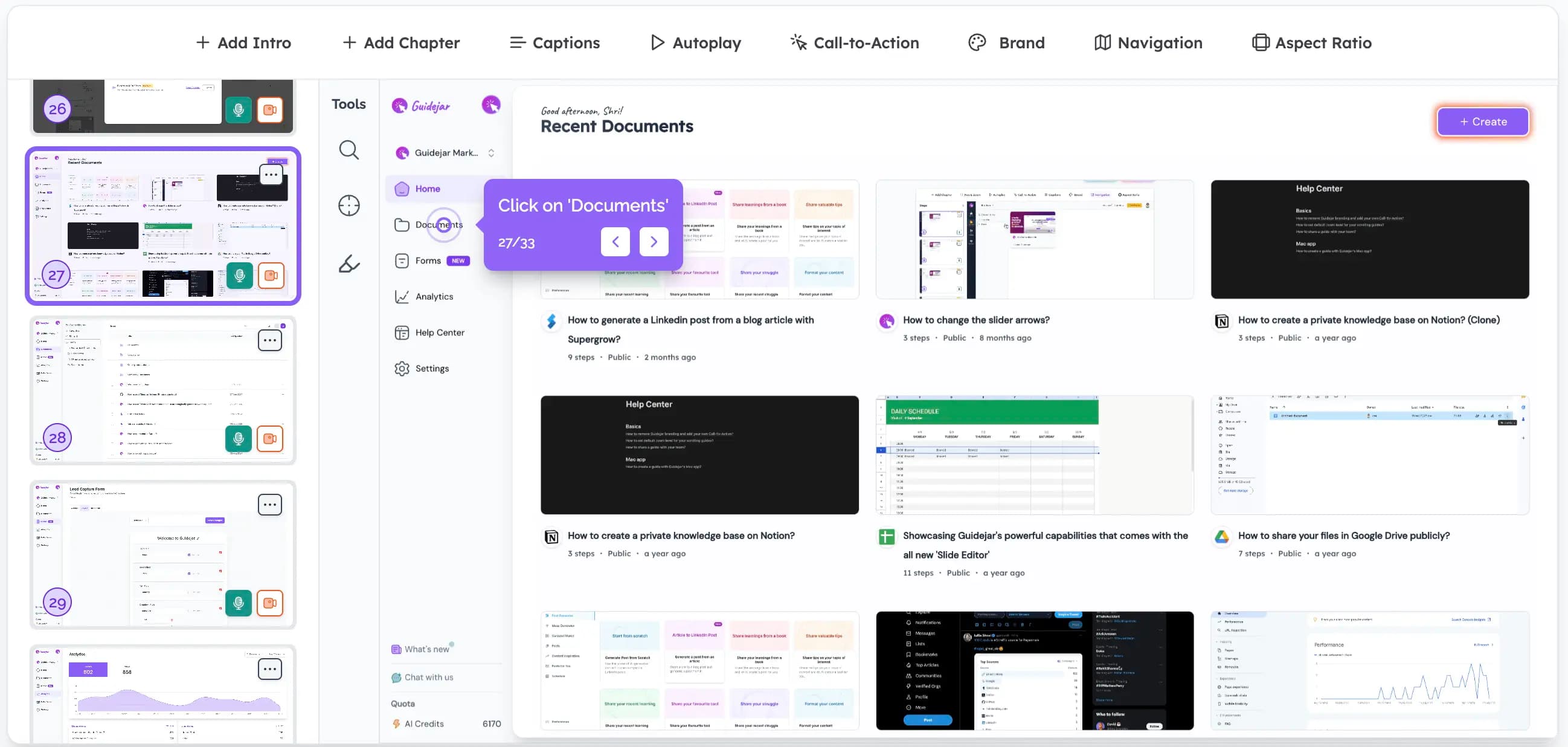
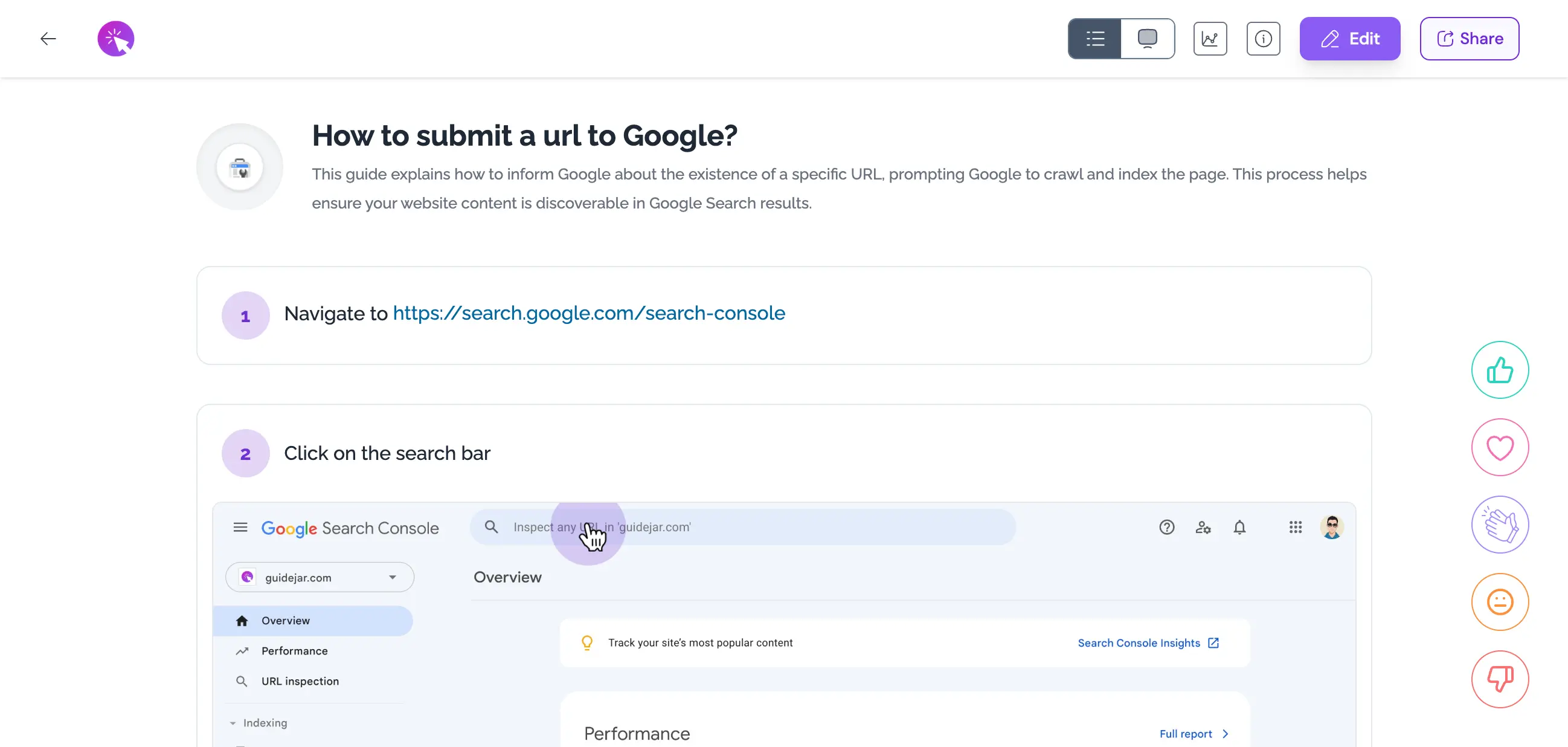
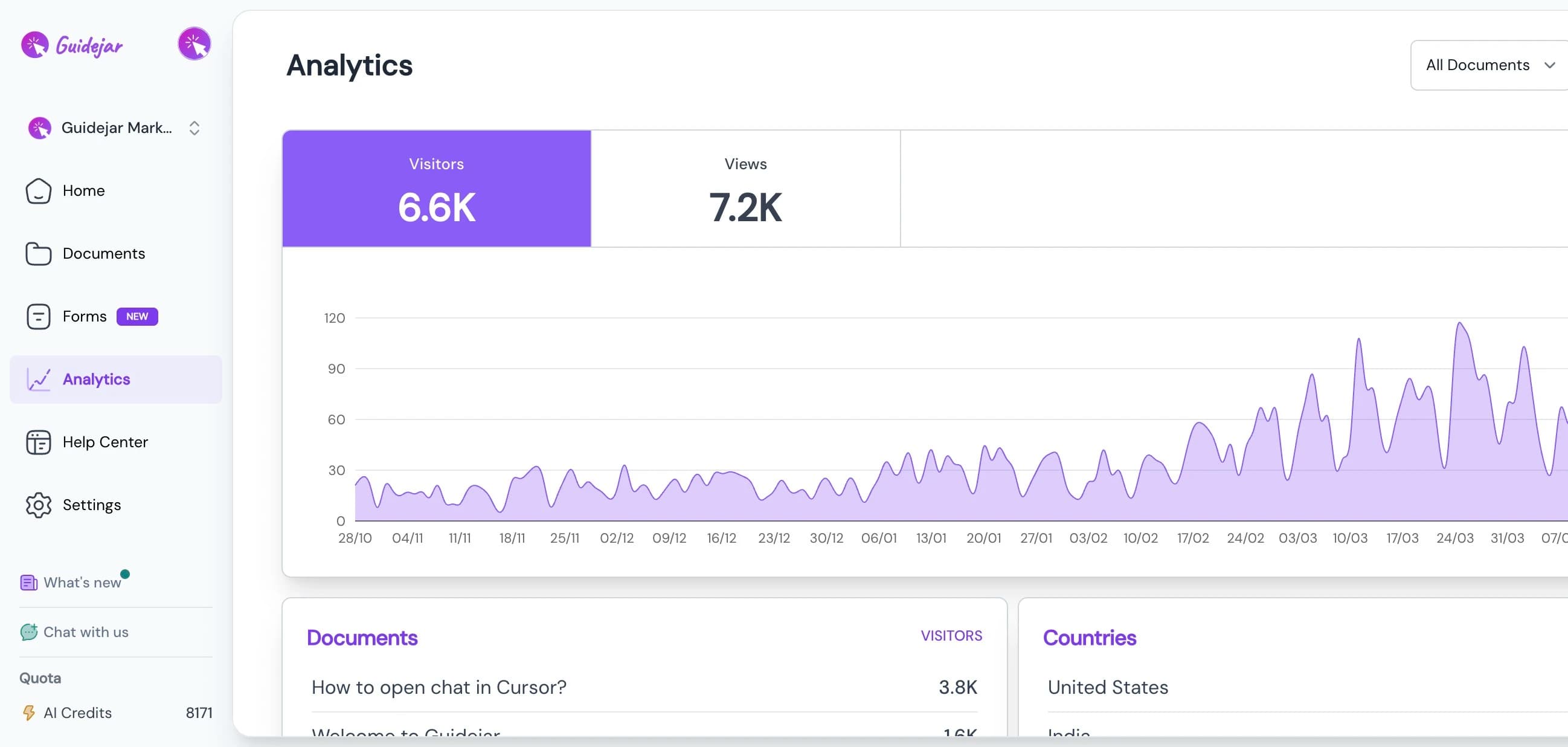
Guidejar vs iorad in 30 seconds
iorad is one of the older, more established tools in this category, and its signature trick is real. Capture a workflow once and learners can pick how they consume it: Watch, Try, Scroll, Slide, Quiz or Do. Quiz and Try make the learner perform the correct on-screen action, which is genuine assessment, and Guidejar has no equivalent.
The price is where most people stall. iorad does not bill per seat, it bills a flat platform fee: $200/month for one creator, $500/month for a team. On the $200 plan there are no exports at all, so your content stays inside iorad’s player. The free plan is unlimited on volume, but every tutorial is public and search-engine-indexed. There is no privacy setting until you pay.
Guidejar captures the same workflows and starts at $19/seat/month, with PDF export on the free plan, translation into 30+ languages from Pro, and a branded help center at your own domain. The full feature table and pricing math are below, and where iorad is genuinely the better buy, we say so.
Four reasons training teams pick Guidejar over iorad
Both tools turn one capture into step-by-step training content. The difference is what it costs, and how much of it you can take with you.
Price
One creator: $19 a month, not $200
iorad’s cheapest paid plan is $200/month and it covers exactly one creator. Guidejar Pro is $19/seat/month, or $16 billed yearly. At five creators the gap widens rather than closes: iorad Team is $500/month with one seat included and $50/month for each extra, so $700/month, while Guidejar Business is $75/month with five seats bundled. That is a real model difference, not a discount war. iorad charges a flat platform fee and Guidejar charges per seat, which is why iorad gets more competitive the more authors you have.
Exports
Getting your content out shouldn’t cost $500 a month
This is the sharpest practical difference between the two. iorad’s pricing matrix leaves both export rows empty on Free and on the $200 Individual plan, so until you reach the $500 Team tier your tutorials live in iorad’s player and nowhere else. Team then unlocks MP4, GIF, Word, Google Docs, Slides and PDF, and HTML with SCORM is Enterprise. Guidejar exports PDF on the free plan, HTML and Markdown on Pro, and a downloadable MP4 on Plus.
Help center
Put the whole library on your own domain
iorad’s closest equivalent is the Web Library, a standalone page you can link to or embed. It arrives on the $500 Team plan, caps out at 10 libraries, and the URL stays on iorad.com. Branding stops at theme, logo, favicon, fonts and colours. Guidejar’s help center runs at help.yourcompany.com with your branding, search, password or SSO gating, and Ask AI on Business to answer questions straight from your guides.
Explore the help centerLanguage & voice
Train a global team without an Enterprise contract
iorad translates into 100+ languages, which is more than Guidejar, but only on Enterprise. Below that, learners get an on-the-fly Google Translate of the player rather than an authored, published translation you control. Guidejar translates a guide into 30+ languages on every paid plan and generates AI voiceover from Pro, with voice cloning on Business. The same capture also supports branching, chapters and dynamic variables, so a long procedure can fork by role instead of running as one flat list.
See AI translation
Feature-by-feature comparison
Side by side on the training job — capture, learning formats, exports, publishing, and what each plan actually costs.
| Capability | Guidejar | iorad |
|---|---|---|
| Capture | ||
| Browser capture | Yes — free plan | Yes — free plan |
| Desktop capture | Plus plan | Yes — free plan (public tutorials) |
| Manual blur & redaction | Yes — free plan | Mask Data, from $200/mo Individual |
| Assisted / automatic redaction | Auto-Redact PII (Business) | Manual one-click masking only |
| Content & output | ||
| Written step-by-step output | Yes — Scroll View | Yes — Scroll mode |
| Interactive walkthrough output | Yes — Walkthrough View | Yes — Try & Do modes |
| Knowledge check / scored practice | Not available | Quiz & Try modes, free plan (public tutorials) |
| Configurable AI voiceover | Yes — Pro plan | Basic audio from $200/mo, neural voices at $500/mo |
| AI voice cloning | Business plan | Not available |
| Multi-language translation | Translate into 30+ languages, Pro plan | Translate into 100+, Enterprise only |
| Video-to-guide import | Plus plan, no cap | Not available |
| Interactive branching | Yes — Pro plan | Not available |
| Chapters within a guide | Yes — Pro plan | Not available |
| Dynamic variables | Yes — Pro plan | Not available |
| Exports | ||
| Any export on the free plan | PDF export | Not available |
| PDF export | Yes — free plan | Individual plan, $200/mo |
| Downloadable video / MP4 export | Plus plan | Team plan, $500/mo |
| HTML export | Pro plan | Enterprise only |
| Markdown export | Pro plan | Not available |
| SCORM / LMS package export | Not available | SCORM 1.2, Enterprise only |
| Publishing & AI | ||
| Hosted branded knowledge base | Help center, Plus plan | Web Library, Team plan, 10 max |
| Custom domain | Plus plan | No — tutorials stay on iorad.com |
| AI answers over your content | Help Center Ask AI (Business) | The Librarian, Team plan (beta) |
| In-app contextual delivery | Help Center Widget (Plus) | Widget & Extension Libraries (Team); Live Guidance is Enterprise, beta |
| MCP server (AI integration) | Build & query your library with AI (Plus) | Enterprise only (beta) |
| Native third-party integrations | Insta Copy paste, not native connectors | ~40+ publish connectors |
| Confluence integration | Can be done with Insta Copy | Yes — native connector |
| Notion integration | Can be done with Insta Copy | Not available |
| Lead-capture forms | Forms, Plus plan | Not available |
| SAML SSO | Business and Enterprise plans | Team plan, $500/mo |
| Analytics | Pro plan | Team plan, $500/mo; dashboard from Individual |
| Pricing | ||
| Free plan | 5 guides, 1 user, watermarked | Unlimited tutorials, 1 creator |
| Privacy on the free plan | Guides shared by link or embed | None — every tutorial is public and search-indexed |
| Starting paid price (monthly) | $19/seat — Pro | $200/mo — Individual, 1 creator only |
| Starting paid price (billed yearly) | $16/seat — Pro | 12 months for the price of 11 |
| Team plan (monthly) | $75, 5 seats included — Business | $500, 1 seat included, +$50/seat — Team |
| Cost for 5 creators (monthly) | $75 — Business | $700 — Team |
| Per-viewer or per-learner fees | None for link & help-center readers | None — unlimited learners |
| Enterprise | Custom | Custom |
Capture is a tie, and iorad wins the rows that matter most to a formal L&D function: Quiz and Try give you scored practice that Guidejar simply does not have, SCORM 1.2 packages let you drop a tutorial into an LMS, and desktop capture is free. The gap is money and ownership. iorad’s entry plan is $200/month for one creator with no exports of any kind, its free plan publishes every tutorial to the public web, and its Web Library never leaves iorad.com. Guidejar starts at $19/seat, exports PDF on the free plan and MP4 on Plus, translates into 30+ languages from Pro, and puts the whole library on a branded help center at your own domain.
Verified against iorad’s public pricing and documentation, October 2026. Spot something out of date? Tell us and we’ll correct it.
Pricing compared
Two different billing models. At small and mid author counts, the gap is enormous.
$7,500less/year
for a 5-creator team, both billed monthly
$19/seat
Guidejar Pro monthly vs iorad Individual at $200/month for one creator
$0exports
what iorad’s $200/month Individual plan lets you export
Bottom line: Billed monthly, one creator on iorad costs $200/month against $19 on Guidejar Pro. Five creators cost $700/month on iorad Team, since Team includes a single seat and charges $50 for each extra, against $75/month on Guidejar Business, which bundles five. That is $7,500 less a year. iorad’s annual option is 12 months for the price of 11, applied at checkout, which trims the figure but not the shape of it. iorad’s model earns its keep at scale: the platform fee is flat, extra seats are only $50, and learners are never charged, so a 20-author team serving 40,000 people has very predictable costs. Guidejar has unlimited share-link and help-center views on every plan too, so the comparison still holds, but the crossover is real and worth doing your own math on.
Prices as of October 2026. iorad Team includes 1 creator seat and bills $50/mo per additional creator; Guidejar Business bundles 5 seats. See full Guidejar pricing →
Where iorad genuinely wins
No tool is best at everything. Here’s where iorad is the more sensible pick.
Real knowledge checks, on the free plan
Quiz mode makes a learner perform the correct on-screen action before they can advance, and Try mode drops them into a safe simulation of the workflow to practise it. Both come from the same capture with no extra authoring, and both are available at $0. Guidejar has no equivalent at any tier: its Forms are lead capture and feedback, not scored assessment. If your requirement is proving someone learned the process rather than documenting it, iorad is purpose-built for that and Guidejar is not.
SCORM 1.2 and self-hosted HTML packages
Advanced Exports on Enterprise produces HTML, SharePoint and SCORM 1.2 packages you can host on your own server or push into an LMS such as Cornerstone, Docebo or Moodle. Guidejar has no SCORM support at any tier. For a regulated training function, or anyone whose completion records have to live in an LMS, this one row can decide the whole evaluation.
A flat fee that stops mattering as you scale
iorad charges for creators, never for learners, and there are no tutorial caps or view caps at any tier including Free. Extra creator seats are $50/month on top of the $500 Team fee, so the effective per-author cost keeps falling as the team grows. A large enablement org with a huge read-only audience gets a predictable bill, and desktop capture for native apps is free, so you can evaluate the thing properly before paying anything.
Around 40 real publish-to-destination connectors
These are authenticated connectors that push a finished article into the destination, not embed snippets: Zendesk Guide, Freshdesk, Salesforce Knowledge, HubSpot Knowledge, Help Scout, Guru, Document360, Confluence and Microsoft Dynamics, plus an LMS bench covering Canvas, Docebo, Brightspace, Litmos, Seismic Learning and WorkRamp. Guidejar’s equivalent is Insta Copy, a rich clipboard paste rather than a native connector. iorad also carries a decade of operating history, a SOC 2 Type 2 audit, and July 2026 scores of 4.7 on G2 across 51 reviews and 4.7 on Capterra across 59.
Which tool is right for your team?
Honest recommendations based on how your team builds and delivers training.
Choose Guidejar if
- Your budget doesn’t start at $200/month for a single creator
- You need to export your own content without paying $500/month to unlock it
- You want internal SOPs kept private from day one, including on the free plan
- You want the library on your own domain, searchable and branded, with Ask AI answering from it
- You translate training content into 30+ languages and want that on a $19 plan, not an Enterprise contract
- You want branching, chapters and dynamic variables so one long procedure can fork by role
- You want AI voiceover from Pro and your own cloned voice on Business
- You want an AI agent to build your training library from existing docs, and the team to self-serve answers from ChatGPT or Claude, on Plus instead of iorad’s Enterprise-only MCP beta
Choose iorad if
- You need scored knowledge checks and simulated practice, not just documentation
- SCORM 1.2 or self-hosted HTML packages for your LMS are a hard requirement
- You have many authors and an enormous read-only audience, where a flat fee plus $50 seats beats per-seat pricing
- You publish into Zendesk, Freshdesk, Salesforce Knowledge or an LMS rather than hosting your own site
- You document native desktop software and want to trial it before paying anything
- Procurement wants a long-established vendor with a SOC 2 Type 2 audit and custom contract support
Most teams should pick Guidejar.
It does the same capture-to-training-content job at a fraction of the cost: $19 a seat against $200 a month for one creator, exports you can actually reach, translation into 30+ languages from Pro, and a branded help center on your own domain instead of a Web Library on iorad.com. The same capture also publishes as an interactive walkthrough or a narrated MP4 when a written SOP isn’t the right format. Choose iorad when scored assessment or SCORM packages are hard requirements, or when your author count is high enough that a flat platform fee works out cheaper.
Switching from iorad to Guidejar
You don’t have to start over. Most teams finish the move in under a week.
- 1
Export what you have
Check your plan first. iorad has no exports at all below the $500/month Team tier, which adds MP4, GIF, Word, Google Docs, Slides and PDF. HTML and SCORM packages are Enterprise only.
- 2
Import into Guidejar
Those Word and PDF files become guides in a few clicks, and recordings run through our AI Video-to-Guide Maker. Anything left re-captures with our extension or desktop app in a couple of minutes.
- 3
Publish it properly
Choose Scroll View or Walkthrough View or both per guide, add AI voiceover, translate into 30+ languages, and put the whole library on a branded help center at your own domain.
Trusted by teams worldwide










“It’s intuitive, easy to use, and helps us create SOPs.”
Justin Masangcay, Success Manager at Purple
Frequently asked questions
The questions people actually search before picking one of the two.Something else on your mind? Talk to us
For most teams documenting processes and training people on software, yes. Guidejar starts at $19/seat/month against iorad’s $200/month for a single creator, exports PDF on the free plan, translates into 30+ languages from Pro, and publishes to a branded help center at your own domain. iorad is the better pick when you need scored knowledge checks, simulated practice, or SCORM packages for an LMS. Guidejar has none of those.
iorad is priced as a flat platform fee rather than per seat. Individual is $200/month and covers one creator. Team is $500/month with one seat included and $50/month for each additional creator, so five creators come to $700/month. Enterprise is a custom quote. Choosing annual at checkout gets you 12 months for the price of 11. The logic behind the number is that learners are never charged and tutorials are never capped, so a large audience costs nothing extra. That trade works well if you have thousands of learners and a handful of authors, and badly if you are a small team.
There is a free plan, and on volume it is genuinely generous: unlimited tutorials, unlimited learners, browser and desktop capture, and all six Learning Modes. The catch is privacy. Every free tutorial is public and indexed by search engines, and Tutorial Privacy with its Unlisted, Embed Only and Invite Only settings starts on the $200 Individual plan. Free also has no data masking, so you cannot redact a customer name before it goes live. That rules it out for anything internal. Guidejar’s free plan is 5 guides for 1 user with a Guidejar watermark, including browser capture, PDF export, sharing and embedding.
Only on Team at $500/month or above. MP4 export with control over the instruction panel, playbar and captions sits alongside GIF export and a YouTube connector that uploads the video version for you. Free and Individual have no exports at all. Guidejar exports a downloadable MP4 on Plus and Business.
Yes, on Enterprise. Advanced Exports produces HTML packages, SharePoint packages and SCORM 1.2 files so you can host a tutorial on your own server or in an LMS. It is not available on Free, Individual or Team. Guidejar has no SCORM support at any tier, so if an LMS package is a hard requirement, iorad wins that row outright.
Neither, exactly. iorad charges per tutorial creator and never per learner, at any tier including Free, with no tutorial caps and no view caps. Extra creator seats on Team are $50/month. Guidejar bills per seat from $19, and every workspace member needs a seat, but share-link, embed and help-center readers are free with unlimited views on every plan. The bigger difference is the floor: iorad’s starts at $200/month.
Yes, and this is one of its nicer touches. Native Mac and Windows capture apps are included on every plan, including the free one, so you can document a desktop ERP or a native line-of-business app without paying. Guidejar gates desktop capture at Plus, which is $25/seat/month. Worth knowing that iorad reviewers rate the desktop app as weaker than the browser extension, particularly for command-line work.
No. iorad’s branding covers theme, logo, favicon, fonts and colours, but published tutorials and Web Libraries stay on iorad.com. Whitelisted Domains is an embed access control for up to three domains, not a custom domain. Guidejar runs your help center at your own subdomain, such as help.yourcompany.com, on Plus and above.
Check which plan you are on first, because that decides everything. Team at $500/month exports MP4, GIF, Word, Google Docs, Slides and PDF, and Enterprise adds HTML and SCORM. On Free and Individual there are no exports, so that content needs re-capturing. Guidejar imports PDFs and Word docs on Pro and videos on Plus with no all-time import cap, and anything else re-captures with the extension. One thing worth planning for: iorad’s Try, Do and Quiz modes only exist inside iorad’s player, so exporting flattens them into a document or a video either way.