Arcade vs Navattic in 30 seconds
These two are direct competitors, not opposites. Arcade leads with “You’re the storyteller. Arcade makes every format effortless.” Navattic leads with “Make buying easier with demos.” Both turn your product into clickable, self-paced demos, and both sell to the same buyer: product marketing, demand-gen, and sales engineering teams who want interactive demos across the buyer journey. Same job, same audience.
What differs is how you buy and what each one is best at. Arcade is the self-serve, cheaper entry. Its Growth plan is $50 per seat billed monthly ($42.50 annually), you can add up to ten seats yourself, and it has re-centred on AI video: prompt-to-video generation grounded in a Brand Kit, plus a Figma plugin and Page Morph for demoing screens that don’t exist yet. Navattic is priced and built for the enterprise GTM motion. Its prices still render as animated digit-reels rather than static text (Base is $600/mo billed monthly or $500/mo billed annually), but it bundles five seats, clones the live DOM with real scroll and hover states, wires native CRM connectors and pipeline attribution in from Base, and its headline is Navattic Agents, a separately priced product where an AI agent runs a live demo and answers a prospect’s questions in real time.
So the question isn’t which one is the “demo tool.” They both are. It’s whether you want the self-serve, AI-video-forward path you can expense on a card, or the higher-fidelity, enterprise-integrated platform with agent demos and deep attribution. The full table and pricing math are below. There’s also a third option worth a look, because neither of these turns one capture into a hosted written SOP, and neither hosts a branded help center on your own domain.
Four differences that decide it
Both capture your product as an interactive demo and share it by link and embed. From there, they diverge on how you buy, how faithful the capture is, and where the AI is headed.
Pricing & billing model
A self-serve $50 seat vs a five-seat bundle
Arcade publishes a three-plan lineup you can start on yourself: Free, Growth at $50 per seat billed monthly ($42.50 annually, a 15% discount), and custom Enterprise. You add seats up to ten with a card, no call required. Navattic now bills monthly or annually, but it still renders prices as animated digit-reels rather than static text: Base is $600/mo billed monthly or $500/mo billed annually, and Growth is $1,200 or $1,000. It bundles seats instead of charging per head (five on Base, ten on Growth), so the per-seat math lands near $100 either way, and a cheaper Startup plan for eligible seed-stage teams does not display its price. One caveat cuts against Arcade’s cheaper sticker: its Growth plan meters AI credits, and from 19 October 2026 AI video moves to a separate paid video plan, so a video-heavy team pays more than a seat count alone suggests.
Capture fidelity & sources
Polished screenshot Arcades vs high-fidelity DOM captures
Both tools clone the real UI, but the fidelity differs. Navattic makes editable HTML Web Captures its core capability from Base: it copies the live DOM with scroll and hover states, and you edit any element, blur, hide, or delete it in a no-code editor, so a demo feels like the live product. Arcade captures from a Chrome extension, a Mac and Windows desktop app, and a Figma plugin, then polishes the result with pan and zoom, and its Page Morph lets you rewrite on-screen text before you record. Arcade’s DOM-level HTML capture is an Enterprise feature, though, so on Growth its demos are screenshot-and-recording based. Arcade wins on capture sources (Figma and native desktop, both on lower tiers); Navattic wins on live-DOM fidelity from the entry paid tier.
Sales-motion & analytics stack
How far each one reaches into the pipeline
This is the closest thing to a tie, and it splits on depth. Arcade brings genuinely strong GTM analytics for a demo tool: Audience Reveal de-anonymizes viewer companies, a dedicated Leads page ranks prospects by engagement, and Growth ships connectors into Amplitude, Mixpanel, PostHog, Segment, HubSpot, and Slack, with a native Salesforce integration on Enterprise. Navattic reaches deeper into the CRM sooner: native HubSpot, Salesforce, Marketo, Pardot, and Segment connectors from Base, plus account identification, A/B testing, and advanced analytics at Growth, and Launchpad to automate how sales routes demos across the cycle. If you want demo engagement wired to revenue from the entry paid tier, Navattic gets you there; if de-anonymized leads and event propagation on a self-serve plan are enough, Arcade covers it for less.
AI direction
AI video generation vs autonomous agent demos
Both are betting heavily on AI, in different shapes. Arcade’s roadmap is pointed at AI video: Creator Studio generates a video from a prompt, grounded in your Brand Kit and attached source material, with an average time to a first draft it puts around six minutes. It also ships a real MCP server on every plan including Free, so an AI tool can create Brand Kits, add sources, and generate videos from natural language. Navattic’s flagship is agent demos: an AI agent runs a live demo, interprets a prospect’s questions, and navigates the product in real time, now sold as its own product, Navattic Agents, priced by conversations and agents. Its MCP server, from the Startup plan up, reads analytics and builds demos too, and it auto-translates into 35 languages on Growth. If generated marketing video is the job, that is Arcade; if autonomous live demos are, that is Navattic.
Feature-by-feature comparison
Same job, different fidelity and different reach. Grouped and side by side.
| Capability | Arcade | Navattic |
|---|---|---|
| Capture & demo creation | ||
| Browser capture | Yes — Chrome extension, all plans | Yes — Web Captures (HTML/DOM) |
| Desktop capture | Yes — Mac & Windows app | No — media upload only |
| HTML / DOM demo capture | Enterprise only | Yes — Base, core capability |
| Figma import | Yes — all plans | Not available |
| On-screen text / element editing | Page Morph — pre-capture, Growth | Capture Editor — edit, blur, hide, delete |
| Chapters | Yes — all plans | Yes — via Flows |
| Dynamic personalization variables | Custom variables — Growth | Base |
| AI & interactivity | ||
| Interactive clickable demo | Included | Included |
| AI voiceover narration | Yes — all plans (Eleven Labs) | Startup+; premium voices Base |
| Interactive branching | Growth | Included |
| AI video generation (prompt-to-video) | Yes — Creator Studio | Not available |
| Autonomous AI agent demos | Not available | Navattic Agents — separately priced |
| Multi-language translation | AI Translate — Growth | 35 languages — Growth |
| MCP server (AI tool access) | All plans — authors demos & video | Startup+ — builds demos, reads analytics |
| Sales & GTM | ||
| Native CRM / analytics connectors | Growth; native Salesforce on Enterprise | HubSpot, Salesforce, Marketo, Segment — Base |
| Visitor de-anonymization | Audience Reveal — Growth | Account identification — Growth |
| Lead-capture forms | Forms + Leads page — Growth | Embedded forms — Base |
| Sales demo automation | Collections — Enterprise | Launchpad — Growth |
| Sandbox / live-environment demos | Not available | Growth ($1,000/mo annual) |
| Analytics | Basic + Advanced — Growth | Basic free; Advanced + A/B — Growth |
| Output & export | ||
| Written step-by-step document | Step-by-Step Guide — Growth, static | PDF Document + Copy as Text (≤60 steps) |
| Downloadable MP4 video | Growth — up to 720p | MP4 — capped at 15 steps |
| GIF export | Growth | Included |
| PDF export | Growth — via Step-by-Step | Yes — ≤60 steps |
| HTML / Markdown export | Not available | Not available |
| Interactivity preserved on export | No — flattens to video or static images | No — static PDF, MP4, GIF only |
| Publishing, help center & security | ||
| Hosted branded help center / KB | Not available | Not available |
| Help center AI answers over your content | Not available | Not available |
| Custom domain | Enterprise | Growth |
| SAML SSO | Enterprise | Growth |
| Pricing | ||
| Free plan | 1 demo + 1 AI video, 1 seat | 1 demo, 1 seat, default theme |
| Entry paid plan | $50/seat/mo — Growth, monthly | $600/mo — Base, 5 seats ($500 annual) |
| HTML / DOM capture tier | Enterprise | Base — included |
| Team tier | Growth — up to 10 seats, $50/seat monthly | Growth — $1,200/mo ($1,000 annual), 10 seats |
| Billing | Monthly or annual (−15%) | Monthly or annual |
| Enterprise | Custom — HTML capture, SSO, Salesforce | Custom — offline demos, audit logs |
Both build clickable product demos for GTM teams, so that job is a tie. Arcade wins the entry: $50 per seat billed monthly, self-serve up to ten seats, AI video generation neither rival has, a Figma plugin, and an MCP server on every plan. Navattic wins on fidelity and depth: editable DOM captures from Base, native CRM connectors and attribution from the entry paid tier, autonomous agent demos through Navattic Agents, and sandbox demos on Growth. Price cuts both ways, since Arcade is far cheaper to start but meters AI credits and caps Growth at ten seats, while Navattic starts at a five-seat bundle. And they leave the same two things on the table: no hosted written SOP that stays live, and no branded help center on your own domain.
Verified against both vendors’ public pricing and documentation, October 2026. Navattic renders its prices as animated digit-reels; the $500/$600 and $1,000/$1,200 figures come from its own pricing-page data. Spot something out of date? Tell us and we’ll correct it.
Pricing compared
Every number below states its billing interval. Mixing them is how comparisons mislead.
$50/seat/mo
Arcade Growth billed monthly — $42.50/seat/mo billed annually, self-serve up to 10 seats
$600/mo
Navattic Base billed monthly for 5 seats — $500/mo billed annually; Growth $1,200/mo ($1,000 annually) for 10
$19/seat/mo
Guidejar Pro billed monthly — $16/seat/mo billed annually
Bottom line: Arcade is the self-serve, cheaper way to start, at $50 per seat billed monthly ($42.50 annually) with no annual lock-in and up to ten seats you can add yourself. The asterisk is its AI-credit meter, and from 19 October 2026 AI video moves to a separate paid video plan, so a video-heavy team pays more than the per-seat sticker. Navattic bundles more seats and wires the CRM in from Base, and it now bills monthly or annually: Base is $600/mo billed monthly or $500/mo annually, Growth $1,200 or $1,000, shown as animated digit-reels rather than static prices. A Startup plan for eligible seed-stage teams costs less, but its price is not displayed. For a five-seat team, Arcade Growth runs about $250/month billed monthly and Navattic Base $600/month billed monthly ($500 annually), versus Guidejar Business at $75/month total for five seats, or Guidejar Pro at $19/seat/month billed monthly.
Prices as of October 2026. Arcade bills per seat (Growth up to 10); Navattic bundles 5 (Base) or 10 (Growth) seats, billed monthly or annually; Guidejar Business bundles 5 seats.
Where each one genuinely wins
Neither tool is a strictly better version of the other. These are the real, checkable advantages.
Arcade: AI video generation and a Figma plugin
Arcade has re-centred on a category neither Navattic nor Guidejar competes in. Creator Studio generates a video from a prompt, grounded in a Brand Kit it pulls from your website and any attached PDFs, docs, or images, with a first draft in around six minutes and weekly shipping on the video surface. Alongside it, the Figma plugin is a first-class capture source on every plan including Free, so marketing can ship a credible clickable walkthrough of a screen engineering hasn’t built yet.
Arcade: self-serve pricing, Page Morph, and MCP on every plan
Arcade is the low-friction way in. You start on Growth at $50 per seat and add up to ten seats yourself, no sales call, and its MCP server runs on every plan including Free so an AI tool can build Brand Kits and generate videos from natural language. Page Morph is its other quiet advantage: you rewrite on-screen text and anonymize customer names or numbers on the live page before you record, which beats scrubbing a screenshot after the fact when you can’t spin up a clean staging environment.
Navattic: autonomous agent demos and high-fidelity capture
Navattic’s flagship is agent demos: an AI agent interacts with prospects, interprets their questions, and navigates your product live, a genuinely novel capability with no equivalent in either Arcade or Guidejar. It is now sold as its own product, Navattic Agents, priced by conversations and agents. Underneath it, Web Captures clone the real app with scroll and hover states and let you edit element by element from Base, so the demos look and feel like the live product rather than a polished set of screenshots. For a buyer who wants the demo to be indistinguishable from the app, that fidelity is the whole point.
Navattic: native CRM depth, attribution, and demo automation
Navattic is the stronger pick when demo engagement has to show up in the pipeline. It ships native connectors to HubSpot, Salesforce, Marketo, Pardot, and Segment from Base, plus account identification, advanced analytics, and A/B testing at Growth, so marketing can attribute demo activity to revenue. Launchpad automates how sales routes demos across the cycle, and sandbox demos on a live environment arrive at Growth. It is built end to end for a sales-led motion in a way a self-serve demo builder is not.
Which demo tool is right for you?
Same job, different shape. Honest recommendations based on how your GTM team actually buys and works.
Choose Arcade if
- You want the self-serve, cheaper entry, since Growth is $50/seat billed monthly and you add up to ten seats yourself with no annual lock-in
- AI-generated marketing video is a job you have, not just narrated captures, and Creator Studio is where you want it
- You demo screens that do not exist yet, where the Figma plugin and Page Morph let you build a credible walkthrough of unbuilt UI
- You want an MCP server and AI voiceover on the free plan rather than from a paid tier
- A polished showcase demo for a homepage, a launch, or a sales leave-behind is the deliverable, and visual polish matters most
Choose Navattic if
- You want high-fidelity DOM captures that feel like the live app from the entry paid tier, not an Enterprise upgrade
- Demo engagement has to flow into HubSpot, Salesforce, or Marketo with real attribution, available from Base
- Autonomous agent demos that answer prospects live are worth buying as a separate Navattic Agents product
- You run a mid-market or enterprise motion and a five- or ten-seat bundle fits how you buy
- Launchpad demo automation and sandbox demos on a live environment match how your sales team sells
Self-serve, video-forward marketing teams lean Arcade. Enterprise GTM motions with deep CRM needs lean Navattic.
They compete for the same job, so the choice comes down to how you buy and what you optimize for: a cheaper, self-serve, AI-video-forward entry on Arcade, or higher-fidelity captures, native CRM attribution, and autonomous agent demos on a bundled Navattic plan. But neither one turns that capture into a hosted written step-by-step SOP, and neither hosts your content in a branded, searchable help center on your own domain. That is the gap the third option below fills.
Both of them stop at the same two places
Arcade and Navattic both build clickable demos, and both keep those demos hosted on their own platform. Neither turns one capture into a hosted written step-by-step SOP or help article, and neither hosts a branded, searchable help center on your own domain. If your only job is a sales demo, either tool will serve you. If support, onboarding, and internal docs are part of the picture, here’s the third option.
Guidejar
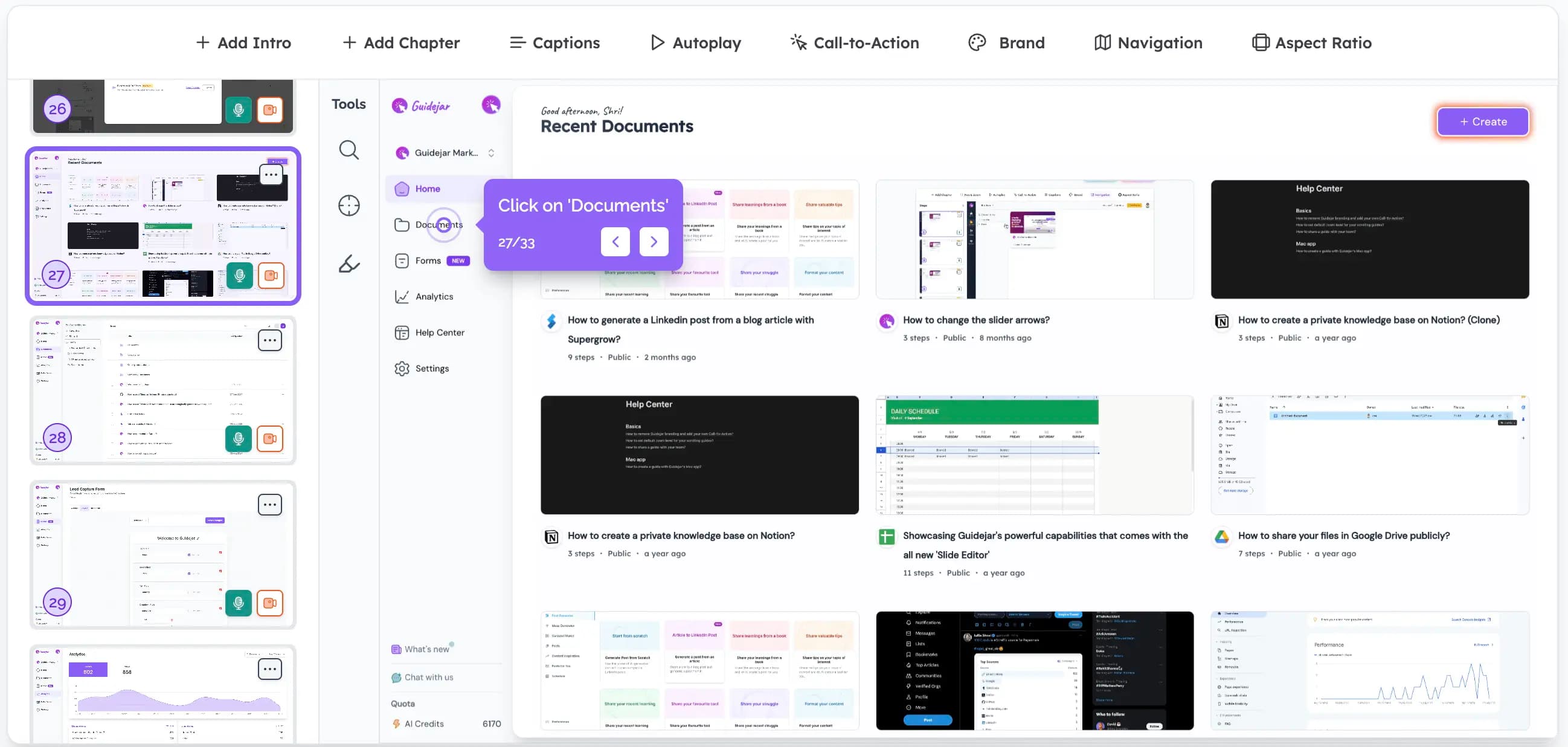
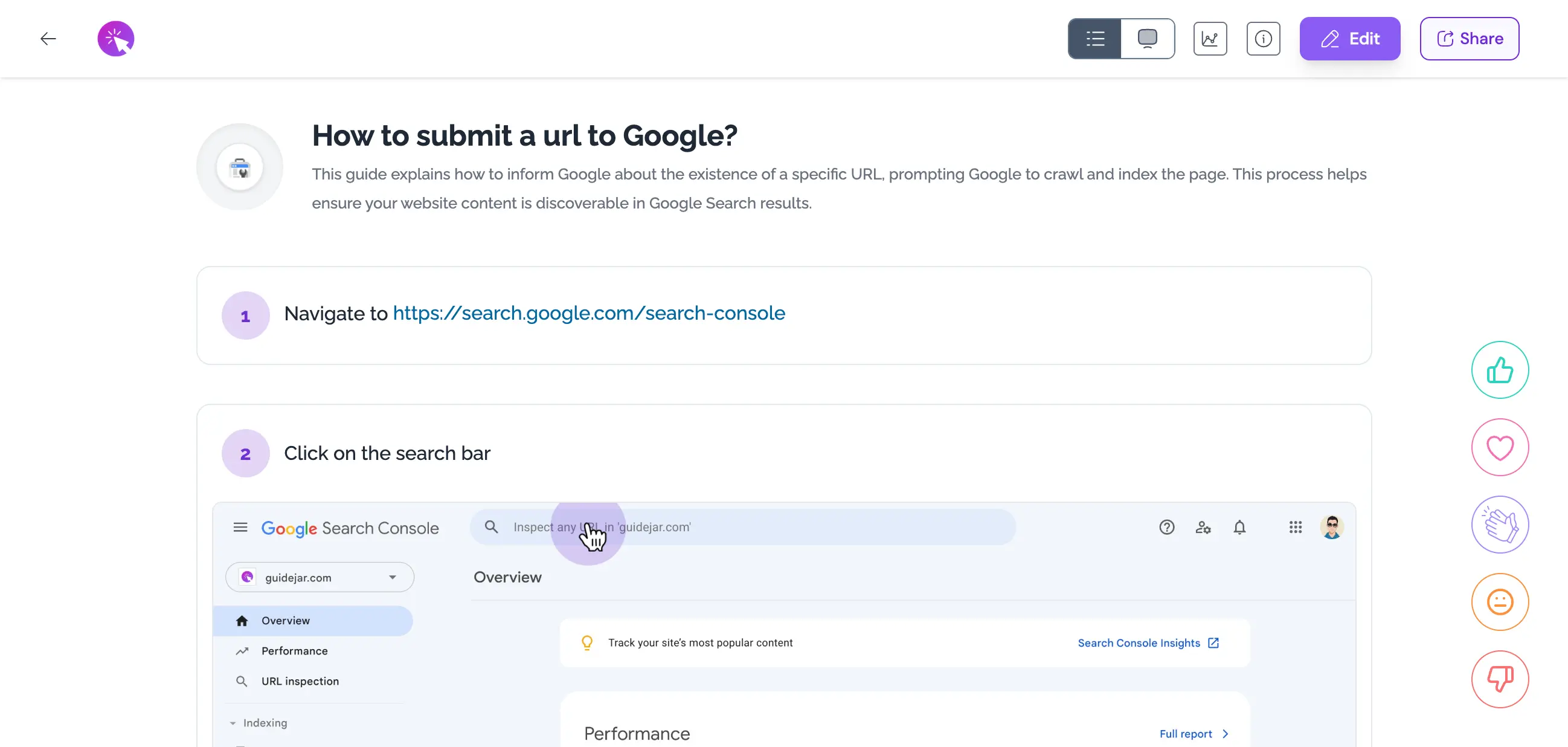
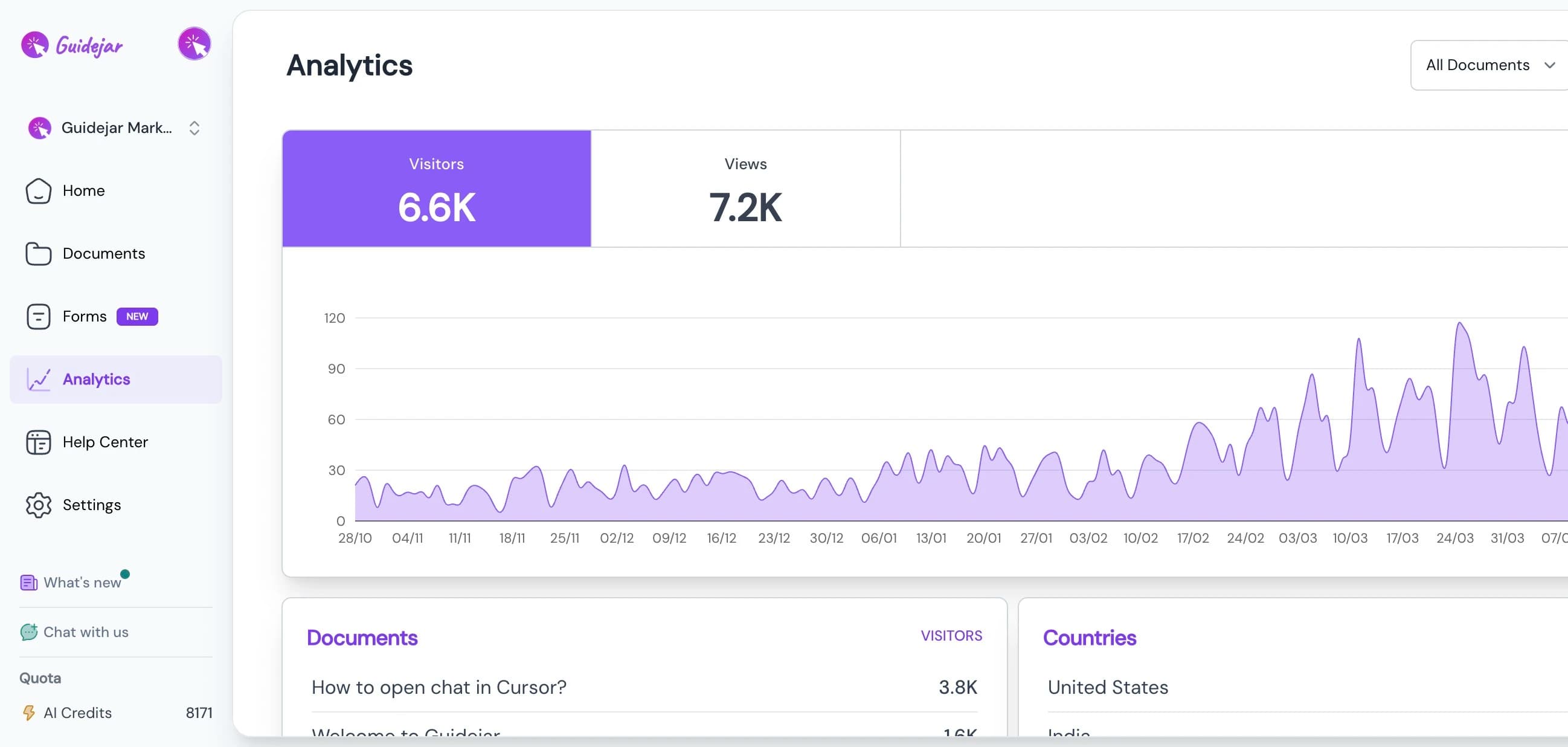
Guidejar takes one capture and publishes it two ways: a Walkthrough View people click through with hotspots and branching, and a Scroll View written step-by-step doc, like an SOP or help article. Both come from the same recording, chosen per guide. The whole library then lives in a searchable, branded help center at your own domain, and you export it as MP4, PDF, HTML, or Markdown whenever you want. Self-serve from $19/seat/mo billed monthly, no annual commitment.
- One capture published as a clickable walkthrough and a written SOP, chosen per guide
- Searchable branded help center on your own custom domain, with Ask AI ticket deflection
- MP4 export up to 30 minutes on Plus, with AI voiceover from the Pro plan
- Guidejar MCP builds your SOP library and answers team questions inside ChatGPT or Claude, on Plus
Starting at
$19/mo
per seat, billed monthly ($16 billed annually)
vs Arcade $50/seat/mo Growthvs Navattic $600/mo Base
Try GuidejarYou own and export your content
Take guides out as MP4, PDF, HTML, or Markdown, instead of demos locked to a hosted link
Translate into 30+ languages
From the Pro plan, not a Growth tier or a metered AI-credit budget
Transparent, self-serve pricing
Published per-seat rates, monthly or yearly, as plain numbers rather than digit-reels
Trusted by teams worldwide










How Guidejar stacks up
The rows that actually separate them, with the third column filled in.
| Capability | Arcade | Navattic | Guidejar |
|---|---|---|---|
| Interactive clickable demo | Yes — demos + AI video | Yes — HTML demos | Yes — Walkthrough View |
| Written step-by-step SOP / doc | Step-by-Step Guide — static, Growth | Static PDF export (≤60 steps) | Yes — hosted Scroll View, all plans |
| Branded help center on your domain | Not available | Not available | Yes — Plus plan |
| AI video generation | Yes — Creator Studio | Not available | No — MP4 export, not generated video |
| Autonomous AI agent demos | Not available | Navattic Agents — separate product | Not available |
| Native CRM + demo attribution | Growth; Salesforce Enterprise | Native CRM + attribution — Base | No — embed & copy, not native connectors |
| Multi-language translation | AI Translate — Growth | 35 languages — Growth | 30+ languages — Pro |
| MCP server | All plans — authors demos & video | Startup+ — builds demos, reads analytics | Plus — authors docs library + team Q&A |
| Entry paid price | $50/seat/mo — Growth, monthly | $600/mo — Base, 5 seats, monthly | $19/seat/mo — Pro, monthly |
Switching to Guidejar
From either tool, most teams finish the move in a few days.
- 1
Export what you have
Arcade exports a GIF or MP4 up to 720p on Growth, plus a Step-by-Step Guide you download as PDF or copy into Notion or Google Docs, though the copy silently drops any video steps and none of it is available on the free plan. Navattic exports a static PDF capped at 60 steps, an MP4 capped at 15, a GIF, and Copy as Text, with no HTML source and no bulk export. Either way, the flat content comes out and the interactive demos stay behind.
- 2
Import into Guidejar
Turn those exported PDFs or your existing screenshots into guides with our importer in a few clicks, with no all-time import cap, and run any exported MP4 through our AI Video-to-Guide Maker. Anything interactive takes a couple of minutes to re-capture with our Chrome extension or desktop app.
- 3
Publish it properly
Choose Walkthrough View or Scroll View or both per guide, add AI voiceover, translate into 30+ languages, and put the whole library on a branded help center at your own domain.
“One of best applications I ever used to onboard clients.”
Aditya Gupta
Frequently asked questions
The questions people actually search before picking one of the two.Something else on your mind? Talk to us
Neither, in the abstract. They compete for the same job, interactive product demos for GTM teams, so it comes down to how you buy and what you optimize for. Arcade wins on self-serve and video: $50 per seat billed monthly, up to ten seats you add yourself, AI video generation in Creator Studio, a Figma plugin, and an MCP server on every plan. Navattic wins on fidelity and depth: editable HTML captures from Base, native CRM connectors and attribution, autonomous agent demos (sold separately as Navattic Agents), and sandbox demos, though Base starts at $600/mo billed monthly ($500 annually) for five seats. Neither produces a hosted written SOP or hosts a branded help center on your own domain, which is where Guidejar comes in.
Arcade publishes three plans: a free tier (one demo plus one AI video), Growth at $50 per seat billed monthly ($42.50 annually) with up to ten seats, and custom Enterprise, with AI credits metered on Growth and, from 19 October 2026, AI video on a separate paid plan. Navattic shows its prices as animated digit-reels and bills monthly or annually: Base is $600/mo billed monthly or $500/mo annually for five seats, Growth $1,200 or $1,000 for ten, and there is a free Starter tier limited to one demo. A Startup plan for eligible seed-stage teams sits below Base, but its price is not displayed, and Navattic Agents is priced separately. For comparison, Guidejar Pro is $19/seat/mo billed monthly, and Business bundles five seats for $75/month.
Both do, and both cap it at one demo. Arcade’s free plan gives you one published interactive demo and one AI video on a single seat, with the Chrome extension, desktop app, Figma plugin, AI voiceover, and MCP included, but no exports, custom branding, or analytics. Navattic’s free Starter is one demo and one seat on the default theme only, with no custom branding, integrations, or forms. Neither free tier can run a real demo program. Guidejar’s free plan gives you 5 guides with browser capture, PDF export, sharing, and embedding, with the Guidejar watermark shown.
Arcade, clearly, to start. Its Growth plan is $50 per seat billed monthly ($42.50 annually) and you buy it self-serve, while Navattic’s cheapest publicly priced tier, Base, is $600/mo billed monthly or $500/mo annually for five seats (its Startup plan for eligible seed-stage teams does not display a price). For a five-seat team that is about $250/month on Arcade against $600/month on Navattic, both billed monthly. Two catches on Arcade: Growth caps at ten seats before you talk to sales, and its AI-credit meter means a video-heavy team pays more than the seat price alone. Guidejar undercuts both at $19/seat/mo, with Business bundling five seats for $75/month.
Yes, but only as flat files, and the interactivity does not survive. Arcade exports a GIF or MP4 up to 720p on Growth, plus a Step-by-Step Guide as a PDF or a clipboard copy, though that copy drops video steps and nothing exports on the free plan. Navattic exports a PDF capped at 60 steps, an MP4 capped at 15, a GIF, and Copy as Text, with no HTML source and no bulk workspace export, so the interactive demos themselves stay locked to the platform. Guidejar exports MP4, PDF, HTML, and Markdown, and you own the content rather than renting a hosted link.
Both bet on AI, in different shapes. Arcade’s Creator Studio generates a marketing video from a prompt, grounded in your Brand Kit, with a first draft in around six minutes, and it is where Arcade is shipping most weeks. Navattic’s flagship is agent demos: an AI agent runs a live demo and answers a prospect’s questions in real time, now sold as a separately priced product, Navattic Agents, with no Arcade equivalent. Guidejar has neither generated video nor agent demos; it includes AI voiceover from its Pro plan at $19/seat/mo and MP4 export on Plus.
Not really. Arcade’s Step-by-Step Guide turns a demo into a static, scroll-through walkthrough, but it does not auto-update, it is not embeddable, it carries no analytics, and it is Growth-only. Navattic’s written output is a flat PDF export or Copy as Text. Neither tool hosts a branded, searchable help center or knowledge base on your own domain; their nearest concepts (Arcade Collections, Navattic Launchpad) are sales assets, not a support KB. Guidejar publishes the same capture as a living Scroll View doc and puts the whole library on a help center at your own domain from the Plus plan.