Navattic vs Walnut in 30 seconds
These two are direct competitors, not opposites. Navattic leads with “Make buying easier with demos.” Walnut leads with “A demo for every buyer. Built by AI, guided by you.” Both are no-code interactive product-demo platforms for B2B go-to-market teams, both clone your live app into editable HTML, and both personalize clickable demos across the funnel. Same job, same buyer.
The first thing that separates them is how you buy. Navattic has a free Starter tier (one demo, one seat) and an entry of $500/mo on Base billed annually, or $600 billed monthly. Walnut has no free plan and no free trial at all: every plan CTA is “book a demo,” the floor is Ignite at $575/mo billed annually ($6,900/yr) for three editor seats, and the Walnut watermark stays until you buy the White-labeling add-on. If you want to try before you talk to sales, only Navattic lets you.
The second thing is depth. Walnut goes further into the enterprise revenue stack: a genuine Salesforce app, Walnut Uncover to deanonymize demo viewers, Digital Sales Rooms, SOC 2, and SSO/SCIM. Navattic answers with autonomous agent demos (now sold separately as Navattic Agents), A/B testing, and its own analytics and a demo-building MCP server. The full table and pricing math are below. There is also a third option worth a look, because neither tool produces a written SOP doc, hosts a branded help center on your own domain, or lets you export and own your content.
Four differences that decide it
Both capture a live web app as editable HTML and both publish personalized, clickable demos. From there, they diverge on access, AI, revenue tooling, and lock-in.
How you buy
A free tier and a published-ish price, or a sales call for everything
Navattic lets you start for nothing on Starter, one demo on one seat, then move to Base at $500/mo billed annually, or $600 billed monthly, for five seats. Navattic still renders those prices as animated digit reels rather than static text, but the figures are its own. Walnut is the opposite. There is no free plan, no self-serve trial, and every CTA is “book a demo.” Its cheapest usable tier, Ignite, is $575/mo billed annually, which is $6,900 a year for three editor seats, and the Walnut watermark stays on your demos unless you pay for the White-labeling add-on. If evaluating without a sales call matters, Navattic is the only one of the two that allows it.
AI demo engine
Autonomous agents versus a broad, mature AI toolset
Navattic’s flagship is agent demos, now sold as a separate Navattic Agents product: AI agents that interact with a prospect, interpret questions, and navigate your product in real time. Walnut’s closest answer is Buyer Xpert, a newer metered add-on that answers buyer questions inside a demo, and Guidejar has no equivalent. Walnut counters with breadth rather than a single headline. StoryCapture builds a demo from a live click-through, AI Mode edits any element from one prompt, EditsAI does bulk changes, InsightsAI answers questions about your analytics, and AI text-to-speech narration ships on every plan. Navattic has AI voiceover on every paid plan too, from its Startup plan up. So narration is a draw, and Navattic wins on the autonomous-agent frontier.
Revenue tooling
Demo analytics on one side, deep CRM attribution on the other
Both tie demos to the funnel, but Walnut reaches further into the enterprise revenue stack. Its Salesforce app launches demos, scores engagement, and surfaces deal risk inside the CRM, and Walnut Uncover deanonymizes anonymous demo viewers through ZoomInfo, 6sense, Demandbase, and Clearbit. Digital Sales Rooms wrap live demos in a shared buyer space with mutual action plans. Navattic brings real native connectors of its own, HubSpot, Salesforce, Marketo, Pardot, Segment, Slack, and ZoomInfo, plus A/B testing and account identification that Walnut’s matrix does not list. Navattic is strong GTM analytics. Walnut is closer to a revenue platform.
Export & lock-in
Your demos are hard to take with you either way
Neither tool lets you leave with your interactive demos intact, but Navattic gives you more on the way out. It exports a PDF document capped at 60 steps, an MP4 capped at 15 steps, a GIF, and copy-as-text. Walnut exports essentially nothing portable: no MP4, no PDF, no HTML source, only an “offline demos” interactive package for playback and CSV import/export of guide text for translation. In both cases the demos themselves are proprietary hosted HTML, shared only by link, embed, or package, and captures need redoing whenever your app’s UI changes. Whichever you pick, plan on rebuilding if you switch.
Feature-by-feature comparison
Same job, different access and different depth. Grouped and side by side.
| Capability | Navattic | Walnut |
|---|---|---|
| Capture | ||
| Browser (HTML) capture | Yes — Web Captures via Chrome extension | Yes — Chrome extension, editable HTML |
| Desktop (non-browser) capture | No — uploaded media only | No — browser-tab video only |
| Sensitive-data redaction | Manual — blur/hide/delete elements | Manual — edit captured HTML |
| Automatic PII redaction | Not available | Not available |
| Import from PDF / DOCX | Not available | Not available |
| Video-to-guide import | Not available | Not available |
| Demo output & delivery | ||
| Interactive clickable demo | Yes — core product | Yes — core product |
| Interactive branching | Yes — flows, CTAs, interest paths | Yes — “choose your own adventure” playlists |
| Dynamic personalization variables | Base plan | Yes — variables + CRM data |
| Autonomous AI agent demos | Navattic Agents — separately priced | In-demo Q&A only — Buyer Xpert add-on |
| Sandbox / live-environment demos | Growth plan | Accelerate / add-on |
| Digital Sales Rooms / deal rooms | Not available | Scale / add-on |
| A/B testing of demos | Growth plan | Not available |
| Written step-by-step document | No — static PDF export only | Not available |
| Branded help center on your domain | Not available | Not available |
| AI, voice & translation | ||
| AI voiceover (audio narration) | Startup+; premium voices Base | Yes — all plans |
| Voice cloning | Growth — via avatar cloning | No — preset narrator voices |
| Multi-language translation | Growth — 35 languages | Yes; 243 languages on Scale / add-on |
| MCP / AI-tool access | Startup+ — builds demos, reads analytics | Read-only analytics MCP — Data API (Scale) |
| Export & GTM integration | ||
| Downloadable MP4 file | Yes — capped at 15 steps | Not available |
| PDF export | Yes — capped at 60 steps | Not available |
| HTML / Markdown export | Not available | Not available |
| Native CRM / MAP connectors | Base — HubSpot, Salesforce, Marketo, Segment | Yes — Salesforce app, HubSpot, Marketo, Slack |
| Viewer deanonymization | Account identification — Growth | Walnut Uncover — Accelerate |
| Lead-capture forms | Base plan | Yes — Ignite plan |
| Analytics | Basic free; advanced + A/B on Growth | Strong; InsightsAI on Accelerate |
| Security & pricing | ||
| SSO / SAML | Growth plan | Accelerate / add-on |
| Custom domain | Growth plan | Add-on / Accelerate |
| Custom branding on entry tier | Free Starter is default-theme-only; branding on Base | Watermark until White-labeling add-on |
| Free plan | Yes — 1 demo, 1 seat | No — sales-led only |
| Entry paid plan (billed annually) | $500/mo — Base, 5 seats | $575/mo — Ignite, 3 editor seats |
| Team plan (billed annually) | $1,000/mo — Growth, 10 seats | $1,550/mo — Accelerate, 6 editor seats |
| Billing model | Monthly or annual | Annual commitment only |
Both are no-code interactive-demo platforms, so the core capture-and-publish job is a tie. Navattic wins on access and reach: a free tier to evaluate, a lower entry price with monthly billing available, autonomous agent demos through Navattic Agents, A/B testing, and downloadable MP4 and PDF exports. Walnut wins on enterprise depth: a real Salesforce app, Walnut Uncover deanonymization, Digital Sales Rooms, and SOC 2. Walnut is annual-commitment only, and both leave the same three things on the table: no written SOP document, no branded help center on your own domain, and no way to export and own your content.
Verified against both vendors’ public pricing and documentation, October 2026. Navattic renders its prices as animated digit reels; the figures come from its own pricing-page data. Spot something out of date? Tell us and we’ll correct it.
Pricing compared
Every number states its billing interval. Navattic now bills monthly or annually; Walnut is annual only.
$500/mo
Navattic Base billed annually ($6,000/yr, 5 seats) — $600/mo billed monthly
$575/mo
Walnut Ignite billed annually ($6,900/yr, 3 editor seats) — no free plan
$19/seat/mo
Guidejar Pro billed monthly — $16/seat/mo billed annually, self-serve
Bottom line: both are enterprise tools, and both cost roughly the same to start. Navattic’s Base is $500/mo billed annually for five seats, or $600 billed monthly, and Walnut’s Ignite is $575/mo billed annually, which is $6,900 a year for three editor seats with the watermark still on. Walnut now also meters AI against a pooled yearly credit allowance per plan. The gap between them is access, not headline price: Navattic gives you a free single-demo tier to try first and a monthly option, while Walnut requires a sales call to buy anything. For reference, five seats of Guidejar Business is $75/month billed monthly, or $59/month billed annually ($708/yr), a different order of magnitude, though it is a different shape of product.
Prices as of October 2026. Navattic bundles 5 (Base) or 10 (Growth) seats, billed monthly or annually; Walnut is billed annually with no free plan and a pooled AI-credit allowance. Guidejar Business bundles 5 seats.
Where each one genuinely wins
Neither is a strictly better version of the other. These are the real, checkable advantages.
Navattic: autonomous agent demos
Navattic’s agent demos, now sold as a separate Navattic Agents product, put an AI agent in front of a prospect to run a live demo on its own. It interprets questions, navigates your product in real time, and adapts to what the buyer wants to see. It is the current headline of Navattic’s homepage and a genuinely novel, category-leading capability. Walnut’s newer Buyer Xpert add-on answers buyer questions inside a demo, but Navattic’s agents go further and run the demo live, and Guidejar has nothing comparable.
Navattic: a real free tier and lower barrier to start
You can build and publish a demo on Navattic’s free Starter tier without talking to sales, then move to Base at $500/mo billed annually ($600 monthly), with A/B testing, account identification, and demo analytics on Growth. It is the only one of the two you can evaluate hands-on before committing to a contract, which matters when a demo tool has to prove it lifts conversion first.
Walnut: demo-to-pipeline attribution and Uncover
Walnut’s enterprise Salesforce app launches demos, scores engagement, and flags deal risk from inside the CRM, and Walnut Uncover deanonymizes anonymous viewers through ZoomInfo, 6sense, Demandbase, and Clearbit. If your revenue team needs demo engagement tied directly to accounts and opportunities, Walnut goes deeper than Navattic’s analytics and far beyond Guidejar’s clipboard-style copy.
Walnut: enterprise credibility and deal rooms
Walnut is built for large orgs standardizing demos across global teams. It is SOC 2 certified, offers SSO and SCIM, role and permission controls, a dedicated CSM, and professional-services hours, and its Digital Sales Rooms give buyers a shared deal space with mutual action plans. Named customers include Adobe, Cisco, NetApp, and Maersk. That enterprise packaging is something neither Navattic nor Guidejar sells as completely.
Which tool is right for you?
Same job, different access and depth. Honest recommendations based on how you actually buy and sell.
Choose Navattic if
- You want to evaluate hands-on before a sales call, since the free Starter tier lets you publish a demo for nothing
- Autonomous agent demos (Navattic Agents, sold separately) that run themselves in front of a prospect are the capability you care about most
- You need A/B testing, account identification, and demo analytics to prove conversion lift
- You want a downloadable MP4 or PDF to hand to a stakeholder, even with the step caps
- A $500/mo entry (billed annually) with five bundled seats fits your budget better than a $6,900/yr floor
Choose Walnut if
- Your demos need to be wired into Salesforce with engagement scoring and deal-risk signals inside the CRM
- Deanonymizing anonymous demo viewers through Walnut Uncover is worth paying for
- You are standardizing demos across global teams and need SOC 2, SSO, SCIM, and a dedicated CSM
- Digital Sales Rooms and curated buyer playlists are part of how your revenue team runs deals
- You have a $6,900+/yr budget with an annual commitment and buying through sales is not a blocker
Teams that want to try before they buy and value autonomous demos pick Navattic. Enterprise revenue teams that live in Salesforce pick Walnut.
They compete for the same GTM demo job, so the choice comes down to access and depth: a free tier and agent demos on Navattic, or deep CRM attribution, Uncover, and deal rooms on Walnut. Both are hosted-only with meaningful lock-in, Walnut sells on annual commitment only, and neither produces a written SOP document or hosts a branded help center on your own domain. That is the gap the third option below fills.
Both of them stop at the same three places
Navattic and Walnut are both excellent at interactive demos, and if a hosted, sales-priced demo tool is all you need, either will serve you. But neither produces a written SOP you can read instead of click, neither hosts a branded help center on your own domain, and neither lets you buy self-serve or export and own your content. If any of that matters, here is the third option.
Guidejar
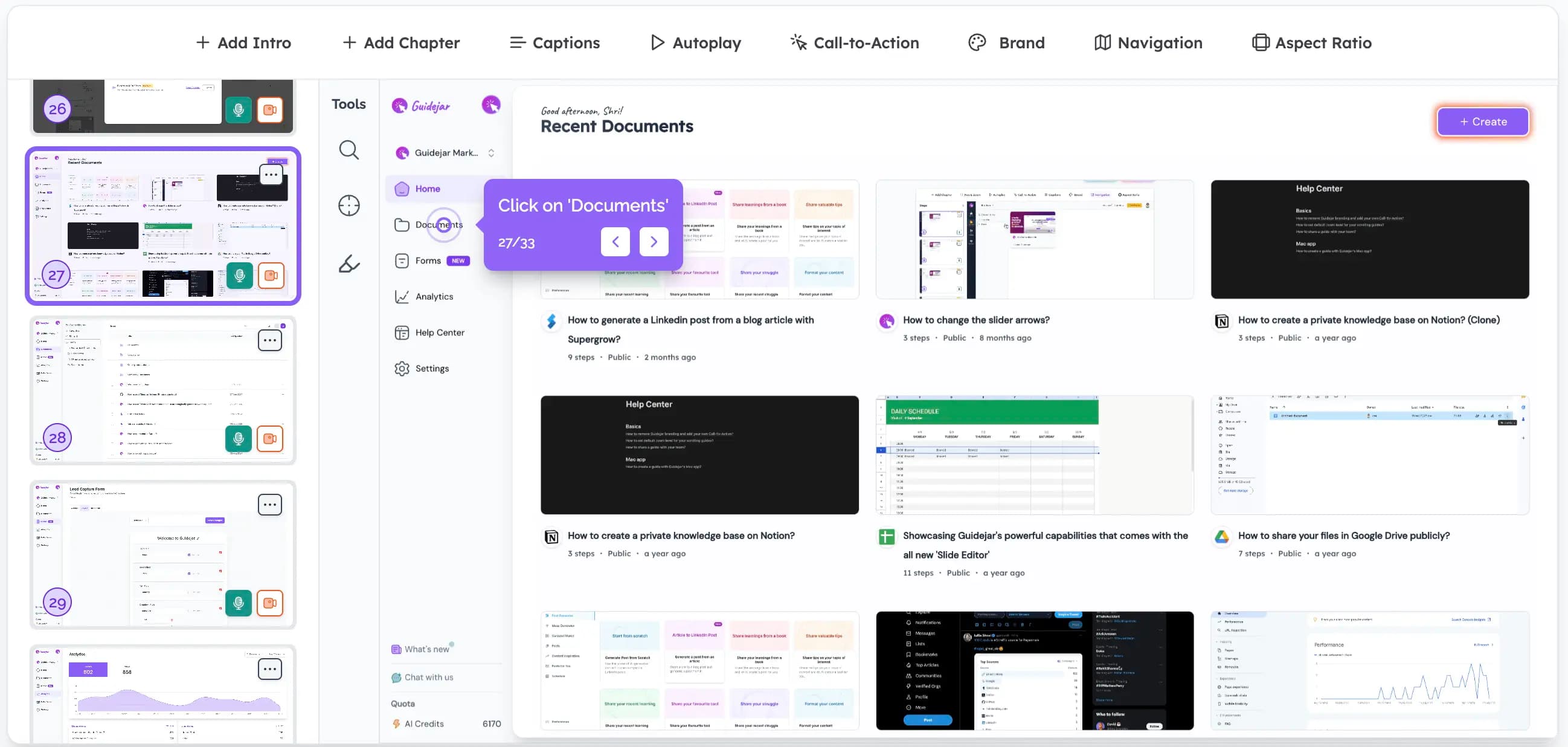
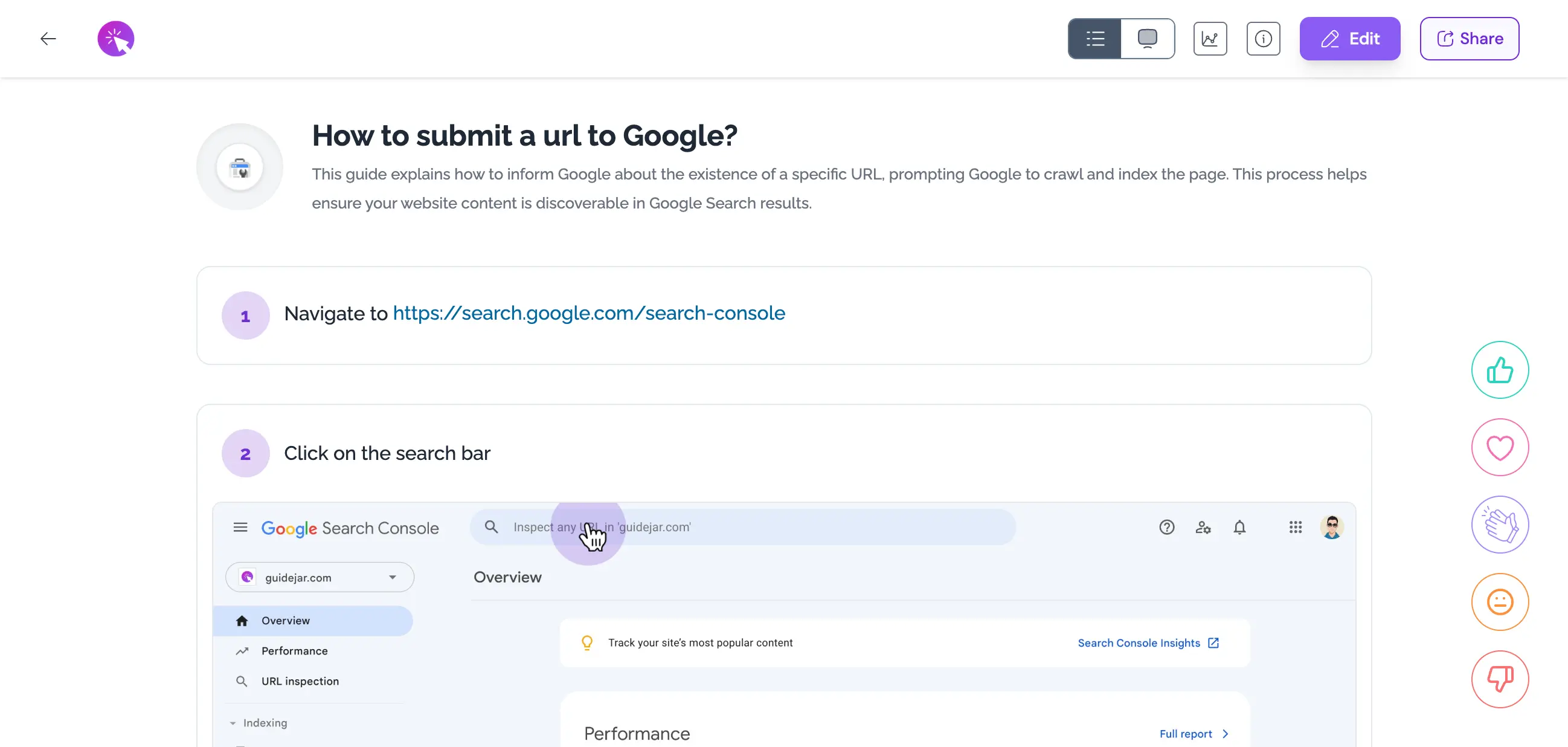
Guidejar takes one capture and publishes it as a Walkthrough View people click through with hotspots and branching, like both tools do, and as a Scroll View that reads as a written step-by-step doc, which neither does. Add AI voiceover, translate into 30+ languages, export it as MP4, PDF, HTML, or Markdown, and put the whole library on a searchable branded help center at your own domain. Self-serve from $19/seat/mo billed monthly, no sales call.
- One capture, published as an interactive walkthrough or a written SOP, chosen per guide
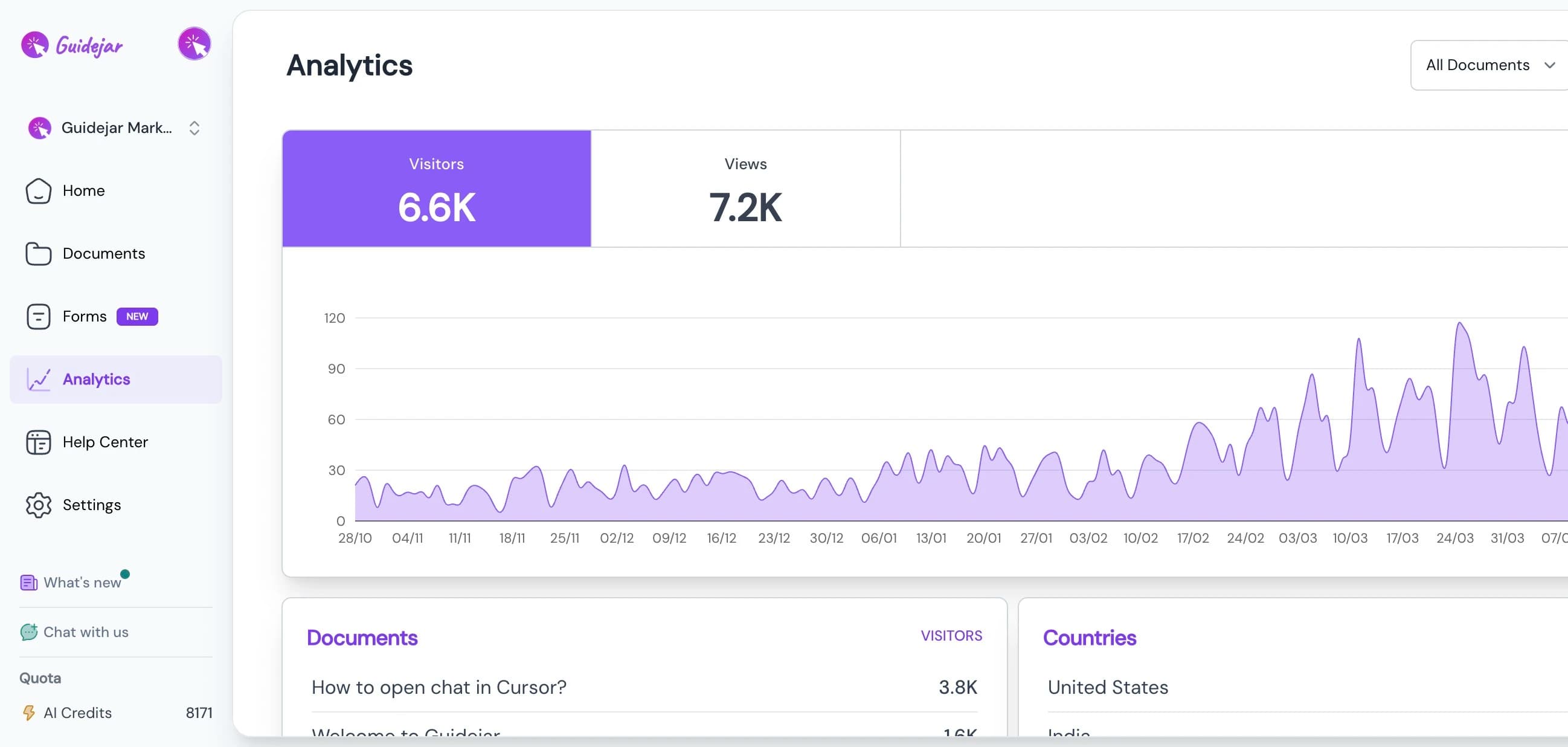
- Searchable branded help center on your own custom domain, with Ask AI
- Export and own your content: MP4 up to 30 min, plus PDF, HTML, and Markdown
- Guidejar MCP lets an AI agent build your SOP library and the whole team self-serve answers, from the Plus plan
Starting at
$19/mo
per seat, billed monthly ($16 billed annually), self-serve
vs Navattic $600/mo Basevs Walnut $575/mo, annual
Try Guidejar freeTransparent, self-serve pricing
Public per-seat rates you can buy today, not a digit-reel page or a “book a demo” gate
A written doc and a walkthrough from one capture
Scroll View reads as an SOP; Walkthrough View is clickable. Neither rival ships the written half
Own your content
Export as MP4, PDF, HTML, or Markdown instead of being locked to a hosted demo
Trusted by teams worldwide










How Guidejar stacks up
The rows that actually separate them, with the third column filled in.
| Capability | Navattic | Walnut | Guidejar |
|---|---|---|---|
| Interactive clickable demo | Yes — core product | Yes — core product | Yes — Walkthrough View |
| Written step-by-step document | No — static PDF export only | Not available | Yes — Scroll View, all plans |
| Branded help center on your domain | Not available | Not available | Yes — Plus plan |
| Downloadable MP4 export | Yes — capped at 15 steps | Not available | Yes — up to 30 min, Plus plan |
| Demo-to-pipeline CRM attribution | Advanced analytics — Growth | Uncover + Salesforce app | No — basic analytics only |
| AI voiceover entry plan | Startup plan | All plans | Pro — $19/seat/mo |
| Multi-language translation | Growth — 35 languages | Scale / add-on — 243 languages | Pro — 30+ languages |
| MCP / AI-tool access | Builds demos, reads analytics — Startup+ | Read-only analytics — Data API (Scale) | Authors your docs + team Q&A — Plus |
| Buying model | $500/mo annual or $600 monthly, 5 seats | $575/mo, annual, sales-led only | $19/seat, self-serve, monthly or annual |
Switching to Guidejar
From either tool, most teams finish the move in 1–2 weeks.
- 1
Export what you have
Navattic gives you static exports on the way out: a PDF capped at 60 steps, an MP4 capped at 15, a GIF, and copy-as-text. Walnut gives you much less, no MP4, PDF, or HTML export at all, only an offline interactive package and CSV export of guide text. The interactive demos themselves stay hosted in both.
- 2
Import into Guidejar
Turn exported PDFs, Markdown, or existing screenshots into guides with our importer, with no all-time import cap. Anything live takes a couple of minutes to re-capture with our Chrome extension, or the desktop app if you need to record a non-browser app.
- 3
Publish it properly
Choose Walkthrough View or Scroll View or both per guide, add AI voiceover, translate into 30+ languages, and put the whole library on a branded help center at your own domain.
“Guidejar is a lifesaver. Software is amazing.”
Christian Smith, CEO of CareerNiche Inc.
Frequently asked questions
The questions people actually search before picking one of the two.Something else on your mind? Talk to us
Neither, in the abstract. They compete for the same job, no-code interactive product demos for go-to-market teams, so it comes down to access and depth. Navattic wins if you want to try before you buy: it has a free Starter tier, a lower entry price with a monthly option, autonomous agent demos (sold separately as Navattic Agents), A/B testing, and downloadable MP4 and PDF exports. Walnut wins on enterprise depth: a real Salesforce app, Walnut Uncover deanonymization, Digital Sales Rooms, and SOC 2. Neither produces a written SOP or hosts a branded help center on your own domain, which is where Guidejar comes in.
Navattic is, in a limited way. Its free Starter tier gives you one published demo on one seat with the default theme, enough to evaluate but not to run a real program. Walnut has no free plan and no free trial at all: every plan CTA is “book a demo,” and the cheapest way in is Ignite at $575/mo billed annually, which is $6,900 a year. Guidejar is self-serve from $19/seat/mo, with a 7-day free trial on paid plans.
They land in a similar range. Navattic’s Base is $500/mo billed annually for five seats ($600 billed monthly), and Growth $1,000/mo for ten ($1,200 monthly), shown on its pricing page as animated digit reels; a Startup plan for eligible seed-stage teams does not display its price. Walnut is annual only: Ignite is $575/mo billed annually ($6,900/yr) for three editor seats, and Accelerate is $1,550/mo ($18,600/yr) for six, with a pooled AI-credit allowance on each plan and the Buyer Xpert agent billed per answered conversation. Guidejar Business bundles five seats for $75/month billed monthly, or $59/month billed annually.
Both can, but on different terms. Walnut includes AI text-to-speech narration on every plan, with a choice of narrator voices and unlimited generations. Navattic has AI voiceover too, generated from step text, on every paid plan from its Startup plan up, with premium voices on Base. Neither offers voice cloning of your own voice: Navattic’s cloning is part of AI avatar cloning on Growth, and Walnut uses preset voices only. Guidejar includes AI voiceover on its Pro plan and clones your own voice on Business.
Only partly, and the interactive demo itself never leaves. Navattic exports a PDF capped at 60 steps, an MP4 capped at 15 steps, a GIF, and copy-as-text. Walnut exports nothing portable: no MP4, no PDF, no HTML source, just an offline package for playback and CSV import and export of guide text. In both, the demos are proprietary hosted HTML shared by link, embed, or package, so switching means rebuilding. Guidejar exports the same capture as MP4, PDF, HTML, or Markdown, so you own what you make.
Yes, and this is where Walnut is strongest. Its enterprise Salesforce app launches demos, scores engagement, and flags deal risk inside the CRM, plus it connects to HubSpot, Marketo, Pardot, Slack, and adds Walnut Uncover for viewer deanonymization. Navattic has real native connectors too, including HubSpot, Salesforce, Marketo, Pardot, Segment, and ZoomInfo, alongside A/B testing and account identification. Guidejar’s integrations are lighter here: it embeds and copies into tools like Notion and Confluence but is not built for CRM pipeline attribution.
Both have an endpoint, but not the kind that builds your documentation. Navattic’s MCP server lets AI tools read your demo analytics and build and manage demos, from its Startup plan up. Walnut’s shipped MCP server wraps its Data API (Scale) with three read-only analytics tools, an analytics endpoint rather than an authoring tool; a companion MCP for running Walnut from your own AI provider was announced in September 2026 but had not visibly shipped as of October. Guidejar’s MCP does something different: an AI agent can build a whole SOP library from your existing docs, and your whole team can self-serve answers by connecting the same server to their own ChatGPT or Claude. It is on the Plus plan at $25/seat.
Not really. Navattic can export a static PDF document of a demo, capped at 60 steps, but it is a flat file, not a living written article, and it has no hosted help-center product. Walnut produces interactive demos only, with guide text living inside the demo and no standalone written document or knowledge base. Neither hosts a branded, searchable help center at your own domain. Guidejar publishes the same capture as a written Scroll View and a clickable Walkthrough View, and puts the whole library on a help center on your own domain from the Plus plan.