Arcade vs Supademo in 30 seconds
These two are head-to-head competitors, not opposites. Arcade leads with “You’re the storyteller. Arcade makes every format effortless.” Supademo leads with “The AI demo platform for the full customer journey.” Both capture your product and turn it into a clickable demo, and both sell to marketing, sales, and enablement. Same category, same buyer.
What differs is where each one leans. Arcade has re-centred on AI content: prompt-to-video generation grounded in a Brand Kit, a Figma plugin that lets you demo screens before they exist, Page Morph for cleaning up data before you record, Audience Reveal to de-anonymise who is watching, and an MCP server on every plan. Supademo leans into the revenue and training motion: guided HTML demos that clone your app’s front-end, sandbox demos a prospect free-explores, Route Hub, an AI Demo Agent, native HubSpot and Salesforce connectors, a free SCORM wrapper for your LMS, and an in-app searchable Demo Hub from its entry paid plan. If the deliverable is polished content, Arcade fits. If it feeds a pipeline or an LMS, Supademo does.
Price starts level and then splits. Both entry paid plans are $50 a seat billed monthly, though Supademo is a little cheaper billed annually ($38 vs $42.50). Supademo’s marquee HTML demos start on its new Business plan at $199/mo billed annually for one creator, and sandbox demos sit on Growth at $350/mo for five, while Arcade caps its Growth plan at 10 seats and meters AI video in credits. The full table and pricing math are below. There is also a third option worth a look, since neither tool publishes a written help article from the same capture or hosts a branded, searchable help center on your own domain.
Four differences that decide it
Both capture a product from a browser extension and both publish an interactive demo. From there they pull in different directions.
Output focus
AI-generated video vs HTML-cloned demos
This is the core split. Arcade generates marketing video from a prompt, grounded in a Brand Kit that pulls your logos, colours, and fonts off your website, and it says a new video averages six minutes to make. Its changelog ships video improvements roughly weekly. Supademo went the other way. Its guided HTML demos clone your app’s actual front-end so the demo is pixel-perfect and the text inside it stays editable after capture, and its sandbox demos let a prospect click around freely instead of following a fixed path. One tool is chasing polished video, the other a demo a buyer can drive. Both still produce a standard screenshot walkthrough too.
What each plan gates
The price you see isn’t the price of the feature you want
Both start at $50 a seat billed monthly, and both hide their best work higher up. Arcade’s Growth plan is capped at 10 seats, so a bigger team means an Enterprise conversation, and its monthly AI credits run out fast on generated video (from 19 October 2026 AI video moves to a separate paid video plan). Supademo’s Scale plan is the friendlier entry annually at $38, but its guided HTML demos, sandbox demos, Route Hub, and voice cloning are all “not included in Scale.” HTML demos now start on Business at $199/mo billed annually ($249 monthly) for one creator, and sandbox, Route Hub, and voice cloning still need Growth at $350/mo for five creators ($450 monthly). Neither tool lets you buy its headline capability at its entry price.
Delivery & measurement
Who sees the demo, and what you learn from it
Arcade treats the demo as a demand-gen instrument. On Growth it de-anonymises the companies watching, ranks them on a dedicated Leads page, tracks branches, and pushes events into Amplitude, Mixpanel, PostHog, Segment, and Google Analytics. Supademo aims the same energy at self-serve and support. Its Demo Hub is a searchable in-app widget that surfaces categorised demos inside your own product, on Scale and up, and HubSpot, Salesforce, Marketo, Seismic, and Intercom are native connectors from Scale that sync viewers as identified leads. Different shapes of the same goal: turn a viewer into something your team can act on.
Capture & pre-record editing
Cleaning up the demo before anyone sees it
Arcade’s Page Morph is genuinely unusual. From the Chrome extension you click any text or element on the live page and rewrite it before you start recording, and the edit sticks across clicks and reloads, so you can scrub customer names or demo copy that doesn’t exist yet. Supademo takes a different route: Smart blur auto-detects and redacts sensitive content as you capture, on Scale, and its HTML demos let you find-and-replace text and data after the fact. Arcade edits the page before the record; Supademo cleans the capture after it. Both beat manually blurring frame by frame.
Feature-by-feature comparison
Same category, different bets. Grouped and side by side, with plan gating on every cell.
| Capability | Arcade | Supademo |
|---|---|---|
| Capture | ||
| Browser capture | Yes — all plans, Chromium only | Yes — free plan |
| Desktop capture (Mac & Windows) | Yes — all plans | Scale plan |
| Figma import | Yes — all plans | Yes — free plan |
| Build from screenshots you already have | Manual upload | Yes — free plan, upload & reorder |
| Video-to-guide import | Yes — Video to Arcade | Yes — Video Splitting, free plan |
| Manual blur & annotations | Blur on Growth plan | Blur & annotate on Scale |
| Automatic PII redaction | No — manual blur only | Smart blur — Scale plan |
| Demo & interactivity | ||
| Hotspots & callouts | Yes — all plans | Yes — free plan |
| Chapters | Yes — all plans | Yes — free plan |
| Interactive branching | Growth plan | Scale plan |
| Dynamic variables | Growth plan | Scale plan |
| HTML / DOM-cloned demos | Enterprise — HTML capture | Business plan |
| Sandbox (free-exploration) demos | Not available | Growth plan |
| Pre-capture live page editing | Page Morph — Growth | No — HTML edit is post-capture |
| Adaptive viewer routing | Not available | Route Hub — Growth |
| Lead-capture forms | Growth plan | Scale plan |
| Visitor de-anonymisation | Audience Reveal — Growth | CRM lead sync — Scale |
| AI & output | ||
| AI voiceover | Yes — all plans | Scale plan |
| AI voice cloning | Yes — bring your own ElevenLabs key | Growth plan |
| Multi-language translation | Growth plan | Scale plan — 50+ languages |
| Prompt-to-video AI generation | Yes — Creator Studio | Not available |
| Voice-led AI demo agent | Not available | AI Demo Agent — prepaid credits, Scale+ |
| Written step-by-step doc from the same capture | Step-by-Step Guide — Growth, static, no embed or analytics | Copy Steps + Steps view — free plan |
| Import & export | ||
| Import steps from PDF / DOCX | Into AI Video only | No — screenshots & video only |
| PDF export | Growth plan, via Step-by-Step | Yes — free plan (Export as SOP) |
| MP4 export | Growth plan, up to 720p | Free plan (1080p, watermark); 4K on Scale |
| HTML file export | Not available | Clipboard copy only, no file |
| Markdown export | Not available | Not available |
| SCORM / LMS package | Not available | Yes — free SCORM 1.2 wrapper |
| Paste into Confluence or Notion | Copy steps — Growth plan | Copy Steps — free plan |
| Publishing & platform | ||
| Hosted branded help center (article KB) | No — Share Page & Collections, not an article KB | No — Showcase gallery, not an article KB |
| In-app contextual delivery | Not available | Demo Hub — Scale plan |
| Custom domain | Enterprise only | Scale plan |
| MCP server (AI tool access) | Yes — all plans, incl. Free | Scale plan |
| Native CRM & analytics connectors | Amplitude, Mixpanel, PostHog, Segment, HubSpot, Slack (Growth) | HubSpot, Salesforce, Marketo, Seismic, Intercom, Slack (Scale) |
| Analytics | Growth plan — Audience Reveal, Leads | Scale plan — viewer & account insights |
| SAML SSO | Enterprise only | Enterprise only |
| Pricing | ||
| Free plan | 1 published demo + 1 published AI video | 5 guided demos, watermarked |
| Entry paid plan (billed monthly) | $50/seat — Growth | $50/creator — Scale |
| Entry paid plan (billed annually) | $42.50/seat — Growth | $38/creator — Scale |
| HTML demos plan | Enterprise — HTML capture | Business — $249/mo, or $199 annually, 1 creator |
| Sandbox demos plan | No sandbox | Growth — $450/mo, or $350 annually, 5 creators |
| Seat model & caps | Growth caps at 10 seats | Per creator; 5 free view-only seats on Scale, unlimited from Business |
| Enterprise | Custom | Custom — min 10 creators |
On the core demo, these two are close, and both make a real interactive walkthrough with hotspots, chapters, branching, and variables. They diverge on the bet each one placed. Arcade is ahead on AI video generation, the Figma plugin and desktop capture on every plan, Page Morph, and MCP access from the free tier. Supademo is ahead on HTML-cloned and sandbox demos, a free SCORM wrapper for LMS delivery, an in-app Demo Hub and native CRM connectors at the entry paid tier, and a more usable free plan (5 demos against 1). Price starts level at $50 monthly and Supademo edges it annually. Both leave the same two things on the table: no written help article from the same capture, and no branded searchable help center on your own domain.
Verified against both vendors’ public pricing and documentation, October 2026. Spot something out of date? Tell us and we’ll correct it.
Pricing compared
Every number below states its billing interval. Mixing them is how comparisons mislead.
$50/seat/mo
Arcade Growth billed monthly — $42.50/seat billed annually; caps at 10 seats
$38/creator/mo
Supademo Scale billed annually — $50/creator billed monthly; HTML demos need Business ($199/mo), sandbox needs Growth ($350/mo), both annual
$19/seat/mo
Guidejar Pro billed monthly — $16/seat billed annually
Bottom line: the two start level. Billed monthly, five seats on either Arcade Growth or Supademo Scale runs $250 a month, and Supademo edges it billed annually at $190 against Arcade’s $212.50. The catch is what that entry price buys. Supademo’s pixel-perfect HTML demos, the ones people actually shop it for, start on Business at $199/mo billed annually ($249 monthly) for one creator, and sandbox demos need Growth at $350/mo for five ($450 monthly). Arcade’s Growth caps at 10 seats while metering AI video in credits. If you mostly need a clean interactive walkthrough plus a written doc and a place to host it, five seats of Guidejar Business is $75/month billed monthly, or $59/month billed annually.
Prices as of October 2026. Arcade Growth is $50/seat/mo monthly or $42.50 annually, and Arcade moves AI video to a separate paid video plan from 19 October 2026; Supademo Scale is $50/creator monthly or $38 annually; Supademo Business is $249/mo monthly or $199 annually for 1 creator; Supademo Growth is $450/mo monthly or $350 annually for 5 creators. Guidejar Business bundles 5 seats.
Where each one genuinely wins
Neither tool is a strictly better version of the other. These are the real, checkable advantages.
Arcade: AI video generation as a category
Creator Studio makes marketing video from a prompt, grounded in a Brand Kit that pulls your logos, colours, fonts, and writing style off your website, plus source material you attach as PDFs, Office files, images, or URLs. Arcade says a new video averages six minutes, and the changelog ships video work roughly weekly. This is a whole product category Supademo does not compete in. Its AI Demo Agent is a voice-led sales agent, not a video generator.
Arcade: Page Morph, the Figma plugin, and a leads pipeline
Page Morph edits the live page before you record, so you can scrub real customer data or demo screens that don’t exist yet, and the Figma plugin lets marketing ship a clickable walkthrough before engineering has built the screen. Both are unusual. On top of that, Audience Reveal de-anonymises the companies watching and feeds a dedicated Leads page. If demo-sourced pipeline is the number you report on, that is deeper than Supademo’s viewer analytics.
Supademo: HTML-cloned and sandbox demos
From its Business plan up, Supademo clones your app’s actual front-end rather than stitching screenshots, so the demo is pixel-perfect and the text and data inside it stay editable after capture. Sandbox mode, on Growth, then lets a prospect free-explore with invisible hotspots instead of walking a fixed path. Arcade’s nearest equivalent, HTML capture, is Enterprise-only, and it has no free-exploration sandbox at all. For a demo-led sales team, this is a genuine structural gap.
Supademo: free SCORM, an in-app Demo Hub, and CRM connectors
Supademo wraps any demo as a SCORM 1.2 package for Cornerstone, Docebo, or Moodle, free and without an account, reporting completion and score back to the LMS. Fair caveat: it is an iframe wrapper, so the module needs live access to Supademo. Its Demo Hub is a searchable in-app widget from Scale, and HubSpot, Salesforce, Marketo, and Seismic are native connectors from Scale. Arcade offers none of the three. Its free plan also stops at one published demo, against Supademo’s five.
Which tool is right for you?
Same category, different shape. Honest recommendations based on what your demos have to do.
Choose Arcade if
- Your deliverable is polished marketing content and AI-generated video, not just a captured walkthrough
- You need to demo screens or copy that don’t exist yet, via the Figma plugin and Page Morph
- Demo-sourced pipeline is the metric, and Audience Reveal plus the Leads page is the reason
- You want generous capture and an MCP server on the free plan, before you pay anything
- Visual polish of the output is the thing your team gets judged on
Choose Supademo if
- You need a pixel-perfect HTML-cloned demo (Business) or a free-exploration sandbox for prospects (Growth)
- You have an LMS mandate, since SCORM 1.2 packaging is a box Arcade cannot tick
- You want in-app searchable guidance through Demo Hub at the entry paid tier
- You want native HubSpot, Salesforce, Marketo, or Seismic lead sync at the entry paid tier
- A more usable free plan matters, and five demos beats Arcade’s one
Marketing and AI-video teams lean Arcade. Sales and enablement teams who need HTML demos or LMS delivery lean Supademo.
They compete for the same job, so the choice is whether your deliverable is polished content, where Arcade’s video and demo polish win, or a demo that clones your app and feeds a CRM or an LMS, where Supademo’s HTML, sandbox, and SCORM win. Both are strong at making a demo. Neither publishes a written help article from the same capture, and neither hosts your content in a branded searchable help center on your own domain. That is the gap the third option below fills.
Both of them stop at the same place
Arcade and Supademo both make a good interactive demo. Neither one turns that same capture into a written help article, and neither hosts a branded searchable help center on your own domain. If your demos need to double as documentation and support content, that gap costs you a second tool. Here is the third option.
Guidejar
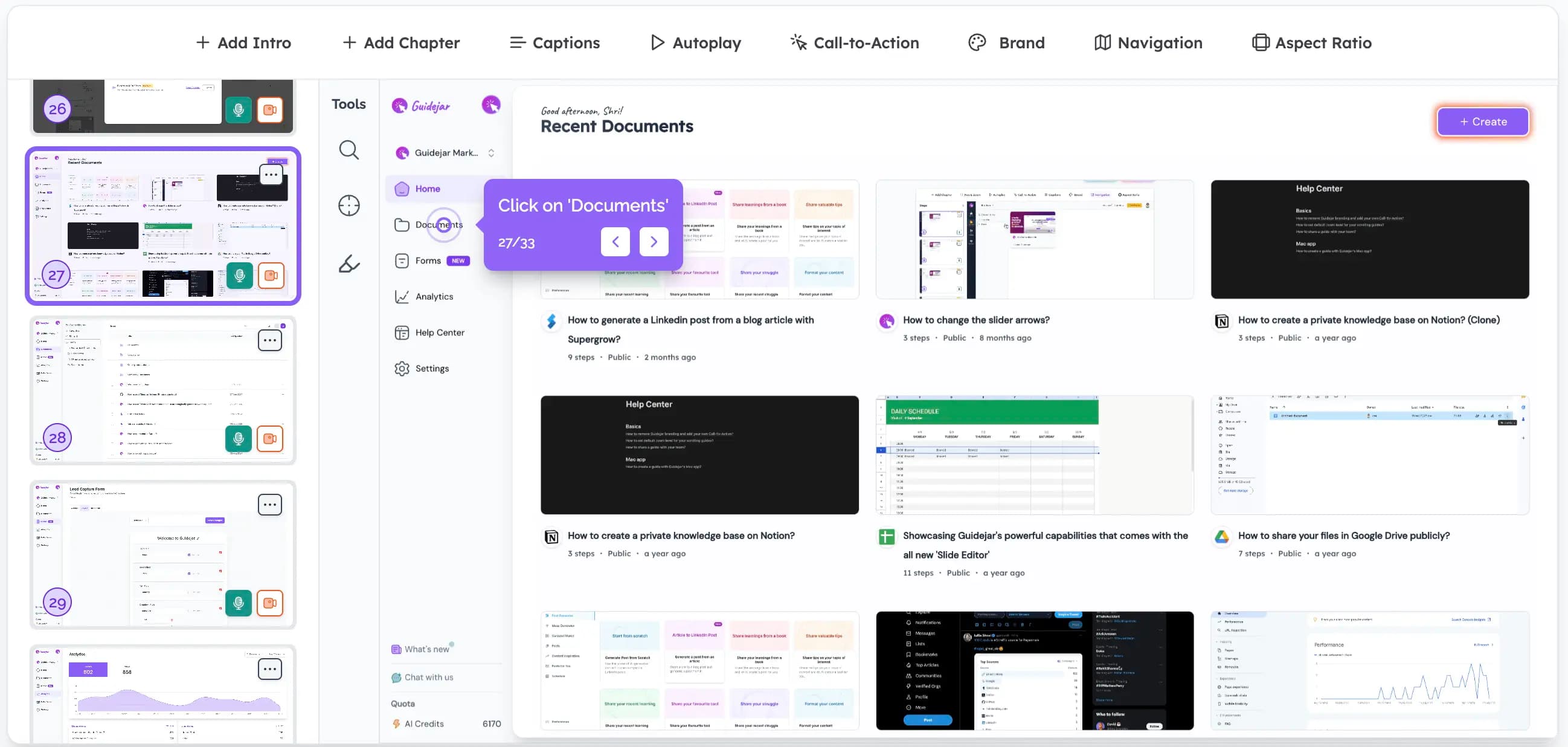
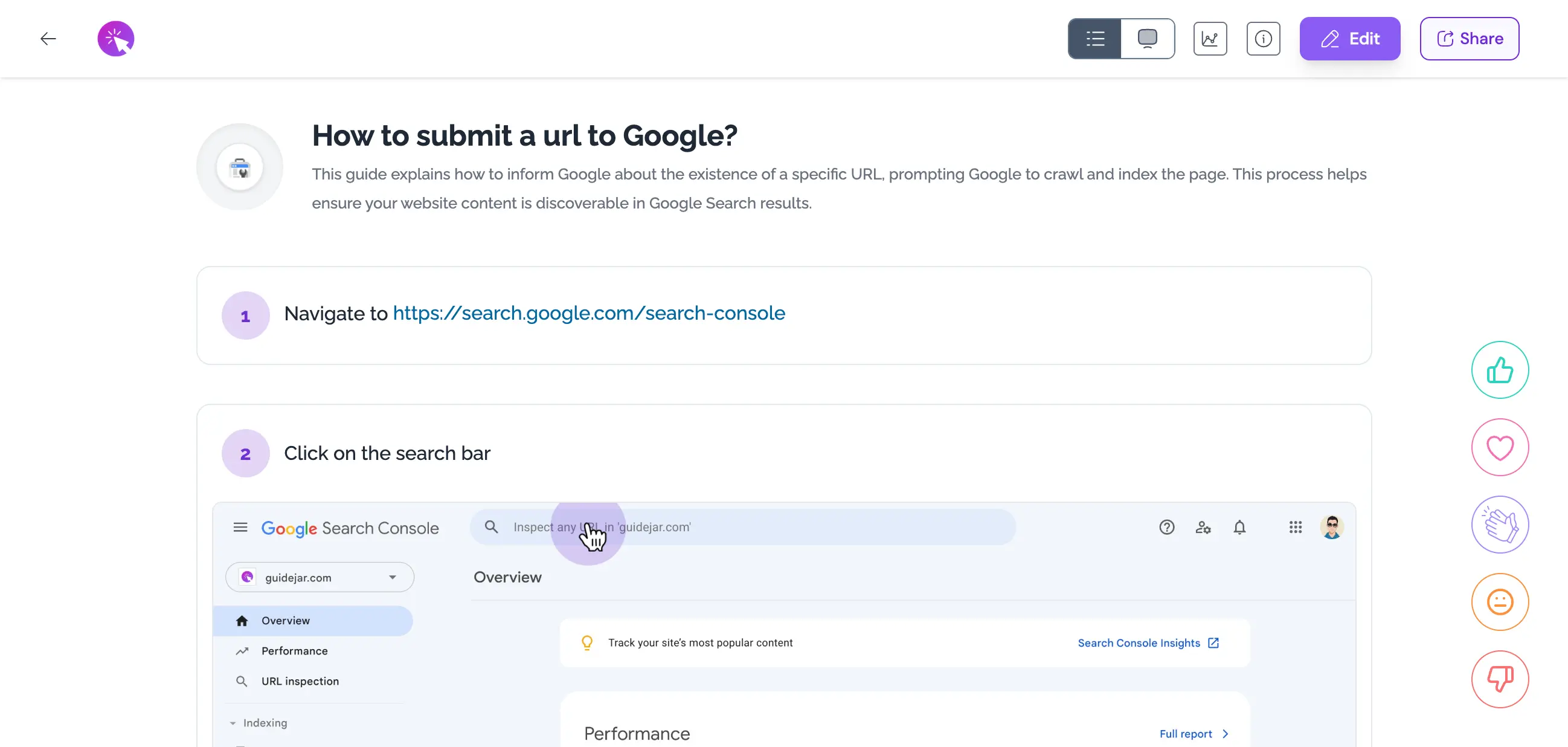
Guidejar takes one capture and publishes it two ways: a Walkthrough View people click through with hotspots and branching, and a Scroll View that reads as a written step-by-step doc. Pick either or both per guide, no rework. The whole library then lives in a searchable, branded help center at your own domain, and you can export it as MP4, PDF, HTML, or Markdown whenever you want. From $19/seat/mo billed monthly.
- One capture, published as a clickable Walkthrough View and a written Scroll View doc, chosen per guide
- Searchable branded help center on your own custom domain, with Ask AI ticket deflection
- MP4 export on the Plus plan with AI voiceover, and translation into 30+ languages from Pro
- Own and export your content as MP4, PDF, HTML, or Markdown, instead of hosted-only lock-in
Starting at
$19/mo
per seat, billed monthly ($16 billed annually)
vs Arcade $50/seat/movs Supademo $50/creator/mo
Try Guidejar freeWalkthroughs and docs in one tool
The same recording becomes an interactive walkthrough and a written guide, so support and onboarding aren’t a separate subscription
MCP that builds a knowledge base
An AI agent turns your docs into a written SOP library your team queries from ChatGPT or Claude, where Arcade’s and Supademo’s MCP author demos instead
Transparent $19/seat pricing
Self-serve and public, with no 10-seat cap and no $199 or $350 jump to reach the headline features
Trusted by teams worldwide











How Guidejar stacks up
The rows that actually separate them, with the third column filled in, and Guidejar conceding where it should.
| Capability | Arcade | Supademo | Guidejar |
|---|---|---|---|
| Interactive demo / walkthrough output | Yes — core product | Yes — core product | Yes — Walkthrough View, Pro plan |
| Written step-by-step doc from the same capture | Step-by-Step Guide — Growth, static, no embed | Copy Steps + Steps view — free plan | Scroll View — live & embeddable, all plans |
| Branded help center on your domain | No — Collections gallery only | No — Showcase gallery only | Yes — Plus plan |
| Downloadable MP4 export | Growth — up to 720p | Free (1080p, watermark); 4K on Scale | Plus — up to 30 min, AI voiceover |
| HTML / sandbox demos | Enterprise — HTML capture | HTML on Business; sandbox on Growth | Not available |
| SCORM / LMS export | Not available | Yes — free wrapper | Not available |
| AI video generation | Yes — Creator Studio | Not available | Not available |
| Multi-language translation | Growth plan | Scale — 50+ languages | Pro — 30+ languages |
| Entry paid price (billed monthly) | $50/seat — Growth | $50/creator — Scale | $19/seat — Pro |
Switching to Guidejar
From either tool, most teams finish the move in a few days.
- 1
Export what you have
Arcade exports GIF and MP4 on Growth, plus a Step-by-Step PDF, but its free plan can’t export at all. Supademo is more generous per demo, with PDF, MP4, and a free SCORM wrapper, though a bulk workspace export is Enterprise-only.
- 2
Import into Guidejar
Run your exported MP4s through our AI Video-to-Guide Maker, or turn PDFs and existing screenshots into guides with our importer, with no all-time import cap. Anything else re-captures in a couple of minutes with our extension or desktop app.
- 3
Publish it properly
Choose Walkthrough View or Scroll View or both per guide, add AI voiceover, translate into 30+ languages, and put the whole library on a branded help center at your own domain.
“Guidejar is an incredible tool! Super intuitive and easy.”
Magdalena Brancewicz, Co-founder at Beelday
Frequently asked questions
The questions people actually search before picking one of the two.Something else on your mind? Talk to us
Neither, in the abstract. They compete for the same job, so it comes down to what your demos have to do. Arcade wins if the deliverable is polished marketing content or AI-generated video, and it adds a Figma plugin, Page Morph, and Audience Reveal for demand-gen teams. Supademo wins if you need a pixel-perfect HTML clone or a free-exploration sandbox for prospects, an LMS-ready SCORM package, or in-app searchable guidance through Demo Hub. Neither one publishes a written help article from the same capture or hosts a branded help center on your own domain, which is where Guidejar comes in.
Both entry paid plans are $50 a seat billed monthly. Arcade Growth drops to $42.50 billed annually and caps at 10 seats. Supademo Scale drops to $38 billed annually, but its guided HTML demos, the feature it’s best known for, start on Business at $249/mo, or $199 billed annually, for one creator, and sandbox demos sit on Growth at $450/mo, or $350 billed annually, for five creators. Above those, both go to custom Enterprise pricing. Guidejar Pro is $19 a seat billed monthly, or $16 billed annually.
Both have a permanent free plan, and Supademo’s is the more usable one. Arcade Free gives one user 1 published interactive demo and 1 published AI video, 200 AI credits a month, and unlimited views, with generous capture (Chrome extension, desktop app, Figma plugin, AI voiceover, and MCP). Supademo Free gives 5 guided demos, 50 recordings, chapters, PDF export, and video-to-guide splitting, though everything carries a Supademo watermark. Guidejar’s free plan is 5 guides with browser capture, PDF export, sharing, and embedding, also watermarked.
Supademo does; Arcade doesn’t. Supademo wraps any demo as a SCORM 1.2 package for Cornerstone, Docebo, Moodle, and others, free and without an account, and it reports completion and score back to the LMS. One honest caveat: it’s an iframe wrapper, not a self-contained package, so the module needs live network access to Supademo, and it breaks if you cancel. Arcade has no SCORM export. For the record, Guidejar has no SCORM either, so if LMS delivery is a hard requirement, Supademo is the pick here.
Arcade. Its Creator Studio turns a prompt into a marketing video grounded in your Brand Kit, and Arcade says a new video averages about six minutes to make. Supademo has no prompt-to-video generator. Its AI Demo Agent is a different thing: a voice-led agent that runs discovery, plays the right interactive demo, and hands qualified buyers to sales, sold as prepaid credits on every paid plan. If AI video is what you want, that is squarely Arcade’s territory.
Page Morph is Arcade’s pre-recording editor. In the Chrome extension you click any text or element on the live page and rewrite it before you record, and the change persists across clicks and reloads, which is handy for scrubbing real customer data or demoing copy the product hasn’t shipped. It’s on Growth. Supademo doesn’t edit the live page before capture, but its HTML demos let you find-and-replace text and data after capture, plus AI data editing from the Business plan. Same goal, opposite ends of the workflow.
Written export, yes; a hosted article help center, no. Both can turn a demo into a written step-by-step doc: Arcade’s Step-by-Step Guide (Growth, static and not embeddable) and Supademo’s Copy Steps as an SOP (free). But neither hosts a searchable, branded article knowledge base on your own domain. Arcade’s Collections and Supademo’s Showcase are demo galleries, not article CMSes. Guidejar publishes the same capture as both a Walkthrough View and a written Scroll View, and puts the whole library on a help center at your own domain from the Plus plan.