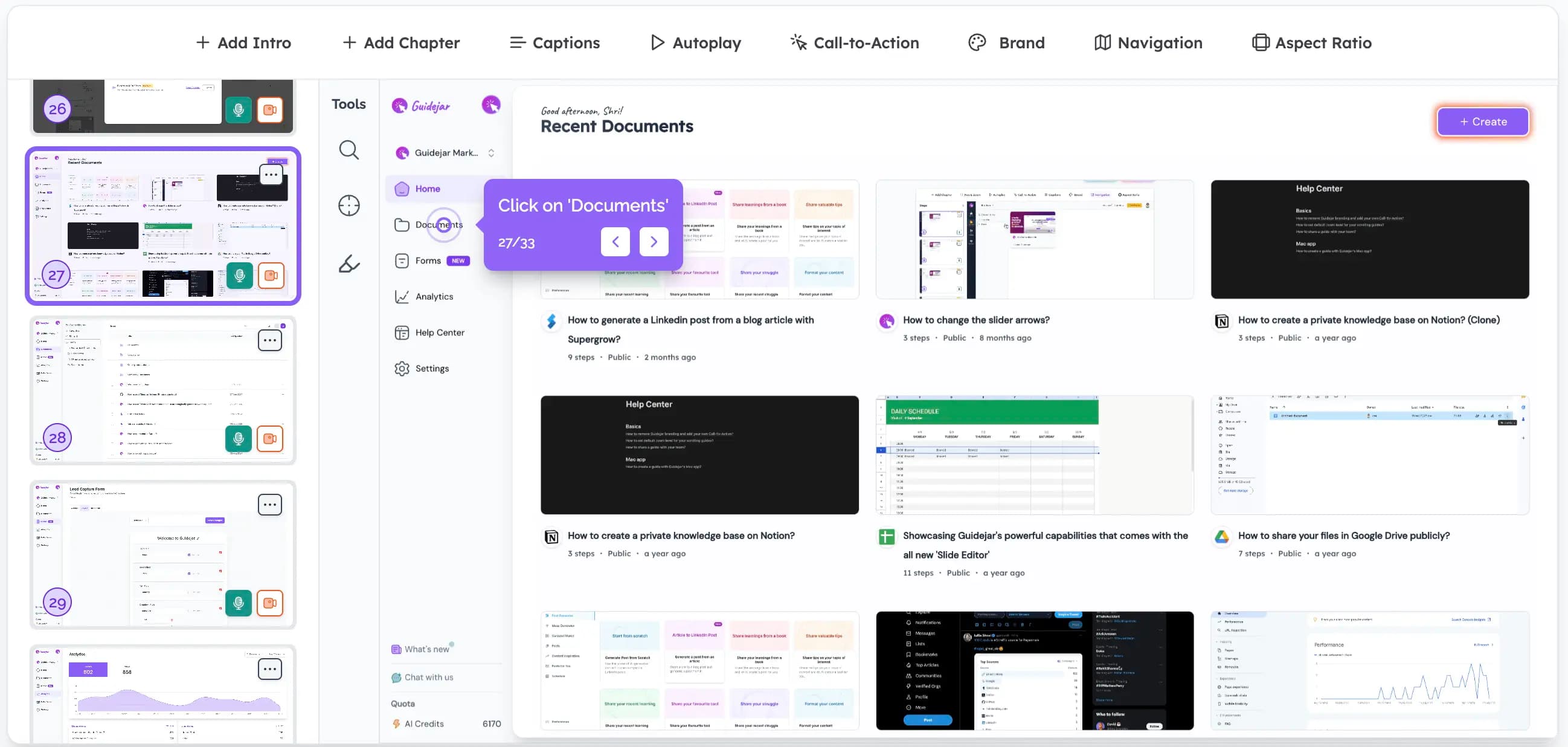
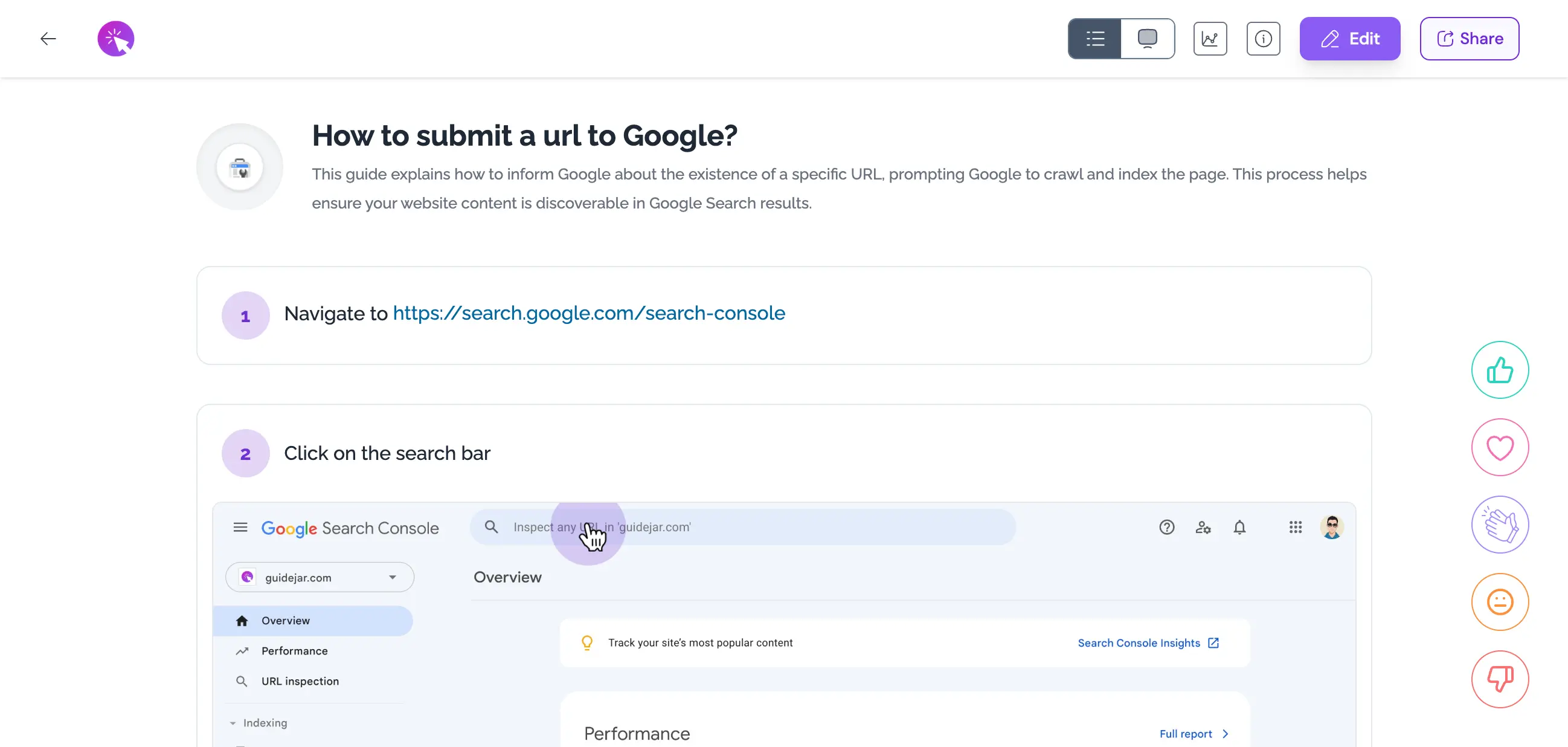
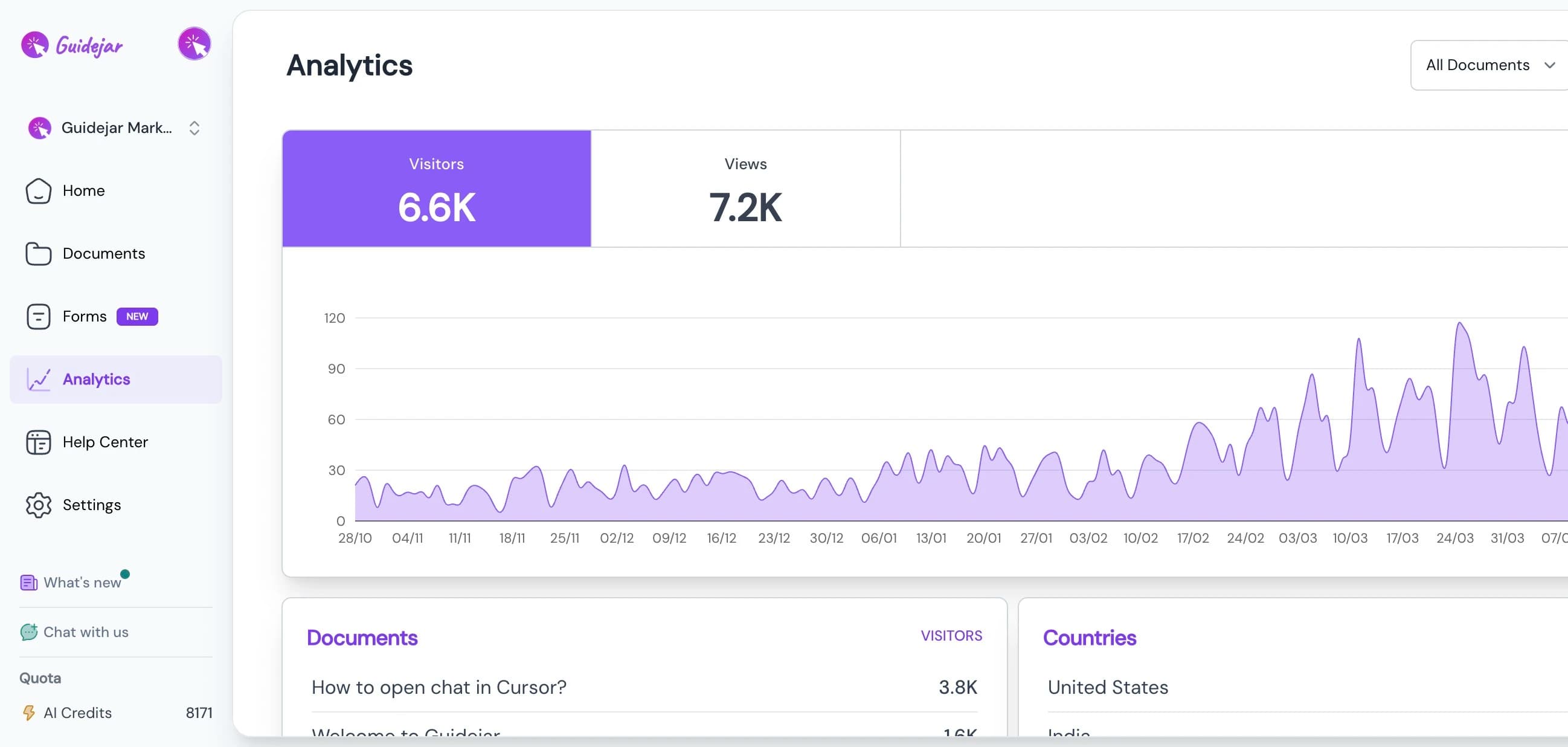
Guidejar vs Storylane in 30 seconds
Storylane is very good at what it does. Guided demos with chapters and personalisation, AI voiceovers, AI translations, lead capture, HTML-level editing of a captured screen, an MCP server for building demos from Claude or ChatGPT, and a sales layer that de-anonymises the people watching. Over 200,000 demos have been built on it. It also exports written documentation as PDF, Word, Markdown or SOP, which makes the common line that Storylane is demo-only simply wrong.
The problem is the ladder. Starter is $50/month for one seat, and every extra seat is another $40. The features most demo teams actually shop for, HTML demos, personalisation tokens and A/B testing, sit on Growth at $625/month for five seats. That works out at $125 a seat. SSO and a whitelabel demo URL need Premium at $1,500/month.
Guidejar covers the same job with interactive walkthroughs from $19/seat, puts a custom domain on a $25 plan and SAML SSO on a $75 one, and gives the finished walkthroughs somewhere to live: a searchable, branded help center on your own domain, which Storylane has no equivalent for. The full feature table and pricing math are below, and where Storylane is the better buy, we say so.
Four reasons demo teams pick Guidejar over Storylane
Both tools turn a captured flow into a clickable interactive walkthrough. Guidejar does that job for a fraction of the price, and without pricing SSO at $1,500 a month.
Price
The same interactive walkthroughs, $31 less per seat each month
Guidejar Pro is $19 a seat per month, or $16 billed yearly. Storylane’s cheapest paid tier is Starter at $50 a month for a single seat ($40 billed annually), with every additional seat charged at $40. Both sides give you branching, chapters, AI voiceover, translation, analytics and no watermark at that level. A three-person team pays $57 on Guidejar Pro against $130 on Storylane Starter, billed monthly.
The Growth tier
$125 a seat is where Storylane keeps the good stuff
Storylane’s Growth plan is $625 a month for five seats ($500 billed annually), which is $125 per person, with extra seats at $100 each. That tier is where the HTML Demo Editor, personalisation tokens and A/B testing live, so it is the one most demo teams end up quoted. Guidejar Business is $75 a month flat for five seats, or $15 a head, and it carries voice cloning, Ask AI and auto-redaction. The per-seat gap is roughly eight to one.
See Guidejar pricingEnterprise-priced basics
SSO and your own domain shouldn’t cost $1,500 a month
Storylane puts SSO and the Whitelabel Demo URL on Premium at $1,500 a month. Those are the two things a security review and a brand team ask for first, and they sit four tiers up. Guidejar publishes to your own domain on Plus at $25 a seat and adds SAML SSO for the help center on Business at $75 a month for five seats. Salesforce, Presenter Demos, Deal Intelligence and Hubs are on that same Premium tier, which is fair if you need them and expensive if you don’t.
Help center
Somewhere for finished walkthroughs to live and be searched
Both tools produce a written version of the same capture. The difference is what happens to it. Storylane’s written output is a download, and their docs are blunt about the trade: exported demos lose their interactivity and become view-only. Guidejar’s Scroll View is a live view of the same guide, embeddable and tracked in analytics, and the whole library publishes to a searchable help center at help.yourcompany.com with Ask AI answering from your own content on Business. Storylane has no hosted article knowledge base at any tier. Hubs are deal rooms for buyers, which is a different job.
Explore the help center
Feature-by-feature comparison
Side by side on the demo job first: capture, interactivity, exports, and price. Publishing and help center rows follow.
| Capability | Guidejar | Storylane |
|---|---|---|
| Building the demo | ||
| Browser capture | Yes — free plan | Yes — free plan |
| Interactive branching | Pro plan | Yes — guided demos |
| Chapters | Pro plan | Starter plan |
| Dynamic variables | Pro plan | Personalization Tokens — Growth, $625/mo |
| HTML / DOM-edited demos | Not available | HTML Demo Editor — Growth, $625/mo |
| Sandbox / live-environment demos | Not available | Enterprise only |
| AI voiceover | Pro plan, $19/seat | Free plan, 1-demo cap |
| Multi-language translation | Translate into 30+ languages, Pro plan | AI Translations, Starter plan |
| Lead-capture forms | Plus plan | Free plan, 1-demo cap; custom forms on Growth |
| A/B testing | Not available | Growth plan, $625/mo |
| Analytics | Pro plan | Basic on free, advanced on Starter |
| Written output & exports | ||
| Written step-by-step output | Yes — Scroll View, free plan | Yes — PDF, Word, Markdown or SOP |
| That output stays live & interactive | Yes — Scroll View is a hosted, tracked view | No — exports are view-only |
| PDF export | Yes — free plan | Included |
| Markdown export | Pro plan | Included |
| Word export | No — PDF, HTML & Markdown | Included |
| Downloadable MP4 export | Plus plan | Starter plan |
| GIF export | Not available | Free plan, 1-demo cap |
| Offline download | Not available | Growth plan, $625/mo |
| Publishing, sales & AI | ||
| Hosted branded help center (articles) | Plus plan | No — Hubs are buyer deal rooms |
| Custom domain | Plus plan, $25/seat | Whitelabel Demo URL — Premium, $1,500/mo |
| AI answers from your own content | Help Center Ask AI, Business plan | Not available |
| MCP server (AI integration) | Build & query your guide library with AI (Plus) | Build & publish demos with AI (Starter) |
| Visitor de-anonymisation | Not available | Account Reveal — 250/mo Starter to 10k/mo Premium |
| Native CRM connectors | Insta Copy paste, not native connectors | HubSpot & Zapier on Starter, Salesforce on Premium |
| SAML SSO | Business plan (help center), Enterprise org-wide | Premium plan, $1,500/mo |
| Pricing | ||
| Free plan | 5 guides, 1 user, watermarked | 1 published demo at a time, 1 seat |
| Starting paid price (billed monthly) | $19/seat — Pro | $50 for 1 seat — Starter |
| Each extra seat (billed monthly) | +$19 — Pro | +$40 — Starter |
| Five-seat team (billed monthly) | $75 flat — Business | $210 — Starter at 5 seats |
| Tier with HTML demos & personalisation | Not available | $625/mo for 5 seats — Growth |
| Tier with SSO & a whitelabel domain | $75/mo for 5 seats — Business | $1,500/mo for 10 seats — Premium |
| Free viewer seats | No — workspace viewers need a seat; help-center & share-link readers are free | Yes — free Viewer seats from Starter |
| Yearly billing discount | Save 2 months | 20% off |
| Enterprise | Custom, from 10 users | Custom — adds sandbox demos |
On the demo itself these two are closer than the price gap suggests. Capture is a tie, both build clickable guided walkthroughs with chapters and branching, both do AI voiceover and translation, and both produce a written step-by-step document from the same capture. Storylane wins outright on HTML-edited demos, sandbox demos, A/B testing, visitor de-anonymisation, GIF and Word export, native CRM connectors and free viewer seats. What differs is the ladder. Guidejar puts branching, variables and voiceover on a $19 plan rather than a $50 one, a custom domain on $25 rather than $1,500, and gives finished walkthroughs a searchable branded help center to live in. One more thing worth knowing before you commit a library: Storylane’s own docs say downloaded demos lose their interactivity.
Verified against Storylane’s public pricing and documentation, October 2026. Spot something out of date? Tell us and we’ll correct it.
Pricing compared
Same team, same job, a much smaller bill.
$1,620less/year
for a 5-person team, both billed monthly
$19/seat
Guidejar Pro monthly vs Storylane Starter at $50 for one seat
8×per seat
Storylane Growth at $125/seat/mo vs Guidejar Business at $15
Bottom line: Billed monthly, five people on Storylane Starter costs $210 a month, because the plan covers one seat at $50 and charges $40 for each of the other four. The same team on Guidejar Business costs $75 flat, which is $1,620 less per year. The gap widens as you climb: HTML demos, personalisation tokens and A/B testing require Growth at $625 a month for five seats, or $125 a head against Guidejar’s $15, and SSO with a whitelabel demo URL requires Premium at $1,500 a month.
Prices as of October 2026, billed monthly. Billed annually, Storylane is 20% off (Starter $40, Growth $500, Premium $1,200 a month) and Guidejar is Pro $16 a seat or Business $59 for 5 seats. Guidejar Business bundles 5 seats. Figures cover Storylane’s Demo Suite plans. See full Guidejar pricing →
Where Storylane genuinely wins
Storylane is the category leader in demo automation, and two of the things it does, Guidejar cannot do at all.
HTML demos you can edit down to the element
On Growth, the HTML Demo Editor clones the actual page rather than photographing it. You can change any text or element on a captured screen, drop in images and custom HTML, and edit the HTML with AI. That means faked data, pre-release UI and per-prospect screens without a re-record. Premium adds AI HTML content editing and HTML screen translation on top. Guidejar annotates screenshots and has no equivalent at any price, so for a demo-led team that needs pixel-level control, this is a structural reason to choose Storylane.
A real sales motion behind the demo player
Account Reveal de-anonymises the companies watching your demos with firmographic enrichment, at 250 a month on Starter rising to 10,000 on Premium. Around it sit Deal Intelligence for pipeline influence, Presenter Demos for live calls, Hubs as buyer deal rooms, A/B testing of demo variants, and a Salesforce app. Guidejar has nothing in this category. If demo engagement has to become pipeline your revenue team can act on, Storylane is built for that end to end and Guidejar is not.
Which tool is right for your team?
Honest recommendations based on what you do with a demo once it exists.
Choose Guidejar if
- You want the same interactive walkthroughs with branching and chapters at $19 a seat rather than $50 for one seat plus $40 for each teammate
- A five-person team costing $75 a month beats one costing $210, and $625 for HTML demos is more than the job is worth
- You need SSO and your own domain without reaching a $1,500-a-month tier
- Your walkthroughs and guides should live in a searchable help center on your own domain rather than only as links, embeds and downloads
- You want the written version of a demo to stay live, embeddable and tracked instead of becoming a view-only file
- You want an AI agent to build a written guide library from existing docs, and the team to self-serve answers from ChatGPT or Claude, via Guidejar’s MCP server. Storylane’s MCP builds and publishes demos instead
Choose Storylane if
- You need to edit the HTML of a captured screen, fake data, or show pre-release UI without re-recording
- Demo viewers have to be de-anonymised and enriched so your sales team can work them
- Presenter Demos, Hubs as deal rooms, Deal Intelligence or a Salesforce app are on your requirements list
- A/B testing demo variants is part of how your demand-gen team operates
- You need a sandbox demo a prospect can explore freely, which sits on their Enterprise tier
- Offline demos for conferences, or GIF and Word exports, matter to how you distribute
Most teams should pick Guidejar.
It builds the same kind of clickable, interactive walkthroughs Storylane is known for, with branching, chapters, AI voiceover and translation on a $19 plan rather than a $50 one, and five seats for $75 rather than $210. A custom domain costs $25 a seat instead of $1,500 a month. The same capture also publishes as a written guide inside a branded, searchable help center on your domain, so support and onboarding are not a second tool and a second bill. Choose Storylane when HTML-edited demos, sandbox exploration or visitor de-anonymisation are hard requirements, because those are real gaps on our side and no price advantage closes them.
Switching from Storylane to Guidejar
Get your content out first, then rebuild the flows that matter.
- 1
Export what you have
Storylane exports GIF, MP4 and documents as PDF, Word, Markdown or SOP, with offline downloads on Growth. Their docs are clear that interactivity does not survive any of it.
- 2
Import into Guidejar
Turn those PDFs and MP4s into guides in a few clicks with our AI Video-to-Guide Maker, with no all-time import cap. Existing screenshots work too, and clickable flows re-capture in a couple of minutes with our extension or desktop app.
- 3
Publish it properly
Choose Walkthrough View or Scroll View or both per guide, add AI voiceover, translate into 30+ languages, and put the whole library on a branded help center at your own domain.
Trusted by teams worldwide











“Completely transformed the way we create product tutorials.”
Snehal Koli, Marketing Executive
Frequently asked questions
The questions people actually search before picking one of the two.Something else on your mind? Talk to us
The Demo Suite ladder runs $0, $50, $625, $1,500 and custom, billed monthly. Free covers one seat and one published demo at a time. Starter is $50 a month for one seat, with extra seats at $40. Growth is $625 a month for five seats and adds the HTML Demo Editor, personalisation tokens and A/B testing, with extra seats at $100. Premium is $1,500 a month for ten seats and adds SSO, a whitelabel demo URL, Salesforce and Presenter Demos. Enterprise is custom and adds sandbox demos. Yearly billing takes 20% off, which makes Starter $40, Growth $500 and Premium $1,200 a month, billed annually. Viewer seats are free from Starter. Guidejar Pro is $19 a seat monthly, or $16 billed yearly.
Yes, and it is more generous than most on features and tighter than most on volume. One seat, guided demos, screenshot and video capture, AI voiceovers, an AI Content Assistant, lead capture, blur, track and zoom, GIF download and basic analytics. The catch is the cap: one published demo at a time, so shipping a second means unpublishing the first. Guidejar’s free plan is 5 guides for 1 user with browser capture, sharing, embedding and PDF export, and it shows a Guidejar watermark until you move to Pro.
Yes, several ways. GIF on the free plan, MP4 video from Starter, documents as PDF, Word, Markdown or SOP through an AI-Powered Document Export, and offline demos on Growth. The caveat is in their own documentation: once downloaded, Storylane demos lose their interactivity and become view-only GIFs or videos. So the export is a record of the demo rather than the demo. Guidejar’s Scroll View is the written version of a guide as a live hosted page, embeddable and counted in analytics, alongside PDF, HTML and Markdown files.
An HTML demo clones your app’s actual page markup instead of stitching screenshots together, so you can change any text or element after capture, add custom HTML, and edit it with AI. Storylane puts that on Growth at $625 a month for five seats. Guidejar has no HTML demo capability at any tier. Guidejar captures screens and gives you annotation, blurring, pan and zoom, branching, chapters and variables on top. If you need to rewrite the data inside a screen or show UI that does not exist yet, Storylane wins that requirement outright.
No, not an article-based one. There is no hosted, searchable help center anywhere in Storylane’s documentation index or its plan feature matrix. The nearest thing is Hubs, which collect demos, PDFs, videos and embeds into a buyer deal room, and Hubs are a paid add-on on Growth and included on Premium. That is a sales surface, not a support site. Guidejar’s help center is a branded, searchable article site on your own domain from Plus at $25 a seat, with Ask AI answering from your own content on Business.
Billed monthly, five people on Storylane Starter costs $210 a month, since the plan includes one seat at $50 and bills $40 for each of the other four. The same team on Guidejar Business costs $75 flat, so $1,620 less per year. On entry price it is $19 a seat against $50. The sharpest number is Growth: at $625 a month for five seats Storylane charges $125 a head where Guidejar Business charges $15, roughly an eight-to-one difference at the tier where HTML demos and personalisation live.
Partly, and the flat parts come out easily. Per-demo exports cover GIF, MP4, and PDF, Word, Markdown or SOP documents, so the content and the screenshots travel fine. Interactivity does not: their docs state that downloaded demos become view-only, so hotspots, guided paths and personalisation need rebuilding rather than importing. Guidejar turns those PDFs and MP4s into guides in a few clicks with our AI Video-to-Guide Maker, existing screenshots import too, and re-capturing a flow with our extension or desktop app takes a couple of minutes.